

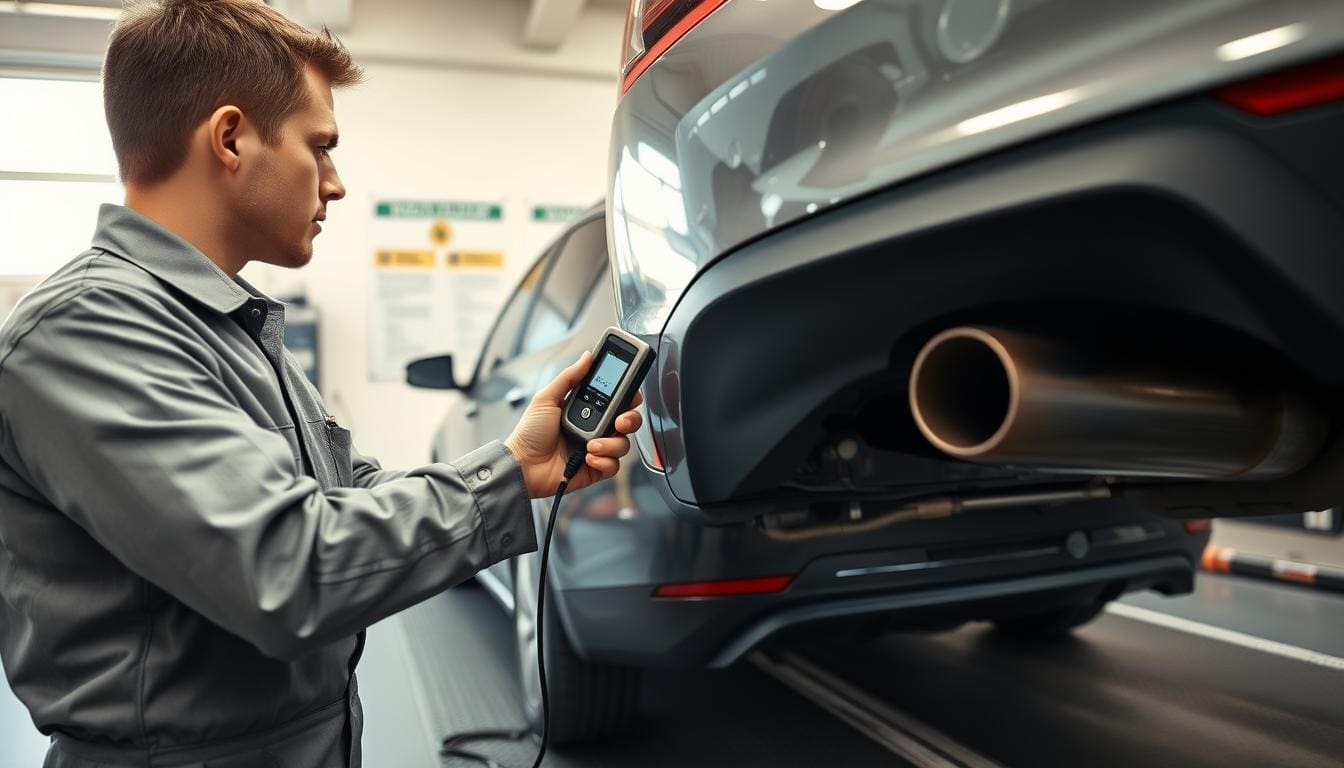
Failing an emissions test can feel surprising when a car seems to run fine. In many parts of the U.S., and with emissions testing Texas rules in place, a failed inspection can stop registration and keep a vehicle off the road until repairs are done.
We explain why this happens: modern compliance relies on monitored systems and stored data, not just tailpipe readings. A vehicle may pass a quick drive but still fail because the onboard computer flagged a fault or logged a problem over time.
Common failure causes include check-engine alerts, EVAP leaks, faulty sensors, and worn catalytic components. Small maintenance issues can raise outputs enough to fail a test and block your registration.
At Heaven Automotive, we find the root cause, outline needed repairs, and get your car ready to pass legitimately. Hire Heaven Automotive to fix your vehicle and clear your registration hold today.
Key Takeaways
- Failing often stems from stored fault data, not just tailpipe output.
- Lights, sensors, EVAP systems, and catalysts are frequent culprits.
- A failed inspection can legally prevent registration renewal.
- Quick diagnosis limits downtime and prevents repeat failures.
- Heaven Automotive pinpoints causes and guides repairs to pass.
How emissions testing works in Texas right now
This year brings a simplified registration flow, but important inspection rules still apply in certain counties. We outline what changed and what drivers must do to stay legal and ready.
What changed in 2025
As of Jan. 1, 2025, the state replaced most routine annual vehicle inspection requirements with a $7.50 Inspection Program Replacement Fee. That fee is collected at registration and appears on your renewal notice.
What the test measures and why it matters
The emissions test checks pollution-control systems, onboard monitors, and readiness indicators. The program began May 1, 2002 under the Department of Public Safety and TCEQ to protect air quality and public health.
How Two Steps, One Sticker works now
Two Steps, One Sticker still links inspection outcomes to your ability to complete registration. Your inspection record, including required emissions where applicable, must be on file before you can renew.
| Item | Pre-2025 | 2025 and after |
|---|---|---|
| Routine safety check | Annual for most vehicles | Removed for many; fee applied at registration |
| Emissions requirement | Required in designated counties | Still required in designated counties |
| Fee | Inspection station fees | $7.50 replacement fee at registration |
| Program oversight | DPS & TCEQ | DPS & TCEQ remain administrators |
- We recommend checking your county rules before renewal.
- Passing means system readiness, not just clearing a light.
- Contact us if you need help preparing your vehicle for an inspection or registration hold.
Who needs an emissions test in Texas and where it’s required
Not every driver in the state must bring their car to an inspection station. Rules depend on the county listed on your vehicle’s registration, not where you commute.
Texas counties that require testing
We recommend checking your registration county. The following counties require an inspection: Brazoria, Collin, Dallas, Denton, El Paso, Ellis, Fort Bend, Galveston, Harris, Johnson, Kaufman, Montgomery, Parker, Rockwall, Tarrant, Travis, and Williamson.
Which vehicles are in the 2–24 model-year window?
Gasoline vehicles that are between 2 and 24 model years old usually must be inspected. In plain terms: if your car is newer than two model years, or older than 24 years, it is exempt.
We see common exemptions: the newest two model years, vehicles older than 24 years, diesel vehicles, motorcycles, and electric cars. Hybrids are not exempt because they use gasoline.
Looking ahead: Bexar County in 2026
Bexar County will add the requirement in 2026. We can help with early diagnostics and maintenance so you don’t face last-minute failures when the rule starts.
“Failing a required inspection prevents completing registration.”
| Item | Applies to | Action we recommend |
|---|---|---|
| Registration county | Affects requirement | Confirm county on your registration |
| Model-year window | 2–24 model years | Check vehicle model year before booking |
| Exemptions | Newest 2 years, 24+ years, diesel, motorcycle, EV | Verify if hybrid counts as gasoline |
| Bexar County | Starts 2026 | Schedule pre-2026 service if you’re registered there |
- We’ll confirm requirements for your household vehicle mix before an appointment.
- We advise early checks to protect your registration timeline and safety.
Which emissions test your vehicle gets at an inspection station
At an inspection station, the first step is to identify which procedure matches your vehicle’s model year and onboard systems. We verify this so you know what to expect and avoid needless trips.
OBD-II scans on 1996-and-newer vehicles
Most cars from 1996 onward receive an OBD-II scan. A scanner downloads readiness flags and Diagnostic Trouble Codes (DTCs) from the vehicle computer.
We check monitor status, stored DTCs, and the readiness report before you go so an inspection station won’t find a predictable fault.
MIL / Check Engine Light behavior
The MIL should do a brief bulb check at key‑on and then go out after start. A light that stays on or never illuminates can cause an immediate failure of the emissions portion.
Legacy tailpipe methods and regional notes
Older tailpipe methods like ASM and TSI measured tailpipe output, but many older vehicles are now exempt due to age. Regional practice still varies: ASM is common in Dallas/Fort Worth and Houston/Galveston, while TSI appears in El Paso and Travis/Williamson areas.
We also confirm any administrative rules tied to the Department of Public Safety so your visit is efficient and focused on the real fixes.
Most common reasons vehicles fail emissions tests
Many vehicle failures trace back to a handful of recurring mechanical faults we see in the shop.
Faulty catalytic converter — Catalysts reduce CO, NOx, and hydrocarbons. When a converter slips efficiency or an exhaust leak exists upstream, the computer logs a catalyst efficiency code and the vehicle can fail. Replacement is often the costliest item on the bill, so diagnosis matters.
Oxygen sensor and air–fuel balance
Oxygen sensors control fuel trims. A bad sensor or wiring fault makes the engine run rich or lean and raises pollutant output. We check live fuel trims before recommending sensor replacement or a tune.
EVAP faults and gas cap leaks
A small vapor leak or a damaged gas cap can trigger an EVAP code and block a pass. Fixing or tightening the cap is a low-cost step that often clears the problem.
Fuel metering, injectors and vacuum routing
Clogged injectors, wrong timing, or misrouted vacuum lines change combustion quality. We pressure-check fuel delivery and smoke-test vacuum lines to find the real fault.
Ignition and routine maintenance
Worn spark plugs, poor timing, dirty air filters, and old oil all increase tailpipe pollutants. Regular maintenance is a cost-smart way to avoid a failed test.
PCV system defects
Failed PCV valves cause rough idle, oil consumption, and crankcase pressure increases. Fixing the PCV often restores drivability and reduces pollutant output quickly.
Smart repair planning — We link each symptom to targeted fixes so you know where your money goes. Accurate diagnosis prevents unnecessary parts and keeps costs down.
| Fault | Common symptom | Typical fix | Estimated cost range |
|---|---|---|---|
| Catalytic converter | High catalyst efficiency codes, reduced power | Replace converter, check for exhaust leaks | $500–$2,000 |
| Oxygen sensor | Poor fuel trims, check-engine light | Replace sensor, inspect wiring | $100–$400 |
| EVAP (gas cap) | EVAP DTC, fuel odor | Tighten/replace gas cap, smoke-test lines | $0–$150 |
| Fuel/ vacuum | Rough idle, misfire, poor economy | Clean injectors, repair hoses, adjust timing | $150–$800 |
| PCV / maintenance | Oil consumption, rough idle | Replace PCV, plugs, filters, oil service | $50–$350 |
How we prep your vehicle to still pass an emissions test
We prepare every car so you arrive at the station confident it will still pass. Our focus is honest, pass-ready work — not quick fixes that delay a legitimate pass.
Pre-test checklist we recommend before you visit an inspection station
Quick checks we run: confirm the Check Engine Light behavior, verify the fuel cap seals, scan for stored and pending codes, and inspect for obvious vacuum or exhaust leaks.
How we use DTCs to pinpoint the real cause
For 1996-and-newer vehicles we pull DTCs and freeze-frame data from the OBD-II system. That lets us target the repair rather than swapping parts by guesswork.
Why clearing codes alone isn’t a fix
Clearing codes without addressing the fault resets readiness monitors. That can cause a “not ready” outcome and block a pass at the vehicle inspection.
Repairs that deliver the best value for money
We prioritize fixes that change results: sealing a verified vacuum leak, replacing a failed oxygen sensor, or repairing EVAP faults. These steps often improve vehicle emissions and driveability at modest cost. The state counts verified readiness, so our goal is a legitimate pass you can depend on.
What to do after a failed emissions test in Texas
A failed result need not be a crisis; clear next steps make recovery fast and predictable.
Practical consequence: you cannot complete vehicle registration until the required inspection and emissions steps are satisfied. That can affect commuting and work, so prompt diagnosis matters.
Retesting after repairs: what to bring and what to expect
Bring the original inspection report and any repair receipts the station may request. We recommend avoiding repeat tests until repairs are verified.
At retest, stations recheck readiness monitors and the MIL behavior. We verify those before you go so the likelihood of a repeat failure is low.
When waivers or extensions may apply
The state may offer waivers or limited extensions through TCEQ-related processes for eligible owners. Eligibility often depends on repair attempts and cost thresholds.
Help with costs: Drive a Clean Machine Program
Cost help: the Drive a Clean Machine program can provide up to $600 for repairs or up to $3,500 toward replacement, subject to income rules. Repair funds require work at a recognized RERF facility.
| Item | Action | Who to contact |
|---|---|---|
| Failed inspection | Schedule diagnostics and repairs | Heaven Automotive |
| Retest | Bring report and receipts | Local inspection station |
| Cost help | Apply for Drive a Clean Machine | TCEQ / program office |
“You cannot register a vehicle until required inspections are complete.”
We guide repairs, confirm readiness, and walk you through retest steps and any program paperwork. If you need help, call us and we’ll manage the process with you.
Conclusion
Accurate diagnosis and verified repairs are the fastest route back to the road. Most failures boil down to a short list: stored codes, monitor readiness, and a few high‑impact components. A systematic approach beats guesswork every time.
Plan ahead to protect your registration timeline, especially if your vehicle falls in the 2–24 model‑year window this year. The 2025 inspection changes simplified some steps, but required emissions and inspection rules still apply in designated areas. Check official DPS, TxDMV, or TCEQ resources for updates.
Keep up with basic maintenance. Small faults like EVAP leaks or worn ignition parts can snowball into preventable failures. Hire Heaven Automotive to diagnose, repair, and prep your vehicle so you pass and complete registration without repeat trips.