


We help drivers and light fleets build a clear plan that stops small issues from turning into big repairs. In plain language, preventative maintenance means regular cleaning, lubrication, inspection, and timely parts replacement. Our approach is practical and step-by-step so you can follow it at home or on the fleet.
We focus on systems that matter: engine fluids, belts, hoses and filters, battery and electrical, tires, suspension and alignment, brakes, and safety systems. We also stress tracking every service. Good documentation supports smarter decisions and helps with warranty questions.
We set a higher bar than a lone oil change. A true preventive maintenance program ties tasks to time, mileage, driving cycles, and operating conditions. Our guidance aligns with OEM recommendations and real-world wear patterns.
Key Takeaways
- Preventive maintenance is proactive upkeep to reduce downtime and surprise repairs.
- We cover engine fluids, belts/hoses, battery, tires, suspension, brakes, and safety systems.
- Tracking service history is as important as the work itself.
- Our program matches OEM guidance and practical wear factors.
- We provide adaptable schedules, checklists, and work-order ideas to keep service on track.
Why Preventive Maintenance Matters for Vehicle Reliability and Lifespan
Catching minor issues early is the single best way to keep a car or truck on the road. Regular checks spot small leaks, worn belts, and weak batteries before they cause a roadside failure.
Reduce breakdowns and progressive failures: Many problems start small and grow. Inspections and timely work stop that progression. That keeps vehicles moving and lowers the risk of unexpected breakdowns.
Lower costs and limit downtime: A consistent strategy shifts spend from costly emergency fixes to planned service. Fewer surprise repairs mean less towing, fewer missed shifts, and less lost productivity.
Improve safety: Routine inspections find worn brakes, tire damage, steering play, and electrical faults before they become hazards. When we find a risk, we recommend prompt repairs to avoid cascading failures.
- We catch minor faults before they turn into a breakdown on the road.
- We track issues so reliability becomes predictable, not luck.
- We help drivers and fleets reduce downtime and control long-term costs.
When you need help, Heaven Automotive steps in to inspect, advise, and perform the repairs that keep your vehicles safe and reliable.
Preventive Maintenance vs. Reactive Maintenance for Cars and Trucks
Letting systems run to failure turns small fixes into major repairs and lost time. We see vehicles as complex equipment where one neglected part often damages others.
What “run-to-failure” looks like and why it costs more long-term
Reactive work means we wait until the car won’t start, the brakes grind, or the engine overheats before acting. That approach often creates secondary damage. A failed water pump can warp a head, or a seized brake can ruin a rotor.
The result: higher repair bills, longer downtime, and faster overall wear on systems.
How preventive maintenance protects performance, resale value, and efficiency
Planned servicing keeps fluids clean, lubrication correct, and wear items replaced on schedule. This leads to smoother operation, steadier fuel economy, and fewer drivability surprises.
We also document every service so resale value improves—buyers value a clear service history.
Stop waiting for warning lights. Lean on Heaven Automotive for a practical plan that protects vehicle life without overdoing routine work.
What “Assets” Mean in Automotive Maintenance
A vehicle performs like equipment — and we protect it as such.
We define an asset as the whole vehicle plus the critical systems inside it that need planned care. Treating components as assets helps us prioritize work that keeps a vehicle in service.
Key vehicle systems to manage
- Engine & cooling: leaks or overheating create immediate downtime.
- Transmission: failures stop the vehicle and cost more than routine service.
- Brakes: worn pads or fluid issues raise safety risk and downtime.
- Tires, suspension & steering: affect handling and tire life.
- Battery & electrical: no-start events are common in neglected fleets.
Using OEM guidance to set work requirements
OEM schedules give us the baseline intervals, fluids, filters, plugs, and belts to follow. We start there and then tailor plans based on asset criticality.
Criticality and hazardous use change priorities. A commuter car needs a lighter cadence than a delivery truck used in stop-and-go city runs or towing in mountains.
Good asset management protects function and safety while controlling total cost of ownership. Bring your OEM schedule to us and we will translate it into a practical plan you will follow.
Preventative Maintenance Basics We Follow Before Building Your Plan
At Heaven Automotive, we start with clearly defined shop steps so service decisions are based on facts. Our approach breaks work into observable actions that reveal condition and guide priorities.

Core shop tasks we perform
Cleaning and lubrication: We remove grime, clean contacts, and apply lubricant where OEM guidance requires it. These simple tasks cut wear and improve function.
Inspections and measurements: We check belts, hoses, brake wear, and fluid condition. Inspections show what is normal and what needs repair.
Parts replacement: Wear items are replaced on OEM intervals or when condition dictates. Not every part is swapped on a timer.
How we document findings and communicate
We log what we did, which parts and fluids we used, and when work occurred. This record supports reliability planning and warranty discussions.
We explain priorities to drivers, separating urgent repairs from scheduled tasks. Consistent checklists help our teams deliver repeatable results.
| Task | How we do it | Record kept |
|---|---|---|
| Cleaning | Degrease, clean connectors, clear debris | Service item, photos, date |
| Lubrication | Apply OEM-specified lubricants to fittings | Product, quantity, interval |
| Inspections | Measure wear, note deviations, test components | Checklist, measurements, recommendations |
| Parts replacement | Replace wear items per condition or OEM | Part number, mileage, warranty info |
Types of Preventive Maintenance and When Each Fits Your Vehicle
Matching service type to use case keeps vehicles reliable without wasting time or parts. Below we define the common approaches and where each fits best.
Time-based / periodic
This calendar-style type uses fixed intervals for oil, filters, and seasonal checks. It works well for simple fleets and predictable duty cycles.
Good for: commuter cars, standard service schedules.
Usage-based
Service tied to mileage, engine hours, or cycles matches wear to use. This reduces overwork for low-mileage vehicles and protects heavy-use units.
Condition-based
Inspections, sensors, and performance data trigger service. Examples: battery load tests, brake thickness checks, and fluid analysis.
Predictive and prescriptive
Predictive maintenance spots trends—like slow coolant loss or repeated low-voltage events—to anticipate failure. Prescriptive adds a recommended fix and interval change, often using analytics or AI to choose the best action.
Risk-based and deferred work
We prioritize high-consequence systems—brakes, tires, steering—for more frequent checks. Deferring work may save time now, but it raises the chance of costly failure and shortens vehicle life.
- We explain the main types so you can pick what fits your vehicles.
- We tailor a schedule and use data to avoid unnecessary service.
- Heaven Automotive helps apply predictive insights so issues get fixed before they turn into failures.
How to Choose the Right Maintenance Program for Your Driving and Operating Conditions
Choosing the right program starts with a clear look at how each vehicle earns its keep. We rank assets by criticality, use, and environment so service matches real risk. This practical view keeps cost in line with uptime needs.
Assessing needs based on vehicle criticality, usage, and environment
Ask what a vehicle down tomorrow would cost. High-consequence units get tighter intervals and faster repairs.
Short trips, towing, rideshare, and extreme climates change inspection focus and scheduling. We set checks to match those conditions.
Using maintenance history data to spot patterns and recurring issues
We analyze service records and sensor data to find repeat faults like battery failures or chronic tire wear. That data drives targeted fixes that stop repeated downtime.
Balancing budget, team capacity, and parts availability
Prioritize safety and critical systems first. Then sequence comfort and performance items to match budget and shop capacity.
“A realistic program fits the calendar of operations, not the other way around.”
- We start with criticality and cost of downtime.
- We use usage and environment to set inspection points.
- We let data reveal root causes and recurring issues.
- We balance budget, parts, and team capacity to make the plan doable.
- We translate facility-level operations thinking into fleet and household scheduling.
Need help prioritizing? We guide teams through trade-offs, set realistic scheduling, and help source parts so your preventive maintenance program delivers uptime without overwork.
How to Create a Preventive Maintenance Plan You’ll Actually Stick To
Good plans survive busy lives. We build a simple, repeatable approach so service gets done on time and with purpose.
Setting clear goals for reliability, cost control, and performance
Start by naming two or three measurable goals: uptime percentage, allowed cost per mile, and steady performance metrics.
Clear goals let us prioritize tasks rather than guessing what to fix next.
Building a schedule that minimizes downtime and avoids over-maintenance
We combine time and mileage triggers to form a compact schedule.
Adjust intervals for severe use to reduce unplanned downtime and stop excess service that raises overall downtime.
Defining standard work for inspections, lubrication, and replacements
Make each visit repeatable. Use the same inspection flow, measurement points, and documentation fields every time.
Standard work means fewer missed checks and faster service.
Planning for wear items like belts, filters, fluids, and brakes
Identify common failure drivers—belts, filters, fluids, brakes—and set replacement triggers before they fail.
Bundle related tasks and parts into single visits to cut total downtime.
- Define goals, then map critical systems to those goals.
- Create a time/mileage schedule with simple triggers.
- Document standard work and required parts for each visit.
- Review results and tweak intervals to protect performance and limit wear.
“A plan that measures results is the only plan that improves.”
We can set up and run the plan for you. Heaven Automotive turns the steps above into clear work orders and keeps the schedule on track so your vehicles stay reliable.
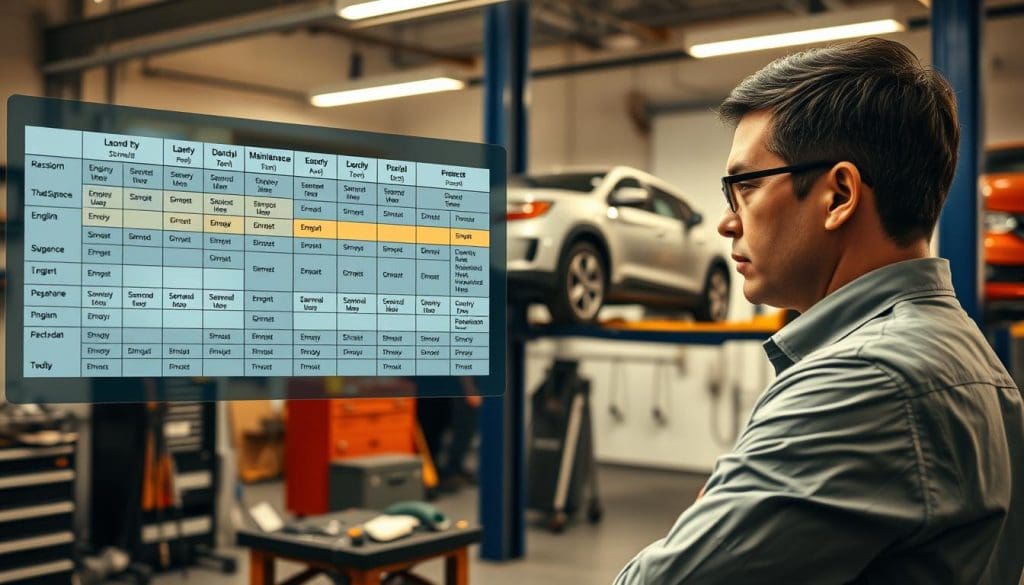
Step-by-Step Preventive Maintenance Schedule for Vehicle Systems
A clear, system-by-system schedule turns routine checks into reliable uptime. Below we give a simple, actionable framework you can map to mileage and calendar dates. Follow OEM intervals as your baseline and use these inspections to spot early wear and failures.
Engine and fluids: oil, coolant, and leak checks
Change oil and filter per OEM or every 5,000–7,500 miles for most light equipment. Check coolant condition and level every visit. Inspect undercarriage and engine bay for fresh leaks; mark any drops and trace source immediately.
Belts, hoses, and filters: preventing wear-related failures
Inspect belts for cracking, glazing, or looseness. Squeeze hoses for softness or bulges. Replace air and fuel filters on schedule or when restriction shows on diagnostics to avoid roadside failures.
Battery and electrical systems: reducing no-start issues
Test battery voltage and alternator output during service. Clean terminals and check cable crimps. Record load-test results so trends reveal weakening before no-start events.
Tires, alignment, and suspension: protecting handling and tire life
Measure tread depth and record pressure at each visit. Rotate tires per the vehicle schedule and inspect for uneven wear that signals alignment or suspension faults. Replace parts before wear reaches unsafe limits.
Brakes and safety systems: inspection points that prevent emergencies
Check pad thickness, rotor condition, and brake fluid level. Note pedal feel and ABS codes. Use measurable thresholds — pad mm, rotor runout, fluid boiling point — not vague notes.
We provide detailed work orders and can perform these tasks and inspections at Heaven Automotive, keeping records so your schedule stays dependable and safety stays high.
Work Orders, Checklists, and Documentation That Keep Maintenance on Track
Clear work orders turn routine visits into predictable outcomes and faster fixes. We use simple orders and checklists so each service visit follows the same steps. That consistency saves time and reduces missed items.
How teams use work orders to standardize tasks and timing
Our team writes orders with defined tasks, mileage/time triggers, and inspection checkpoints. A CMMS-style approach queues recurring work and links each order to a vehicle record.
This makes scheduling repeatable across drivers and multiple vehicles.
What to document for each service visit
We capture measured results (tread depth, battery readings), observed issues, recommended follow-ups, and parts/fluids used. Accurate data highlights recurring faults and supports warranty claims.
- Why orders matter: repeatable visits, no missed steps, clear service history.
- Checklist contents: measured values, defects, follow-up actions, parts used.
- Future-proofing: documented trends let us make better decisions on the next visit.
- Management benefit: turns one-off work into a trackable program.
“If it isn’t written down, it won’t stay on schedule.”
Scheduling and Downtime Planning for Busy Drivers and Fleets
We schedule service around real-world rhythms so vehicles are available when you need them.
We coordinate planned service to match operations and production demands. That means using low-demand windows, like overnight or off-peak shifts, so scheduled pauses have minimal impact.
Coordinating planned work around operations
We translate production patterns—delivery peaks, school runs, and seasonal surges—into practical shop windows. This keeps routes running and reduces unexpected downtime.
Bundling tasks to reduce repeat visits
We group inspections, fluid services, and wear-item replacements into single visits. Bundling cuts repeat trips and lowers the total time vehicles spend out of service.
Spare parts planning to avoid delays and repeat breakdowns
Parts planning is critical. We stock common wear components and pre-order specialty items so waiting for parts doesn’t extend downtime or cause repeat breakdowns.
| Window | What we do | Benefit |
|---|---|---|
| Night / Off-peak | Full inspections, fluid changes | Minimal disruption to routes |
| Between shifts | Quick checks, tire rotation | Faster turnaround |
| Seasonal windows | Bundle major work, part swaps | Reduce peak-season failures |
| On-demand scheduling | Emergency repairs + parts dispatch | Limit production loss |
“A predictable schedule keeps vehicles earning their hours, not sitting in the shop.”
We help fleets standardize intervals across similar equipment so scheduling is simpler and fewer services are missed. Our program focuses on keeping your vehicles in service and aligned with production needs.
Tools, Software, and Data That Improve Preventive Maintenance Today
Good tracking and practical software turn routine checks into predictable outcomes for every vehicle.
How a CMMS-style approach helps: We use software that ties each asset to a clear work history. Automated work orders, reminders, and a linked schedule stop service from becoming scattered receipts.
Using sensors and condition monitoring
Battery health tests, tire-pressure sensors, and scan-tool data give simple, actionable signals. Those signals let us catch faults early and plan visits around real use.
KPIs that show program performance
We track a few focused measures: unplanned downtime events, repeat failures, on-time service rate, and maintenance cost trends. Those KPIs tell us where to tighten intervals or reallocate parts and labor.
Facility-grade thinking scales to single drivers. Treating a car as an asset and using the same tools a shop or facility uses extends equipment life and reduces surprises.
“We turn information into action: clear recommendations, prioritized next steps, and a schedule you can follow.”
Heaven Automotive supports the software setup and interprets the data so you get reliable results without extra work.
Conclusion
Regular care is the simplest, most effective way to extend vehicle life. A steady program lowers unplanned breakdowns, improves safety, and cuts long-term cost versus waiting for failures.
Best results come from a clear preventive maintenance program built on OEM guidance and tuned to real driving conditions. Documentation, checklists, and a schedule you can follow turn good intentions into reliable outcomes.
Start simple: book the next service, record what was done, and use that record to plan the next visit. Consistent actions add up to years of extra service life.
Ready to protect your vehicle? Hire Heaven Automotive to inspect, repair, and build a preventive maintenance plan that fits your driving and keeps your vehicle dependable.