

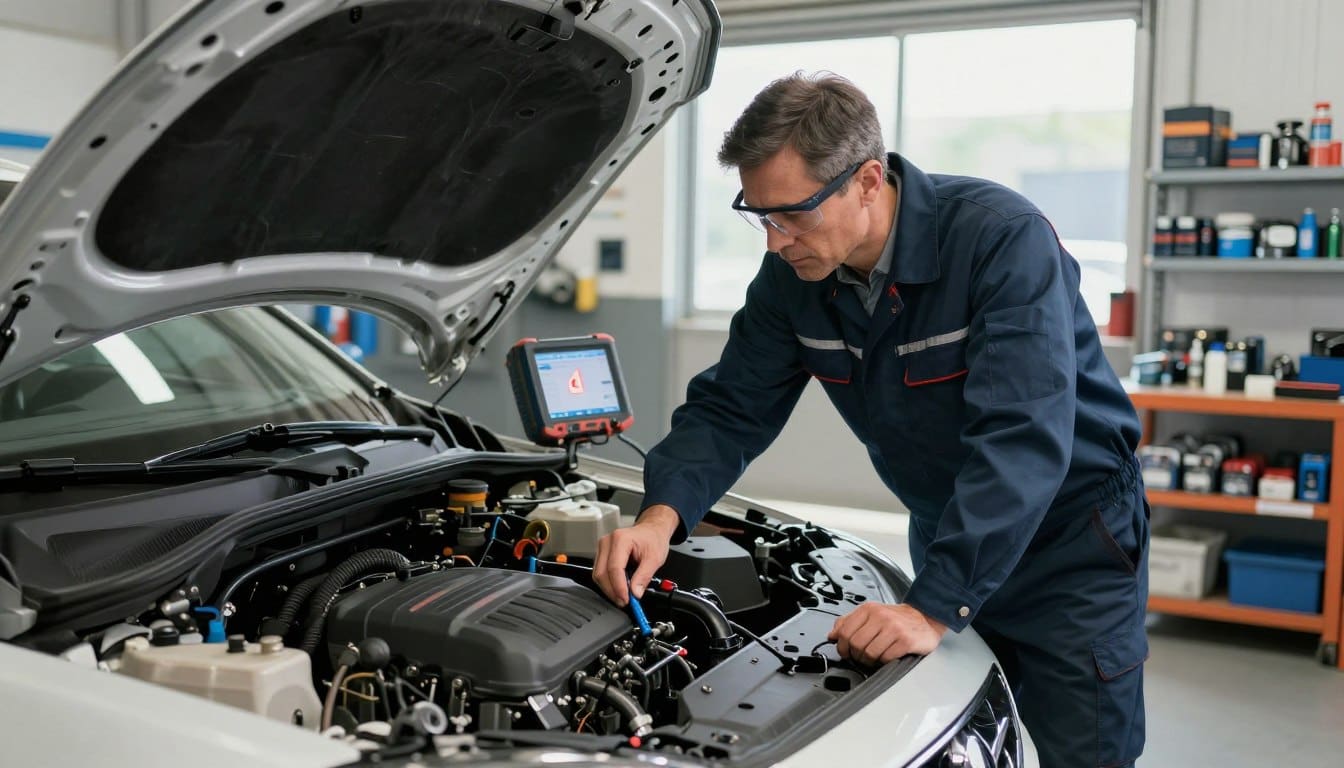
A glowing amber icon on your dashboard can cause instant worry. This light is part of your car’s diagnostics system, known as OBD-II. It lights up when sensors find a problem with the engine or emissions.
It’s important to fix this warning before it turns into a big problem. A small issue could hurt your fuel economy or how well your car performs. Getting a quick check engine light repair can prevent bigger issues and keep your car running well.
At Heaven Automotive in San Antonio, our experts are great at finding these problems fast. We use the latest tools to read codes and give you clear fixes. Don’t let the problem get worse; hire Heaven Automotive to fix your car today.
Key Takeaways
- The alert signals an issue within the OBD-II monitoring system.
- Sensors notify the computer when emissions or performance skip a beat.
- Quick action prevents minor faults from becoming major mechanical failures.
- Fuel efficiency often drops when the warning light remains ignored.
- Modern scanning tools are required to identify the specific error code.
- Professional assistance ensures your car stays safe and road-legal.
Understanding the Check Engine Light
Your car’s check engine light is a warning sign. It tells you that something is wrong. This light is connected to your car’s OBD system. It checks your engine and emissions.
When the OBD system finds a problem, it turns on the check engine light. This alerts you to take action.
What Is the Check Engine Light?
The check engine light is a warning on your dashboard. It lights up when your car’s OBD system finds an issue. It can mean many things, from small problems to big ones.
A steady light usually means it’s not too serious. But a flashing light is a warning that you need to act fast.
Common Reasons for Activation
Many things can make the check engine light turn on. Here are some common reasons:
- A loose gas cap lets fuel vapors escape.
- A bad oxygen sensor can hurt your car’s fuel use and emissions.
- Worn-out spark plugs or ignition coils can cause engine problems.
- A failing catalytic converter is bad for emissions.
- Issues with the mass airflow sensor can affect your car’s performance and fuel use.
If your check engine light comes on, it’s smart to get it checked. Our team at 6645 Poss Rd. San Antonio, TX 78238 can help. We offer an OBD diagnostic scan to find out what’s wrong. Call us at (210) 682-3898 to book a time.
| Common Issue | Description | Potential Consequence |
|---|---|---|
| Loose Gas Cap | Fuel vapors escape due to a loose or damaged gas cap. | Decreased fuel efficiency, possible emissions problems. |
| Faulty Oxygen Sensor | The sensor fails to accurately measure oxygen levels in the exhaust. | Poor fuel efficiency, increased emissions. |
| Bad Spark Plugs/Ignition Coils | Engine misfires due to worn-out or faulty spark plugs or ignition coils. | Reduced engine performance, possible damage to the catalytic converter. |
Importance of Engine Diagnostics
Engine diagnostics are key to spotting problems early. When your check engine light comes on, it means your car’s computer has found an issue. These diagnostics help you figure out what’s wrong and how to fix it.
Why Engine Diagnostics Matter
Engine diagnostics are vital because they stop small problems from turning into big ones. They help you catch issues before they cost a lot to fix. For example, a bad oxygen sensor can make your car use more fuel and pollute more. If ignored, it could harm your engine a lot.
Key benefits of engine diagnostics include:
- Early detection of problems
- Preventing small issues from becoming big repairs
- Better fuel efficiency and performance
- Less pollution
How Diagnostics Can Save You Money
Diagnosing engine problems quickly can save you money in many ways. First, it means cheaper repairs. Second, it can make your car use less fuel, saving you money on gas. Lastly, fixing problems early can make your car last longer, avoiding expensive replacements.
For instance, a diagnostic test might show a loose gas cap or a bad catalytic converter. Fixing these issues early can save you from expensive repairs later.
Key Components of Engine Diagnostics
Fixing check engine light problems starts with detailed engine diagnostics. Knowing what’s involved helps us see how complex and vital accurate checks are.
On-Board Diagnostics (OBD-II) Explained
On-Board Diagnostics (OBD-II) is a system that checks and controls engine performance. It was introduced in the 1990s and is key in today’s cars. It lets techs use a standardized diagnostic protocol to find problems. This system gives real-time data and trouble codes, making it essential for check engine light repair.
OBD-II watches over engine performance, like emissions and fuel use. With an OBD diagnostic scan tool, techs can find issues that make the check engine light come on.
Common Diagnostic Tools Used
At Heaven Automotive, techs use many tools to find and fix problems. Some common ones are:
- Code readers: These devices read trouble codes in your car’s OBD-II system, helping start the diagnosis.
- Scan tools: More advanced, these tools give real-time data and do tests to solve complex problems.
- Multimeters: Used to check electrical voltage, current, and resistance, multimeters are key for electrical system checks.
| Diagnostic Tool | Description | Primary Use |
|---|---|---|
| Code Reader | Reads trouble codes stored in OBD-II system | Initial diagnosis |
| Scan Tool | Provides real-time data and performs tests | In-depth diagnosis |
| Multimeter | Measures electrical voltage, current, and resistance | Electrical system diagnosis |
By using these tools and their knowledge, Heaven Automotive’s techs can find and fix problems. This ensures your car runs well and efficiently.
Signs You Need Engine Diagnostics
Seeing unusual signs in your car can help prevent big problems. Your car’s engine has sensors and systems that watch its health. They alert you to any issues.
Recognizing Warning Signs
The engine warning light is a clear sign something’s wrong. But, other signs are just as critical. These include less power or efficiency, and dashboard lights that show specific problems.
Other signs might not be as clear but are very important. For example, if your car uses more fuel than usual, it could mean a problem that needs fixing.
Unusual Sounds or Vibrations
Unusual sounds or vibrations are also important signs. Grinding, knocking, or hissing sounds can mean many things. They could be from worn-out parts or serious engine problems.
| Warning Sign | Possible Cause |
|---|---|
| Check Engine Light | Faulty oxygen sensor, loose gas cap, or catalytic converter issue |
| Unusual Sounds | Worn-out belts, low oil pressure, or engine misfire |
| Vibrations | Imbalanced tires, misaligned wheels, or engine mount issues |
If you notice any of these signs, getting your car checked is key. Heaven Automotive’s experts can find and fix the problem. They’ll make sure you’re safe on the road.
Engine Diagnostic Process
The engine diagnostic process is a detailed way to find problems in your vehicle’s engine. It’s key to accurately and quickly find issues. This ensures your car is fixed right the first time.
Initial Vehicle Inspection Steps
At Heaven Automotive, we start with a full vehicle check. Technicians look at the engine and other parts for any trouble signs. This step is vital to get info that scans might miss.
During the first check, technicians look at:
- Dashboard warning lights
- Fluid levels and conditions
- Battery and charging system
- Belts and hoses for wear signs
Scanning for Diagnostic Trouble Codes (DTCs)
After the first check, we scan your vehicle’s computer for Diagnostic Trouble Codes (DTCs) with an OBD diagnostic scan tool. This scan shows what the vehicle’s computer finds odd.
The OBD diagnostic scan process includes:
| Step | Description | Outcome |
|---|---|---|
| 1 | Connect the scan tool to the vehicle’s OBD-II port | Establishes communication with the vehicle’s computer |
| 2 | Perform the scan to retrieve DTCs | Identifies stored trouble codes |
| 3 | Interpret the retrieved DTCs | Determines the cause of the issue |
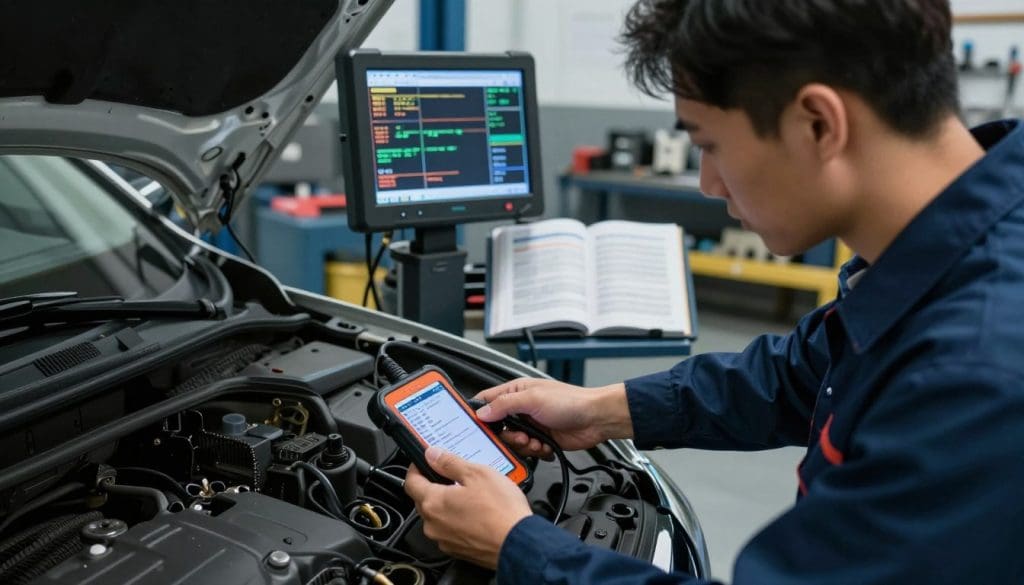
If your vehicle has issues and the check engine light is on, call Heaven Automotive at (210) 682-3898. Schedule a diagnostic check to get it fixed.
Common Diagnostic Trouble Codes (DTCs)
Understanding Diagnostic Trouble Codes (DTCs) is key to fixing your vehicle’s check engine light. These codes give insights into your vehicle’s problems. This helps in making accurate and efficient repairs.
When your check engine light turns on, it’s often linked to a specific DTC. You can read this code using a diagnostic tool. Common DTCs include P0171, P0300, and P0420. Each code points to different issues with your vehicle.
P0171: System Too Lean
The P0171 code means your engine is running too lean. This is when there’s too much oxygen in the fuel mixture. It can be caused by a faulty mass airflow sensor, vacuum leaks, or fuel system issues.
Common causes of P0171 include:
- Faulty mass airflow sensor
- Vacuum leaks
- Clogged or dirty fuel injectors
- Faulty oxygen sensor
P0300: Random/Multiple Cylinder Misfire Detected
The P0300 code means your engine is experiencing random or multiple cylinder misfires. This can cause your vehicle to perform poorly, use more fuel, and damage the catalytic converter.
Possible causes of P0300 include:
- Faulty spark plugs or ignition coils
- Fuel system issues
- Low compression in one or more cylinders
- Faulty oxygen sensor or crankshaft position sensor
P0420: Catalyst System Efficiency Below Threshold
The P0420 code means the catalytic converter isn’t working well enough. This can be due to a faulty catalytic converter, oxygen sensor problems, or engine misfires.
Common causes of P0420 include:
- Faulty catalytic converter
- Oxygen sensor issues
- Engine misfires
- Exhaust system leaks
If you see any of these DTCs, it’s best to visit a professional mechanic. Heaven Automotive in San Antonio, located at 6645 Poss Rd. San Antonio, TX 78238, offers expert diagnosis and repair.
| DTC Code | Description | Common Causes |
|---|---|---|
| P0171 | System Too Lean | Faulty mass airflow sensor, vacuum leaks, clogged fuel injectors |
| P0300 | Random/Multiple Cylinder Misfire Detected | Faulty spark plugs, fuel system issues, low compression |
| P0420 | Catalyst System Efficiency Below Threshold | Faulty catalytic converter, oxygen sensor issues, engine misfires |
Impact of Ignoring the Check Engine Light
When your check engine light comes on, it means your car needs help. Ignoring it can cause big problems. The light is a warning that your car’s health is at risk.
Not fixing the issue can harm your car’s engine or other important parts. It’s important to know what can happen if you don’t fix it fast.
Potential Damage to Your Vehicle
Not fixing the check engine light can damage your car’s engine, transmission, or other key systems. For example, a bad oxygen sensor can make your car use more fuel and harm your catalytic converter.
Some possible damages include:
- Catalytic converter damage
- Engine misfires leading to costly repairs
- Fuel system damage
- Transmission problems
Increased Repair Costs Over Time
The longer you ignore the check engine light, the more it will cost to fix. What starts as a small problem can become a big one, needing expensive repairs or even replacing parts.
| Issue | Initial Repair Cost | Potential Cost if Ignored |
|---|---|---|
| Faulty Oxygen Sensor | $200-$300 | $1,000-$2,000 (including catalytic converter replacement) |
| Loose Gas Cap | $0 (DIY fix) | $500-$1,000 (due to possible damage to the evaporative emission control system) |
| Catalytic Converter Issue | $300-$1,000 | $2,000-$3,000 (including possible engine damage) |
Fixing the check engine light quickly can save you money and keep your car running well. It’s wise to take care of your car’s health early on.
Finding Professional Engine Diagnostics in San Antonio
In San Antonio, finding a certified technician for your vehicle’s engine is simple. When your check engine light turns on, it’s key to find a reliable service. They should do an OBD diagnostic scan to find the problem.
Locating Reputable Auto Shops
To find a trustworthy auto shop, start by asking friends, family, or checking online reviews. Look for shops that focus on engine diagnostics and know your vehicle’s make. Important things to consider include:
- Certifications and qualifications of the technicians
- Availability of modern diagnostic equipment
- Customer service and communication
Heaven Automotive is a top choice in San Antonio. They are known for their expert diagnosis and repair services.
Importance of Certified Technicians
Certified technicians are key for accurate engine diagnostics. They can read check engine light repair codes and find hidden problems. At Heaven Automotive, the team aims to give you the best service. They make sure your vehicle runs well and efficiently.
Choosing certified technicians has many benefits:
- Accurate diagnosis and repair
- Use of the latest diagnostic tools and techniques
- Warranty on repairs
Cost of Engine Diagnostics in San Antonio
Engine diagnostics in San Antonio can cost differently. Knowing what affects these costs helps you get ready for the expenses. This includes diagnosing and possibly fixing your vehicle.
Average Pricing for Diagnostics
The average price for engine diagnostics in San Antonio is between $50 and $200. This depends on the issue’s complexity and your vehicle type. Some shops charge a flat rate, while others bill by the hour.
- Basic diagnostic services: $50-$100
- Advanced diagnostic services: $100-$200
Factors Influencing Diagnostic Costs
Several things can change the cost of engine diagnostics. These include:
- The type of vehicle you own
- The complexity of the issue, such as a simple engine warning light diagnosis or a more complex problem
- The experience and certification of the technician
- The equipment and technology used by the auto shop
At Heaven Automotive, we offer fair prices and clear services. This ensures you get the best value for your money. If your engine warning light is on, contact us for a professional diagnosis.
Trust our certified technicians to diagnose and repair your vehicle efficiently. Contact Heaven Automotive today to schedule your engine diagnostics service.
DIY vs. Professional Engine Diagnostics
Knowing the differences between DIY and professional engine diagnostics is key. It helps you decide what to do when your car’s check engine light turns on.
Pros and Cons of DIY Diagnostics
DIY diagnostics can save you money and help you learn about your car. With an OBD diagnostic scan tool, you can spot simple problems and fix them yourself.
Pros:
- Cost-effective
- Immediate troubleshooting
- Empowers vehicle owners with knowledge
Cons:
- Limited diagnostic capability
- Potential for misinterpretation of codes
- Lack of specialized tools and expertise
For example, a simple OBD scan can show issues like a loose gas cap. But, complex problems need advanced tools and knowledge.
When to Seek Professional Help
If you’re not sure about the problem or if it keeps coming back, get professional help. Complex issues need certified technicians with the right tools.
At Heaven Automotive, our experts can tackle many diagnostic challenges. Call us at (210) 682-3898 for help.
Here’s a comparison of DIY and professional diagnostics:
| Aspect | DIY Diagnostics | Professional Diagnostics |
|---|---|---|
| Cost | Generally lower | Can be higher due to labor costs |
| Expertise | Limited to owner’s knowledge | Certified technicians with extensive training |
| Diagnostic Depth | Limited by the tool’s capability | Advanced tools and techniques available |
Preventive Maintenance Tips
Regular check-ups can prevent big problems before they start. Keeping your vehicle well-maintained is key to its longevity. At Heaven Automotive, located at 6645 Poss Rd. San Antonio, TX 78238, we stress the value of preventive care.
Regular Check-Ups to Avoid Issues
Regular inspections can spot problems early, reducing the chance of a check engine light. Our certified technicians check your vehicle’s parts to make sure they’re working right. This approach can save you from expensive repairs later.
We pay close attention to engine performance, brake condition, and safety during these inspections. Fixing issues quickly can prevent more serious problems that might require a check engine light repair.
Importance of Engine Oil Changes
Engine oil changes are vital for preventive care. New oil keeps your engine’s parts moving smoothly, prevents rust, and controls engine temperature. Skipping oil changes can cause engine damage and turn on the check engine light.
At Heaven Automotive, we advise following your vehicle’s oil change schedule. Our team is ready to help you keep up with maintenance and ensure your vehicle gets the care it needs.
Recognizing Engine Overheating Issues
Spotting engine overheating signs early can prevent expensive fixes and keep you safe. Overheating engines can cause serious damage if not fixed quickly. Knowing the causes and taking steps to prevent them is vital.
Common Causes of Overheating
Many things can make your engine overheat. Here are some common reasons:
- A faulty thermostat that fails to regulate the engine’s temperature properly.
- Coolant leaks, which can reduce the coolant level and lead to overheating.
- A malfunctioning radiator fan that fails to cool the radiator.
- Low coolant levels due to leaks or neglect.
- A clogged radiator that prevents proper coolant circulation.
If your vehicle’s engine warning light is on, it could be indicating an overheating problem among other issues. It’s vital to diagnose the problem as soon as possible.
Solutions to Prevent Further Damage
If you think your engine is overheating, here are steps to prevent more damage:
| Cause | Solution |
|---|---|
| Faulty Thermostat | Replace the thermostat with a new one. |
| Coolant Leaks | Inspect the cooling system for leaks and repair them. Refill coolant as necessary. |
| Malfunctioning Radiator Fan | Check the radiator fan and replace it if necessary. |
Regular maintenance is key to preventing engine overheating. Make sure to check your coolant levels often. Also, inspect your cooling system for any leaks or damage.
The Role of the Mass Airflow Sensor
Your vehicle’s engine performance depends on several key parts, including the mass airflow sensor. This sensor measures the air entering the engine. It gives the engine control unit (ECU) the data it needs to figure out how much fuel to inject.
The mass airflow sensor is key to your engine’s efficiency. At Heaven Automotive, our technicians know how important it is. They can spot problems with an OBD diagnostic scan.
Understanding Its Function
The mass airflow sensor tracks the air mass flow rate into the engine’s intake system. This info is vital for the ECU to keep the air-fuel mix just right. This mix is essential for the engine to run well, save fuel, and cut down on emissions.
- Measures air mass flow rate
- Provides data to the ECU for fuel calculation
- Essential for maintaining optimal air-fuel mixture
Signs of Malfunction
A bad mass airflow sensor can hurt your engine’s performance and fuel use. Look out for these signs:
- Decreased engine performance
- Poor fuel efficiency
- Engine hesitation or stumbling
- Illumination of the check engine light, possibly needing an OBD diagnostic scan
If you see any of these signs, get your car checked by experts like Heaven Automotive. They can do the needed checks and fixes to make your car run right again.
When to Reset the Check Engine Light
Before resetting the check engine light, you must first find and fix the problem. Resetting it without knowing the cause can lead to more damage. This could harm your vehicle.
Proper Procedures for Resetting
To reset the light right, start by using a code scanner. It will show you the trouble codes that turned on the light. After fixing the issue, you can use the scanner or disconnect the battery to reset it.
It’s important to do it correctly to avoid problems. If you’re not sure or don’t feel confident, getting a professional mechanic’s help is a good idea.
Why It Shouldn’t Be Done Prematurely
Resetting the light too soon can hide real problems. This can cause bigger issues later. It’s key to solve the main problem first. This way, your car will run safely and well.
If your check engine light is on, talk to a trusted mechanic. At Heaven Automotive, our experts can diagnose and fix the issue. They’ll get your car running smoothly again.
Conclusion: Stay Informed About Your Engine
Keeping your vehicle in top shape is key for its performance and life span. Regular checks and a good mechanic can make a big difference. By watching your engine warning light and using an OBD diagnostic scan, you’re taking care of your car.
Regular Checks for a Healthy Engine
Regular inspections can spot problems early. This includes looking at OBD diagnostic scan data. It gives you a peek into your engine’s health.
Partnering with a Trusted Mechanic
Having a reliable mechanic, like those at Heaven Automotive, is important. If you have issues or concerns, call them at (210) 682-3898. Or visit them at 6645 Poss Rd. San Antonio, TX 78238.