

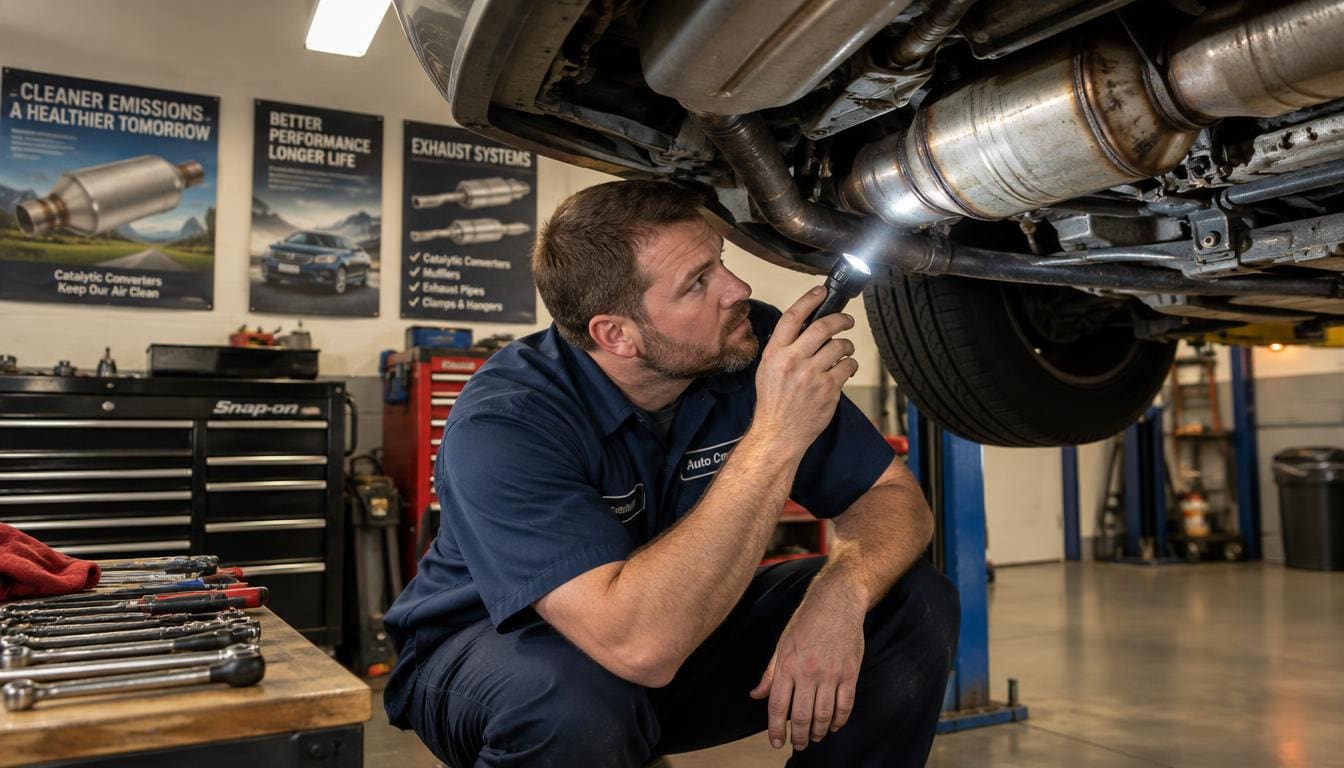
Catalytic converter repair can mean fixing an underlying engine or exhaust fault, or replacing a converter that has failed. The right fix depends on diagnosis, because a sensor fault or engine problem can mimic converter failure. A bad diagnosis can put your money toward the wrong repair.
A converter problem can affect how your vehicle runs and what comes from its exhaust. Some problems call for prompt service, while others need a careful inspection before you decide what to do. This page can help you judge when to stop driving and when to arrange professional service.
You will learn what warning signs can mean, what replacement may cost, and how to lower theft risk. A correct diagnosis can prevent you from paying to replace a converter when another fault is responsible.
Key Takeaways
- Diagnose the cause before replacing a converter.
- A flashing check engine light calls for prompt action.
- Misfires and fluid leaks can harm the catalyst.
- Replacement costs depend on the vehicle and part.
- Choose a converter that fits and meets emissions rules.
- A shield can add a barrier against theft.
How the Catalytic Converter Affects Exhaust and Engine Performance
The converter works in your exhaust system, where hot exhaust passes over its catalyst before leaving the vehicle. The catalyst is the material inside the converter that helps turn exhaust pollutants into less harmful emissions. This process lowers harmful emissions before exhaust exits the tailpipe.
A working converter treats pollutants without blocking normal exhaust flow. Its catalyst often contains precious metals, including platinum, rhodium, and palladium. The converter typically reaches an operating temperature of 500-1200°F.
As exhaust moves through the unit, the catalyst helps change harmful gases into less harmful emissions. The vehicle’s O2 sensors track oxygen levels before and after the converter. The engine computer uses those readings to check how well the system is working.
A failed catalyst may no longer reduce pollutants as well as it should. Physical damage or a buildup inside the converter can also narrow its passages. That restriction makes it harder for exhaust to leave the engine.
When exhaust cannot flow freely, the engine may lose power, especially during acceleration. A severe restriction can make the vehicle hard to drive. A converter that traps exhaust can reduce engine power and, if left unchecked, eventually damage the engine.
Which Warning Signs Call for Prompt Attention?
A rotten-egg exhaust odor, loss of power, or new rattling beneath the vehicle can signal a converter problem. Three possible signs of a bad catalytic converter are rotten-egg odor, reduced engine power, and rattling. Reduced fuel economy is another warning, but none of these signs proves the converter is at fault.
There is no safe mileage limit for driving with a suspected converter fault. A check engine light or a failed emissions test can point to a problem, but neither confirms converter failure. Arrange an inspection rather than judging the cause from one clue.
- Rotten-egg odor from the exhaust while the engine runs.
- Reduced engine power or slower acceleration.
- Lower fuel economy than your usual driving pattern.
- Rattling from beneath the vehicle, often caused by loose internal material.
A check-engine light can appear with many engine or exhaust faults. A flashing light is more urgent than a steady one, since it can signal an active problem that risks further damage. A failed emissions test also needs diagnosis, not an automatic converter replacement.
Do not keep driving to see whether a suspected fault goes away. If the check-engine light flashes, stop driving and arrange a prompt inspection. Stop driving and arrange an inspection if the check-engine light flashes or rotten-egg odor occurs with power loss.
What Can Damage a Catalytic Converter?
A converter can be damaged by engine trouble that sends unburned fuel, oil, or coolant into the exhaust. These upstream faults can harm the catalyst before you notice a major change in performance. Fixing the cause matters before fitting a replacement.
A new converter can fail early if the engine fault remains. The following problems are common reasons a converter loses effectiveness or suffers heat damage.
Engine Misfires and Unburned Fuel
A misfire happens when one or more cylinders fail to burn fuel as they should. Faulty spark plugs or ignition problems can cause this condition. The unburned fuel then travels into the exhaust system.
Fuel can burn inside the converter and raise its temperature beyond normal levels. Excess heat may damage or melt the catalyst. A technician should find and fix the misfire before installing a new part.
Oil, Coolant, and Other Contamination
Oil or coolant entering the exhaust can coat the catalyst and reduce its ability to treat pollutants. A leak inside the engine may let either fluid reach the exhaust. Excessive oil consumption can have the same effect.
The coating can stop exhaust from contacting the catalyst as intended. The engine may need repair to stop the leak or oil loss. Correct the fault causing the contamination or misfire before installing a replacement converter.
Diagnose P0420 and P0430 Before Replacing a Converter
A P0420 or P0430 code is a reason to investigate converter efficiency, not proof that the converter itself has failed. The code alone cannot tell you whether a bad converter, O2 sensor, or exhaust leak caused the reading. A technician needs to test the full system.
Check O2 sensors, exhaust leaks, and engine-running conditions before replacement. Other trouble codes can point to a problem that affects converter readings. Replacing a converter before fixing an upstream fault can damage the new part.
Rule Out Exhaust Leaks and Sensor Faults
O2 sensors measure oxygen in the exhaust at different points in the system. Faulty readings can make a working converter seem less effective. A technician checks sensor response and wiring before blaming the converter.
Leaks can also change the amount of oxygen in exhaust readings. The technician should inspect exhaust joints, welds, flex pipes, and the manifold. A small leak may be hard to spot without a close inspection.
Check Engine Operation and Contamination
A technician checks other diagnostic trouble codes and reviews fuel control and misfire data. They also consider oil or coolant contamination and how the engine is running. These checks help separate converter failure from conditions that can cause a false efficiency reading.
To tell whether you have a bad O2 sensor or catalytic converter, test sensor function, inspect for leaks, and assess engine operation. The findings should support the repair choice, rather than relying on one code.
| Diagnostic check | What the technician checks | Why it matters |
|---|---|---|
| O2 sensors | Sensor readings and response | Faulty data can mimic poor converter efficiency |
| Exhaust leaks | Joints, welds, flex pipes, and manifold | Leaks can alter oxygen readings |
| Engine-running conditions | Fuel control, misfires, and related codes | Engine faults can harm or misjudge the converter |
Confirm the engine and exhaust system are operating correctly before approving converter replacement.
Catalytic Converter Repair Costs and Replacement Options
For most vehicles, a catalytic converter replacement costs $1,000-$3,500 in 2026, including parts and labor. A luxury-car replacement can cost $5,000-$10,000 or more in 2026. Your estimate should separate the part from the work needed to install it.
An aftermarket converter part costs $400-$1,200 in 2026. An OEM converter part costs $800-$2,500 in 2026. Those figures are for the part alone, not the complete repair.
Parts, Labor, and Total Replacement Cost
Replacement typically takes 1-3 hours of labor in 2026. Catalytic converter labor is estimated at $150-$300 per hour in 2026. The final amount combines the part, labor, and any related work.
A new vehicle’s federal emissions warranty covers 8 years or 80,000 miles, whichever comes first. Check whether that warranty applies before paying for a replacement. Warranty coverage may affect who pays for the repair.
| Cost item | Typical 2026 range | What it covers |
|---|---|---|
| Aftermarket converter part | $400-$1,200 | Converter only, not installation |
| OEM converter part | $800-$2,500 | Vehicle manufacturer’s original part |
| Parts-and-labor replacement for most vehicles | $1,000-$3,500 | Part and installation work |
What Changes the Estimate
Vehicle design and access affect how much work the installation takes. Luxury models and the converter type can also raise the estimate. Required work, such as replacing a faulty O2 sensor, may add to the total.
The cheapest way to fix a catalytic converter problem is to diagnose its cause first. A sensor or exhaust fault may need repair instead of converter replacement. A low part price is not a good deal if the converter does not fit or meet emissions rules.
Ask for a written, itemized estimate that names the part and labor. Compare quotes only when each covers the right converter and required work. Compare itemized estimates only after confirming that each one covers the correct, emissions-compliant converter.
Can Cleaning Fix a Catalytic Converter Without Replacement?
Cleaning is worth considering only when diagnosis points to light deposits rather than physical damage or an unresolved engine fault. A cleaner may help with limited carbon buildup, but it cannot restore damaged parts. Follow the product label if you use one.
A fuel additive is not a reliable fix for every clogged catalytic converter. A cleaner such as Cataclean is made for the fuel system and exhaust. It may be considered for light deposits, but it is not a promise that a blockage will clear.
When a Cleaner May Help
Fuel additives and exhaust heat may help with light carbon buildup. The cleaner must be used according to its label and vehicle instructions. Using more than directed does not make it a stronger repair.
A cleaner cannot confirm what caused a code or a drop in fuel economy. If symptoms continue, a technician needs to check the vehicle. Avoid treating an additive as a substitute for diagnosis.
When Cleaning Cannot Solve the Problem
Additives cannot repair a cracked housing, melted core, or severe blockage. They also cannot fix an active engine problem that is harming the catalyst. Those conditions need a repair that addresses the actual fault.
Fixing a catalytic converter without replacement may be possible when the real issue is a faulty sensor or exhaust leak. Repairing that upstream fault may restore correct readings without replacing a sound converter. Damage to the converter itself can require a new unit.
Do not mask a code or bypass an O2 sensor to avoid diagnosis. Do not rely on an additive to repair a rattling, melted, or severely restricted converter.
What Happens During Catalytic Converter Replacement?
A typical converter replacement removes the failed unit, installs a matching part, and checks the exhaust system for leaks. The job is usually focused on the exhaust system, though access and vehicle design affect the work. The technician may also find related repairs.
The replacement itself typically takes 1-3 hours of labor in 2026. A difficult installation or extra repair can add work. Ask what checks the shop will perform after the new converter is installed.
A technician generally follows these steps:
- Raise and support the vehicle.
- Remove the failed converter.
- Install the correct replacement and check for leaks.
- Road-test the vehicle.
During removal, the technician checks how the converter connects to the rest of the exhaust. Rust or tight access can make the work harder. Extra repairs can also affect the total time.
The technician may need to replace an O2 sensor if diagnosis shows it is faulty. A working sensor helps the engine computer track exhaust oxygen and converter performance. The repair should address the failed part, not just clear a warning light.
Replacing a catalytic converter is generally a job measured in hours, not days. Vehicle access and added repairs can make the installation more involved. Ask whether the quote includes a leak check and a road test after installation.
Choose a Converter That Fits and Meets Emissions Rules
The correct replacement must fit your vehicle and satisfy the emissions rules that apply where you drive. Fit and certification both matter, since an incompatible converter may not work with the vehicle’s emissions system. Check the exact application before installation.
Federal and state requirements can affect which converter is legal for your vehicle. A direct-fit converter suits a specific vehicle application, while a universal converter needs adaptation. The right choice depends on fit and local rules.
Direct-Fit and Universal Converters
A direct-fit converter is made for a specific vehicle, while a universal converter is adapted during installation. A universal unit may require cutting and welding. That extra work can affect the installation.
| Converter type | Fit | Installation consideration |
|---|---|---|
| Direct-fit converter | Specific vehicle application | Designed for that vehicle’s connections |
| Universal converter | Adapted to the vehicle | May need cutting and welding |
| Emissions specification | Must match the vehicle | Check the applicable certification |
Federal and State Emissions Requirements
Federal emissions requirements and state rules affect which converters can be used. California Air Resources Board requirements apply where required. A part that fits physically may still fail to meet the rules for your vehicle.
Have a qualified technician confirm your vehicle’s year, make, model, and emissions configuration. A new vehicle’s federal emissions warranty covers 8 years or 80,000 miles, whichever comes first. That coverage may apply before you pay for replacement.
Verify the exact application and emissions certification before authorizing installation.
How Can You Reduce Catalytic Converter Theft Risk?
A catalytic converter shield can add a physical barrier, although no deterrent guarantees that a thief cannot remove the part. A shield raises the effort needed to reach the converter. Its fit depends on your vehicle.
A catalytic converter shield costs $150-$400 installed in 2026. The price and fit depend on the vehicle and shield design. A qualified installer can check whether a shield suits your exhaust system.
- Park in a well-lit or secured location when one is available.
- Consider a professionally installed catalytic converter shield.
- Ask a technician about other deterrents suited to your vehicle.
- Keep vehicle-identifying and insurance information accessible.
A shield adds a barrier, but it cannot guarantee that theft will not occur. A poor fit can interfere with access to the exhaust system during service. Choose a shield designed for your vehicle rather than a part that simply looks close.
Other vehicle-appropriate deterrents may be available, depending on the vehicle’s design. A technician can explain which options fit without interfering with normal service. Choose a deterrent that fits your vehicle and have it installed without compromising exhaust-system access or safety.
What Should You Do After a Catalytic Converter Is Stolen?
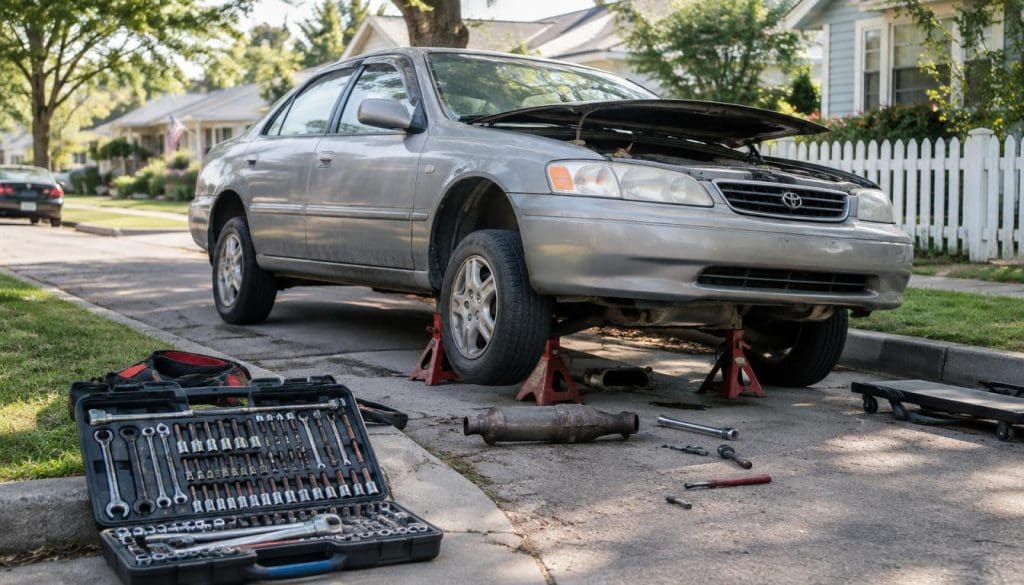
If the converter has been stolen, report the theft to police and avoid driving the vehicle far. The open exhaust can make the vehicle very loud, and exhaust gases may leak beneath it. Arrange an inspection or towing if needed.
Do not take a long drive before the exhaust system is checked. Driving with the converter missing may expose you to exhaust gases. A shop can inspect the damage and determine what repair the vehicle needs.
Report the Theft and Limit Driving
Tell police that the catalytic converter was stolen. Your report can help document the loss. Keep any report details with your insurance and vehicle records.
The vehicle may be too loud to drive comfortably, and gases may enter areas near the exhaust. Avoid driving far and arrange towing if the vehicle seems unsafe. A technician can inspect nearby exhaust parts for damage.
Arrange Repair in San Antonio
Heaven Automotive provides catalytic converter repair at 6645 Poss Rd. San Antonio, TX 78238. You can call (210) 682-3898 to discuss the vehicle and the next steps.
If you need catalytic converter repair near you in San Antonio, call or visit Heaven Automotive for help diagnosing the vehicle and arranging repair. The shop can assess the exhaust system and explain what work is needed. Share the vehicle’s details when you call.
Call Heaven Automotive at (210) 682-3898 to discuss repair for your vehicle in San Antonio.
Conclusion
The right repair starts with finding out whether the converter itself has failed or another fault is affecting it. Diagnosis should come before replacement, since an untreated engine or exhaust problem can damage a new part.
Arrange a prompt inspection if the check engine light flashes or power loss comes with rotten-egg odor. A technician can identify the cause and help you choose a suitable repair.
Hire Heaven Automotive to fix your vehicle.