


Most newer vehicles need an oil change every 5,000 to 7,500 miles, while some allow as much as 15,000 miles when the manufacturer specifies it. The right oil change interval depends on your car, driving conditions, and maintenance schedule. An oil-life monitor is a vehicle system that estimates remaining oil service life using mileage and operating data.
Older advice to change oil every 3,000 miles is not a universal rule for newer vehicles. Frequent short trips, heavy use, and long periods between drives can affect when service is due. Following the right schedule helps protect your engine without paying for changes you do not need.
Key Takeaways
- Use your vehicle’s owner’s manual to find its mileage and time limits.
- Some vehicles allow longer intervals, but only when the manufacturer says so.
- Driving habits can make the severe-service schedule the right choice.
- An oil-life monitor estimates service timing; an oil-pressure warning is different.
- Check oil levels regularly and use the oil type your vehicle requires.
Your owner’s manual is the place to confirm the interval for your exact vehicle.
What Is the Right Oil Change Interval for Your Car?
For most newer vehicles, plan on 5,000 to 7,500 miles between oil changes unless the owner’s manual specifies a different schedule. An oil change interval means the distance or time between services, and the manual’s schedule for your exact car is the deciding reference.
To find your schedule, look for the maintenance section in the owner’s manual. Use its normal-service or severe-service schedule, based on how you usually drive. Check the required oil specification there, too, because the mileage schedule and the approved oil go together.
| Situation | Mileage guidance | Deciding reference |
|---|---|---|
| Many newer vehicles | 5,000-7,500 miles | Owner’s manual |
| Manufacturer-approved extended interval | Up to 15,000 miles | Owner’s manual |
| Older 3,000-mile rule | 3,000 miles as historical guidance, not a default for newer vehicles | Vehicle’s current schedule |
The chart gives general guidance, not permission to extend every vehicle’s interval. A schedule of up to 15,000 miles applies only when the manufacturer approves it for your vehicle and oil. Do not treat that figure as a safe target for every car.
The 3,000-mile rule came from older guidance and does not set the schedule for all newer engines. A newer car may use different service timing, while another model may need an earlier change. The model’s own schedule accounts for its design and approved oil.
An oil change interval chart can help you compare common guidance, but it cannot replace the manual. Look for both the mileage schedule and the type of service conditions that match your driving. If your car has a maintenance schedule on its display, use the manual to understand how it works.
When a manual lists separate schedules, choose based on your regular use rather than one unusual day. A vehicle used for repeated demanding trips may need the severe-service schedule, even if its odometer moves slowly. Keep the manual’s exact distance and time limits in your service records.
Check the manual’s oil type and mileage schedule together before setting your next service reminder.
Synthetic vs. Conventional Oil: What Changes?
Synthetic oil generally resists heat-related breakdown better, but the oil specified for your engine and the schedule in your manual still decide when to change it. Better resistance does not mean the oil lasts forever or changes the manufacturer’s service plan.
Motor oil helps protect moving engine parts as temperatures and use put stress on it. Conventional oil is petroleum-based oil refined from crude oil. Full synthetic oil is made through a more controlled process, and a synthetic blend combines conventional oil with synthetic oil.
How conventional oil differs
Conventional oil can meet the needs of vehicles whose manufacturers approve it. It is not automatically wrong for an older car or an engine that calls for it. The label still needs to match the viscosity grade and performance standard in the owner’s manual.
A synthetic blend offers a mix of base oils, but the words on the front label do not set your service interval. The exact product must still meet the engine’s listed requirements. A brand name alone does not show that the oil is suitable.
What synthetic oil can and cannot change
Full synthetic oil can better resist breakdown at high temperatures than conventional oil. Some newer vehicles require synthetic oil, and you should not replace it with conventional oil to save money. Using the wrong oil can leave the engine without the product its design calls for.
Heat and use still affect synthetic oil over time. Even a high-quality oil can collect contaminants and lose some of its protective ability. A synthetic label does not erase the manufacturer’s mileage or time limit.
Some drivers choose synthetic oil for its heat resistance or because their vehicle requires it. That choice does not let you set a longer interval on your own. Follow the oil specification and service schedule together, even if the container claims long oil life.
If you are comparing oils, read the full label and match its standards to the manual. A low-cost option is not a bargain if it fails to meet the engine’s requirements. Your vehicle’s needs matter more than a broad claim about oil type.
Match the oil type to the requirement in your owner’s manual, not to a longer interval you hope to use.
How Does Time Compare With Mileage?
Your oil change is due when you reach either the mileage limit or the calendar limit set for your vehicle, whichever comes first. Follow the first limit you reach, because low mileage does not stop time from passing.
Oil-change schedules often set a time limit of six or 12 months, but those are common examples, not a promise for every car. Nearly no automaker recommends leaving oil in the crankcase for more than one year, regardless of mileage. Your manual gives the limit for your vehicle.
| Schedule cue | What it tracks | What you should follow |
|---|---|---|
| Mileage limit | Distance driven | The manual’s mileage interval |
| Calendar limit | Elapsed months | The manual’s time interval |
| Both limits apply | Whichever arrives first | Schedule service at that first limit |
Changing oil every three months is not a default requirement when your manual sets a longer interval. That old routine may lead to more frequent service than your vehicle needs. Keep the shorter limit in mind only if the manufacturer specifies it for your car.
Time matters even when a car spends most of its life parked. Oil does not remain fresh indefinitely just because the odometer barely changes. A low-mileage driver still needs to track months as well as miles.
When you plan a trip, compare the expected mileage with the date of your last service. That simple check can help you avoid reaching a limit far from home. Use the manual’s time schedule, not a general rule from another car.
Do not let a low odometer reading cancel a time limit printed in the manual.
Which Driving Conditions Call for More Frequent Changes?
Repeated short trips, towing, extreme temperatures, dusty roads and stop-and-go traffic can call for earlier oil changes than ordinary driving. Regular use matters: one unusual trip does not automatically make your whole routine severe.
Short trips can be hard on a car when the engine does not warm fully. Severe-use examples include trips of five miles or less in normal temperatures, or ten miles or less in freezing temperatures. Repeated drives like these may call for the severe-service schedule.
- Frequent short trips that do not let the engine warm fully
- Towing a trailer or hauling heavy loads
- Driving in extreme heat or cold
- Regular driving on dusty roads
- Regular stop-and-go traffic
If these conditions describe your regular routine, use the severe-service schedule in your owner’s manual. That schedule reflects repeated demanding use, not a single day spent in traffic or one trip with a trailer.
Driving habits can change from season to season. Winter trips may be short, while summer travel may include long highway drives. If the tougher pattern becomes routine, use the schedule that fits it rather than relying on your best driving month.
Dusty roads can expose a car to more dirt, while towing places extra demands on the engine. Stop-and-go traffic also means frequent slow movement and idling. These conditions do not prove that oil has failed, but they can affect the service plan.
A driver who mostly takes short errands may cover few miles yet still use the severe schedule. Another driver may tow only once each year, which may not reflect regular use. The manual’s description of severe service helps you decide which pattern fits.
If these conditions describe your regular routine, use the severe-service schedule in your owner’s manual.
What Does the Oil-Life Light Mean?
An oil-life reminder means the vehicle estimates that scheduled service is due, while an oil-pressure warning can signal an urgent problem. An oil-life monitor uses mileage and driving information to estimate service timing; a displayed percentage is estimated oil life, not oil pressure.
Different dashboard signals need different responses. A maintenance reminder is a prompt to plan service, while an oil-pressure warning light can point to a serious oil-flow or pressure problem. Check your manual because displays and alert names vary by vehicle.
| Dashboard signal | What it indicates | Response |
|---|---|---|
| Oil-life monitor or maintenance reminder | Estimated service timing | Arrange an oil change soon |
| Oil-pressure warning light | Possible oil-flow or pressure problem | Stop driving as soon as possible |
| Low-oil-level indicator | Low oil level on vehicles with that alert | Check the level and follow the manual |
An oil-life monitor does not directly test the oil in a lab. It estimates remaining service life using mileage and operating data, such as how the vehicle is driven. A percentage shows the system’s estimate, not a direct measure of oil pressure.
When the monitor says service is due, arrange an oil change within the timing described in your owner’s manual. The display may show a percentage, a message, or a service light. Use the manual to learn what each signal means for your car.
A low-oil-level alert is also different from the oil-life estimate. If your vehicle has that alert, check the level and follow the instructions in the manual. Do not assume that a service reminder means the oil level is low.
The oil-pressure warning light needs a faster response than a maintenance reminder. Continuing to drive with poor oil pressure can put the engine at risk. Treat that warning as an urgent signal rather than a routine service notice.
If the oil-pressure warning appears while you are driving, stop as soon as it is safe and shut off the engine.
How to Check Your Oil Level Between Changes
Check your oil at least once a month, using the method specified for your vehicle. A level check tells you how much oil is in the engine, not how much service life remains.
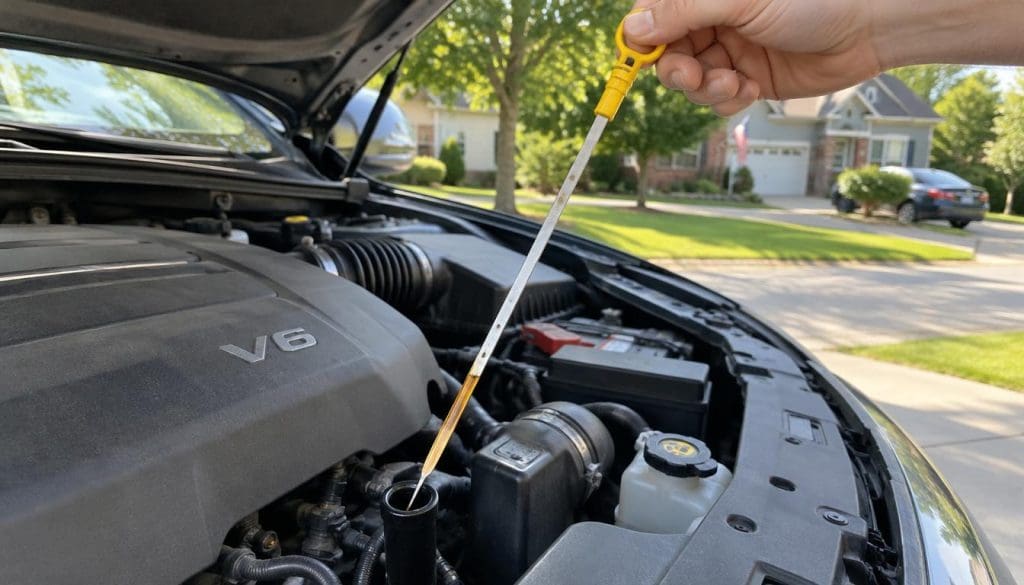
For cars with a dipstick, park on level ground, turn off the engine, and let it cool. Read the level against the dipstick marks after reinserting it fully. Some vehicles have no dipstick, so use the manual’s checking steps.
Read the dipstick safely
Pull out the dipstick and wipe it clean with a cloth or paper towel. Push it all the way back into its tube, then remove it again. The oil level should fall between the marks shown on the dipstick.
Read the marks carefully because designs vary. Some dipsticks have two holes, while others use a crosshatched area or lines. The owner’s manual explains which part of your dipstick shows the safe range.
If the reading is low, add the oil specified in the manual. Add no more than half a quart at a time, then wait and check the level again. Small additions help you avoid adding too much.
Interpret the level and appearance
Brown or black oil can be normal, so color alone does not show how much service life remains. Milky oil is different and can point to coolant leaking into the oil. Have that finding checked rather than treating it as a simple color change.
Do not assume every car uses the same checking method. Some vehicles require a particular wait time or electronic reading. Follow the manual’s instructions if they differ from the basic dipstick process.
A low reading may have more than one cause, including a leak or oil use inside the engine. Recheck after adding oil and note whether the level drops again. A record helps a mechanic understand how quickly the level changes.
If the oil is consistently low, arrange a mechanic’s inspection for a leak or oil consumption.
What Happens as Engine Oil Degrades?
As oil ages and collects contaminants, it becomes less able to protect the parts moving inside your engine. Heat and dirt gradually reduce oil’s effectiveness, so old oil cannot do its job as well as fresh oil.
Motor oil supports several basic engine needs. It moves through the engine while parts run, and the oil filter catches contaminants suspended in it. Three key jobs are:
- Lubricate moving parts inside the engine
- Help carry heat away from engine parts
- Carry dirt and debris toward the oil filter
Oil helps reduce friction between parts that move close together. It also helps carry heat away from hot areas. As the oil breaks down, it can lose some of its ability to lubricate and cool those parts.
Dirt and debris collect as oil moves through the engine. The oil filter captures many of these contaminants, but the oil still ages and gathers material over time. Heat adds stress, which can further reduce its ability to protect the engine.
Oil degradation is gradual, not an instant failure triggered by one missed service. A late change can increase wear risk, but it does not prove that an engine has already suffered damage. Keep to the proper schedule rather than assuming one delay has ruined the car.
When old oil loses effectiveness, the engine has less support against heat and friction. The filter also has a finite job as it collects contaminants. Regular service keeps both oil and filter care in the vehicle’s maintenance plan.
Keeping to the specified schedule helps preserve the lubrication and cooling your engine depends on.
Which Signs Suggest Your Oil Needs Attention?
Unusual engine noise, heavy exhaust smoke, a burnt-oil smell or a sudden fuel-efficiency drop deserves attention, but none proves by itself that an oil change is overdue. Look at the whole picture, including the service schedule and any other changes in how your car runs.
Possible signs include:
- Unusual engine noise
- Excessive exhaust smoke
- A burnt-oil smell
- A noticeable drop in fuel efficiency
These signs can have causes other than overdue oil, so do not use one symptom as a precise service interval. A noise could have another source, while smoke or a fuel-use change may need a separate diagnosis.
Dark oil alone is not a dependable way to decide when service is due. Oil can turn brown or black during normal use, and color does not reveal its remaining life. Use the vehicle’s schedule instead of judging the oil by appearance alone.
A burnt-oil smell may come from oil reaching a hot surface, but that is not the only possible cause. Excessive smoke can also point to an issue beyond routine maintenance. Persistent changes deserve a closer look rather than a guess.
Keep track of when the service reminder appears and compare it with the manual’s schedule. A reminder sticker from a past visit can help with records, but it may not account for current driving or the correct interval. Confirm the date and mileage from your own service notes.
If a symptom is brief and does not return, note when it happened and watch for a pattern. If it continues or worsens, have the car checked. A technician can look for a cause that a color check cannot show.
Have persistent symptoms checked instead of relying on a color check or a reminder sticker alone.
What You Need for a DIY Oil Change
A DIY oil change commonly calls for a drain-plug wrench, an oil-filter wrench, an oil pan, latex gloves and, for some vehicles, a jack. Confirm the oil and filter specifications in your manual before buying supplies.
The tools needed for an oil change depend partly on access to the drain plug and filter. A jack may help on some cars, while others leave enough room without one. The vehicle must rest on secure support before you work underneath it.
Gather the basic tools
Set out the tools and supplies before starting. The drain-plug wrench removes the drain plug, and an oil-filter wrench helps loosen the filter. An oil pan catches the used oil, while latex gloves help keep oil off your hands.
Use a jack only if the vehicle needs extra clearance. Never rely on a jack alone while working beneath a car. Support the vehicle securely with equipment made for that purpose, and follow the vehicle’s lifting points.
Check the manual for the correct oil type, amount, and filter specifications. A filter that does not fit can cause trouble, even if it looks similar to the one removed. Keep the new parts and the used-oil pan within reach before draining anything.
Prepare the vehicle and used oil
Choose a level work area and make sure you can collect the used oil without spilling it. Keep a suitable container ready for transport after the job. Do not pour used motor oil onto the ground or into a drain.
Some auto-parts stores and oil-change businesses accept used oil, but acceptance rules can differ by location. Call or check with the collection site before you start. Make sure the container can hold the used oil without leaking.
Used oil needs proper collection and disposal, even when the job itself goes smoothly. Keep it separate from other liquids and avoid mixing it with coolant or fuel. A clean container can make drop-off easier and safer.
Confirm a local used-oil collection option before beginning the job.
What Determines the Cost of an Oil Change?
An oil-change bill depends mainly on the oil your vehicle requires, how much it takes, the filter and the labor involved. The final amount reflects both materials and labor, so two vehicles can have different service bills.
Materials include the oil and oil filter. A vehicle that needs more oil may use more material than one with a smaller capacity. The filter also affects the total because each engine requires a compatible part.
Oil type can change the material cost. A vehicle that requires a particular synthetic oil may have different material costs from one that allows conventional oil. The manual’s requirements come first, even when another oil costs less.
Labor is the other broad part of the bill. The work may take different amounts of time depending on the vehicle and service setup. The final charge also depends on the service provider’s labor rate, so a general estimate may not fit every car.
When comparing estimates, check that each one includes the correct oil quantity and filter. A lower quote may cover a different oil or may leave out part of the work. Ask for the details rather than comparing totals alone.
For an accurate estimate, have your vehicle’s year, make, model and required oil specification ready.
How to Keep Your Oil-Change Schedule on Track
A simple service record lets you compare the last oil change with both your odometer and the schedule in your owner’s manual. Good records make it easier to spot when the next service is due.
At each service, record the date, odometer reading, oil type and filter. Keep receipts together with that information, either in the car or in a digital folder. A record with those four details can help you track both use and service history.
Record the date and odometer reading
Write down the odometer reading on the day of service, not later from memory. The date matters too, because your vehicle may have a time limit as well as a mileage limit. Add the oil type and filter so future records show what went into the engine.
Receipts can fill gaps in a service history, especially after work done by a shop. Store them in date order or take clear photos for a digital copy. Keep the latest service details easy to find before planning another visit.
Plan for low-mileage driving
A car you drive infrequently still follows the manual’s calendar limit. Do not wait indefinitely for a mileage target when the vehicle’s time limit arrives first. This matters if your car stays parked for long stretches between occasional trips.
The owner’s manual may provide separate normal- and severe-service schedules. Use the one that matches your regular driving, rather than switching schedules based on one unusual trip. Your routine is the useful guide for choosing between them.
A record also helps if someone else drives or services your car. They can see the last date, mileage, oil type and filter without relying on memory. That detail may prevent a missed service after a change in household routines.
Keep the latest service date and mileage somewhere you can check before your next trip.
How to Choose the Correct Motor Oil for Your Vehicle
Choose motor oil by the exact viscosity grade and performance specification your owner’s manual requires. Match both items on the oil container to the manual, rather than choosing only by brand or a promise of longer service life.
SAE identifies viscosity grades on motor-oil labels. Viscosity describes how oil flows at different temperatures, and the manual lists the grade your engine needs. API identifies oil specifications that show whether a product meets a stated performance standard.
Use this checklist when choosing oil and a filter:
- Manual-listed viscosity grade
- Required API specification
- Permitted conventional or synthetic type
- Correct oil-filter fitment
A higher price does not guarantee a better match. Full synthetic oil is not automatically correct if it misses the grade or performance specification your engine requires. The same rule applies to any oil type or brand.
Read the label closely before putting a container in your cart. Look for the SAE grade and API specification that match the manual, not just a large claim on the front. If the label does not show the required information, choose a product that does.
The oil filter also needs to fit your vehicle. A filter that threads onto the engine may still be the wrong part for its design. Check the part listing against the vehicle details and the manual’s service requirements.
Do not extend change intervals because a bottle uses words such as long-life or advanced protection. The manufacturer’s schedule still applies to the approved oil and filter. Select the right products first, then follow the vehicle’s service plan.
Check both the oil label and the filter fitment before buying supplies.
Conclusion
Follow the oil type and service schedule specified for your vehicle, and do not ignore a warning that signals a possible pressure problem. Your owner’s manual and applicable service reminder help you plan care that fits your car and driving routine.
When you are unsure about a symptom or need repair, a mechanic can inspect the vehicle and explain the next step. Timely maintenance can help protect the engine and catch problems before they grow.
Hire Heaven Automotive to fix your vehicle; visit 6645 Poss Rd. San Antonio, TX 78238 or call (210) 682-3898.