


Nothing ruins a summer drive faster than a broken climate control system. When you expect cool air but get heat instead, it usually means there’s a problem. These issues often happen at the worst times, leaving you sweating.
Finding the root cause is the first step to a cool cabin. Sometimes, the system has trouble regulating temperature. You might wonder why your AC blows too cold or freezes before it stops working. Knowing these signs helps you act fast to prevent more damage.
Regular maintenance keeps your cooling parts working well in the heat. If your vehicle needs help, trust the experts to make it comfortable again. Heaven Automotive offers great service for all makes and models in Texas.
Hire Heaven Automotive to fix your vehicle and enjoy the road again. We are located at 6645 Poss Rd. San Antonio, TX 78238. Contact us at (210) 682-3898 to schedule your inspection.
Key Takeaways
- Low refrigerant levels often cause temperature fluctuations.
- Blocked condensers prevent heat from leaving the system.
- Electrical faults can stop the compressor from engaging.
- Leaks in hoses lead to gradual cooling loss over time.
- Regular inspections prevent major repair bills later.
- Clogged cabin filters restrict proper ventilation and flow.
Understanding the Mechanics of Your Car AC Blowing Warm Air
When your car’s AC starts blowing warm air, it’s important to know why. This problem comes from the complex mechanics of your car’s heating, ventilation, and air conditioning (HVAC) system.
To find the problem, you need to know how your car’s AC system works. It’s made to control the air’s temperature and quality. This ensures you stay comfortable while driving.
The Basic Components of an Automotive HVAC System
Your car’s HVAC system has key parts that cool the air. These are the compressor, condenser, evaporator, and refrigerant. Each part is vital for cooling.
| Component | Function |
|---|---|
| Compressor | Compresses the refrigerant, raising its temperature and pressure. |
| Condenser | Dissipates heat from the refrigerant, causing it to condense into a liquid. |
| Evaporator | Allows the refrigerant to expand and absorb heat from the surrounding air, cooling it down. |
| Refrigerant | The substance that circulates through the system, transferring heat and facilitating the cooling process. |
How Heat Exchange Works in Your Vehicle
Cooling the air in your car involves moving heat from inside to outside. This happens through refrigerant flowing between the evaporator and condenser coils.
At the evaporator, the refrigerant takes heat from the air and turns into a gas. This gas is then compressed and goes to the condenser. There, it releases heat to the outside and turns back into a liquid. A problem, like AC compressor failure, can cause warm air to blow inside.
Knowing how this works helps you spot problems and talk to a mechanic if needed.
The Role of Refrigerant in Your Cooling System
Your car’s air conditioning system needs refrigerant to cool the air. This key component helps move heat from inside the car to outside. This makes the air inside cooler.
Refrigerant levels must be precise for the AC to work right. If there’s too little, the air won’t cool properly. This means warm air blows into the car. Too much refrigerant can also cause problems, like parts failing due to high pressure.
Why Refrigerant Levels Must Remain Precise
Keeping the right amount of refrigerant is key for AC performance. Low refrigerant levels make the system work harder. This can damage parts like the compressor or condenser early.
Refrigerant leaks are common and can lower the level. If you think there’s a leak, get it repaired by a professional. This fixes the system and stops warm air from blowing in.
The Dangers of Overcharging or Undercharging
Too much refrigerant can damage the compressor and other parts due to high pressure. Not enough refrigerant means the air won’t cool well and uses more energy.
Both problems can cost a lot to fix and make the system less efficient. So, it’s important to have a skilled technician check and maintain the refrigerant level.
Identifying a Refrigerant Leak Repair Necessity
Leaks in the refrigerant system can make your AC less efficient. This leads to warm air coming out of the vents. If your car’s AC isn’t cooling right, finding the cause is key. Refrigerant leaks are often the problem.
Leaks can happen for many reasons. This includes old hoses, a damaged evaporator, or other system issues. Finding these leaks is vital for fixing them.
Common Locations for System Leaks
Leaks often show up in certain spots in the AC system. These are:
- Seals and connections
- Evaporator coils
- Condenser coils
- Hoses and fittings
Checking these spots often can catch leaks early.
| Component | Common Leak Causes | Inspection Tips |
|---|---|---|
| Seals and Connections | Wear and tear, corrosion | Look for signs of moisture or oil |
| Evaporator Coils | Punctures, corrosion | Check for damage or rust |
| Condenser Coils | Physical damage, debris | Inspect for bent fins or blockages |
Using UV Dye to Locate Hidden Escapes
UV dye is a great way to find refrigerant leaks. It’s added to the refrigerant. When it leaks, it shows up under UV light.
Technicians use a UV light to find the leaks. This makes fixing them easier.
This method is great for finding leaks in tricky spots.
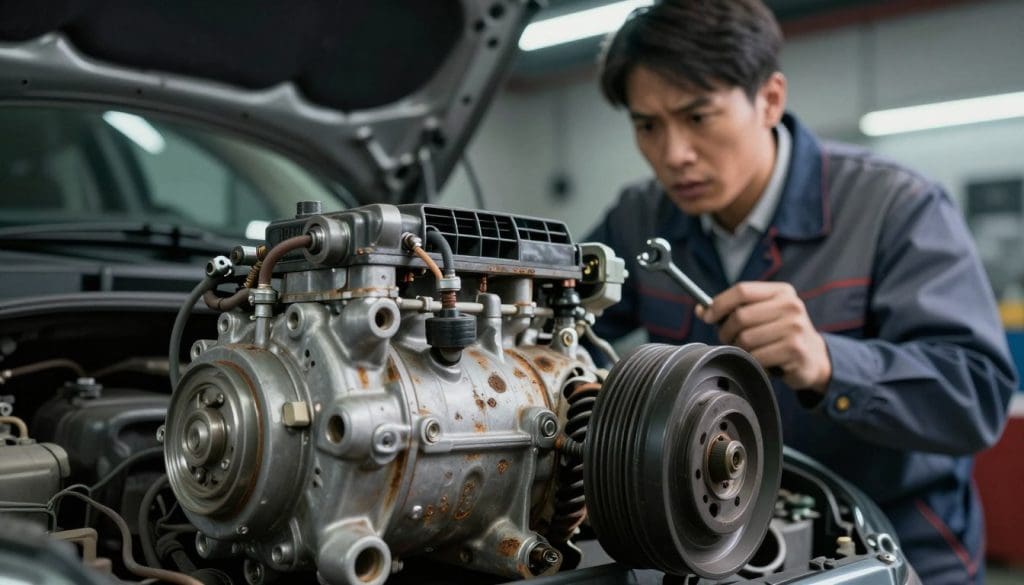
Common Signs of AC Compressor Failure
The AC compressor is key to your car’s air conditioning. If it fails, you’ll get warm air from the vents. Spotting the signs early helps avoid more damage to your AC system.
Recognizing Unusual Noises from the Engine Bay
Unusual noises from the engine bay can mean trouble. You might hear grinding or screeching sounds or clunking or rattling noises. These sounds often mean the compressor is wearing out or needs more lubrication.
- Loud clunking or banging noises when the AC is turned on
- Squealing or screeching sounds due to a worn-out serpentine belt or compressor clutch
- Rattling noises indicating loose or broken internal components
Why a Seized Compressor Stops Cold Air Flow
A seized compressor is a serious failure. It means the compressor’s parts are stuck, stopping cooling. When this happens, your AC will stop blowing cold air because it can’t move refrigerant.
Seized compressors can be caused by overheating due to low refrigerant levels, internal wear and tear, or contamination within the AC system. Fixing these issues quickly can prevent a seized compressor and save you money on repairs.
How Electrical Issues Impact Your Cooling Performance
Electrical problems can really mess with your car’s cooling system. Your car’s AC needs a bunch of electrical parts to work right. If any of these parts fail, you might find yourself feeling too hot while driving.
The electrical system powers important AC parts like the compressor and fans. If there’s a problem, your AC might not work right. Knowing how to find and fix these issues is key to staying cool while driving.
Checking Fuses and Relays for AC Circuits
Start by checking the fuses and relays for your car’s AC. A blown fuse or a bad relay can stop the AC from working. You’ll find the fuse box under the dashboard or in the engine area.
- Find the fuse for the AC system.
- Look for damage or wear on the fuse.
- Swap out any blown fuses with new ones of the same rating.
- Check the AC system’s relays and replace them if needed.
| Component | Function | Symptoms of Failure |
|---|---|---|
| Fuses | Protects electrical circuits from overload | AC system not turning on |
| Relays | Acts as a switch for electrical circuits | Intermittent AC operation |
| Wiring Harnesses | Connects electrical components | Erratic AC performance |
Diagnosing Faulty Wiring Harnesses
Wiring problems can also affect your car’s AC. Wires can get damaged from heat, vibration, or wear. This can make your AC act strangely or stop working altogether.
Look for signs of damage like fraying or corrosion on the wiring. Fixing or replacing damaged wiring can fix AC problems. If you’re not sure what to do, it’s best to get help from a pro.
The Importance of Condenser Maintenance
Ignoring condenser upkeep can harm your AC’s performance and raise the chance of refrigerant leak repair. The condenser is key in cooling the refrigerant. Any blockages or damage can stop it from working right.
To keep your condenser running well, it’s vital to clear it of debris and damage. Here are some important points to remember:
Clearing Debris from the Front Grille
The front grille often gets clogged with debris, which can block the condenser. Make sure to regularly check and clean the grille for good airflow.
- Look for leaves, twigs, and other blockages
- Use compressed air or a soft brush to remove debris
- Think about getting a grille guard to protect the condenser
Signs of Physical Damage to the Condenser Fins
Damage to the condenser fins can really hurt its performance. Watch for signs like:
- Bent or crushed fins
- Rust or corrosion
- Visible damage from road debris
By taking care of your condenser and fixing problems fast, you can keep your AC system running smoothly. This helps avoid expensive repairs later on.
Troubleshooting Cooling Fan Malfunctions
The cooling fan is key to your car’s AC system. Troubleshooting its malfunctions is vital for cool air. Issues with the cooling fan can cause car cooling issues. It’s important to fix these problems quickly.
The cooling fan is not just a simple part. It’s a critical element that keeps your car’s engine and AC system cool. This ensures they work at their best.
The Relationship Between Engine Cooling and AC Efficiency
The cooling fan is essential for engine cooling and AC efficiency. When the engine runs, it gets hot. This heat can harm the AC system’s performance. A working cooling fan helps to remove this heat, making the AC system cool the air better.
- A faulty cooling fan can cause the engine to overheat. This can lead to AC compressor failure.
- Not enough cooling can make the AC system less efficient. This means warm air gets blown into the car.
- A working cooling fan is key to keeping the AC system at its best operating temperature.
Testing Fan Motors and Control Modules
To fix cooling fan problems, test the fan motors and control modules. You need to check the electrical circuit that controls the fan. This includes the motor, relay, and fuse.
- Check the fuse and relay for the cooling fan circuit to make sure they work right.
- Look for any damage or wear in the wiring and connections.
- Use a multimeter to check the voltage to the fan motor. Make sure it’s getting the right voltage.
If your car’s cooling fan isn’t working right, you need to fix it fast. This prevents damage to your AC system. Regular checks and maintenance can catch problems early.
Why Blend Door Actuator Problems Cause Warm Air
The blend door actuator is key in controlling your car’s cabin air temperature. It mixes hot and cold air. If it fails, the air conditioning might blow warm air.
Understanding How Air Temperature is Mixed
The blend door actuator adjusts the blend door. This door controls the mix of cold air from the evaporator and hot air from the heater core. This mix is vital for the right temperature.
When working right, it keeps the air mix balanced with your temperature settings. But, if it fails, the balance is off.
Symptoms of a Stuck Blend Door
A stuck blend door can cause several issues, including:
- Warm air blowing from the vents when cold air is selected.
- Inability to adjust the temperature.
- Unusual noises from the dashboard area.
If you’re seeing these signs, your blend door actuator might be broken.
| Symptom | Possible Cause | Recommended Action |
|---|---|---|
| Warm air from vents | Stuck blend door | Inspect blend door actuator |
| Inability to adjust temperature | Faulty blend door actuator | Test actuator operation |
| Unusual noises | Mechanical failure | Check for mechanical issues |

The Impact of Cabin Air Filter Blockages
Do you find your car’s AC not cooling as it should? A clogged cabin air filter might be the reason. This filter is key to keeping the air in your car clean and cool. But, when it’s blocked, it can really mess with your car’s car cooling issues.
A clogged cabin air filter makes the air feel warmer than it is. It’s because the filter cleans the air before it gets to you. But, when it’s full of dust and dirt, it stops the AC from cooling the air right.
How Airflow Restriction Affects Cooling Perception
A blocked cabin air filter limits airflow, which hurts your car’s AC performance. You might think the air isn’t cool enough, even if the AC is working fine. This is because the air can’t move around as it should, making you feel like it’s not cooling enough.
Recommended Intervals for Filter Replacement
To prevent car cooling issues from a clogged cabin air filter, you need to replace it often. It’s best to check and swap out your cabin air filter every 12,000 to 18,000 miles. Or, follow what your car’s manual says. For tips on keeping the air in your car fresh, check out Heaven Automotive’s guide.
Keeping your cabin air filter clean and working well helps your car’s AC cool better. This makes your drives cooler and more comfy.
Recognizing When Your AC System Needs Professional Diagnostics
Modern car AC systems are complex. They often need a pro to diagnose and fix them right. DIY kits for refrigerant recharge or leak repair might not be the best choice. They can sometimes cause more harm than good.
DIY refrigerant kits can be risky for your AC system and your safety. They don’t have the precision needed for today’s systems. This can lead to overcharging or undercharging, damaging the AC compressor and more.
The Risks of DIY Refrigerant Kits
DIY refrigerant kits might seem like a way to save money. But they come with big risks. Without the right tools and training, you can mess up refrigerants. This can harm your system, fail components, or even hurt you because of the high pressures.
Improper refrigerant handling can also harm the environment. Many refrigerants are bad for the air if released. Plus, if you can’t find the real problem, you might just fix the symptoms. This can lead to more problems and expensive fixes later.
Why Specialized Equipment is Required for Modern Systems
Today’s car AC systems are made with high tech and precision. They need special tools for fixing and checking. For example, finding refrigerant leaks often needs UV dye kits and leak detectors not found in DIY kits.
Fixing issues like AC compressor failure is more than just looking at it. It needs tools like pressure gauges and electrical multimeters. Pros have these tools and know how to use them. They make sure your AC system is fixed right and safely.
Knowing when to get a pro for your AC system avoids DIY mistakes. It ensures your car’s cooling system works well again.
Current Trends in Automotive Climate Control Technology
The world of car cooling systems is changing fast with new tech. Knowing about these changes can help you choose the right upgrade for your car.
Compressors are getting a big upgrade. Variable displacement compressors are now popular. They adjust to how much cooling your car needs, making it more efficient and easier on the engine.
Advancements in Variable Displacement Compressors
Variable displacement compressors have big advantages over old ones. They can change how much cooling they do based on what your car needs. This means better gas mileage and less energy use.
| Feature | Variable Displacement Compressors | Fixed Displacement Compressors |
|---|---|---|
| Cooling Output | Adjustable based on cabin needs | Fixed output, often leading to inefficiencies |
| Fuel Efficiency | Improved due to adjustable output | Generally lower due to constant load |
| Energy Consumption | Reduced as it adjusts to demand | Higher as it runs at full capacity constantly |
The Shift Toward Eco-Friendly Refrigerants
There’s also a big move to eco-friendly refrigerants. Older refrigerants are being phased out for better ones. These new ones are kinder to the planet and safer.
Keeping up with these changes is key. They affect how well your car works and its impact on the environment.
Knowing the latest in car cooling tech helps you keep your car running well. It stays efficient, effective, and good for the planet.
Preventative Maintenance Tips for San Antonio Drivers
To keep your car’s AC cool, regular checks are key in San Antonio. The hot Texas weather can damage your car’s cooling system. So, keeping it in good shape is important to avoid car cooling issues.
Regular inspections are vital to ensure your AC system works right. Spotting problems early can save you from expensive repairs later.
Combating the Texas Heat with Regular Inspections
Regular inspections can help you stay ahead of problems. Here are some key areas to focus on:
- Check refrigerant levels to ensure they’re within the recommended range.
- Inspect the condenser for debris and damage.
- Test the compressor and other electrical components.
Seasonal AC Check-ups Before Summer
Before summer hits, it’s important to have your AC checked. A professional mechanic can:
- Inspect the system for leaks and damage.
- Clean or replace filters as needed.
- Ensure the cooling fan is working correctly.
By following these tips, you can enjoy a cooler, more comfortable drive in San Antonio’s hot summers.
Why Heaven Automotive is Your Trusted Partner for Repairs
Heaven Automotive is known for top-notch AC system repairs and maintenance. They have a strong reputation for expertise and customer satisfaction. They are the go-to for fixing AC compressor failure and refrigerant leak repair.
Their team is great at finding and fixing complex AC system problems. Whether it’s a bad compressor or a refrigerant leak, they use the latest tools and methods. This ensures they solve the issue quickly and effectively.
Expertise in Complex AC System Diagnostics
Heaven Automotive is skilled in complex AC system diagnostics. They have experience with many vehicle models. This means they can handle even the toughest problems.
Commitment to Quality Service at 6645 Poss Rd. San Antonio, TX 78238
Located at 6645 Poss Rd, San Antonio, TX 78238, Heaven Automotive offers excellent service. Their facility is equipped with the latest technology. This ensures your AC system is fixed to the highest standards.
| Service | Description |
|---|---|
| AC Compressor Repair | Expert repair and replacement services for faulty AC compressors. |
| Refrigerant Leak Repair | Efficient detection and repair of refrigerant leaks to restore your AC’s performance. |
Contacting Our Team at (210) 682-3898
For all your AC repair needs, call Heaven Automotive at (210) 682-3898. Their friendly staff will help schedule an appointment or answer any questions.
Conclusion
If your car’s AC is blowing warm air, finding and fixing the issue is key. Problems can come from leaks, broken compressors, or electrical issues.
Knowing how your car’s cooling system works helps you spot problems early. Regular checks and maintenance can keep your AC running well.
For tough problems, it’s best to get help from a pro like Heaven Automotive. They’re experts in fixing AC systems and are known for their quality service. You can find them at 6645 Poss Rd, San Antonio, TX 78238, or call (210) 682-3898.