

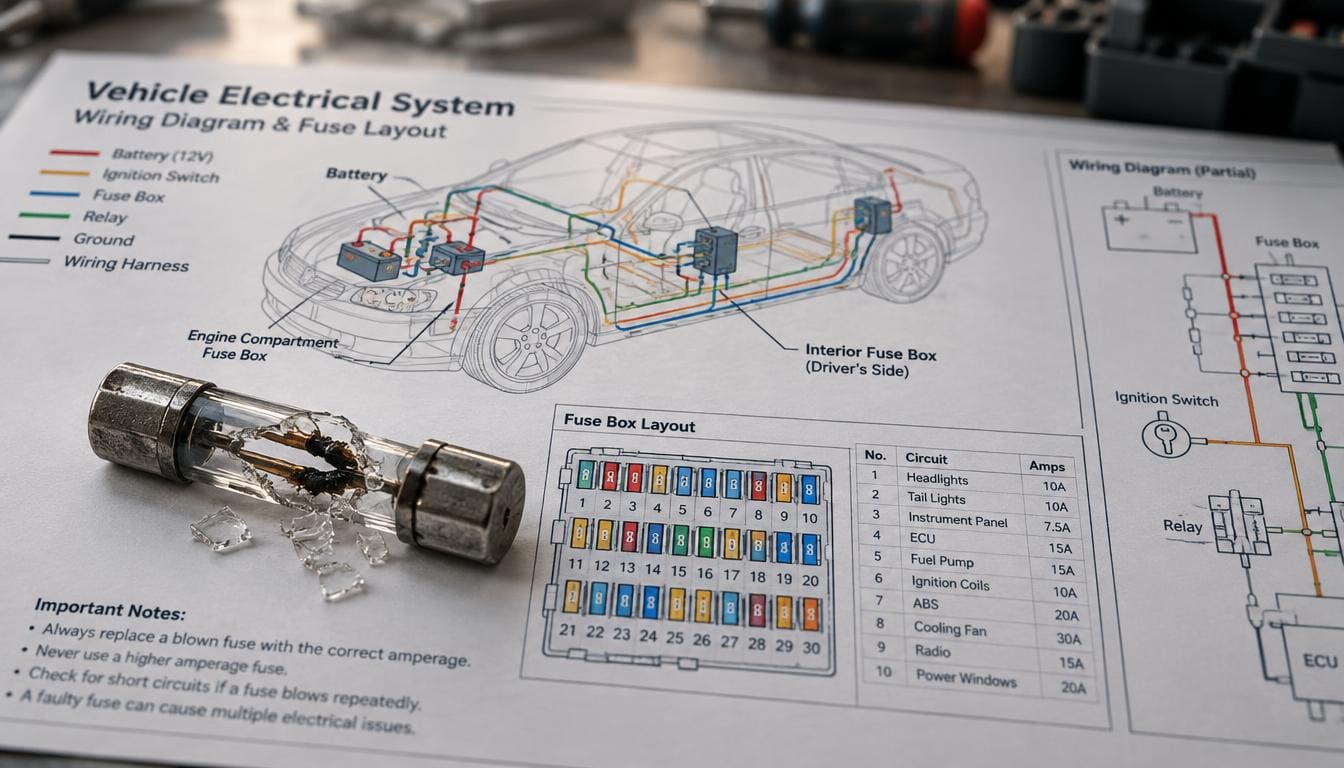
If the same fuse blows again, the circuit it protects still has a problem that needs attention. A fuse interrupts excessive current to help protect wiring and components in your electrical system.
Repeated failures are a sign of unresolved electrical problems, not proof that you need another replacement. A voltage-drop test measures voltage lost across a circuit section while current flows.
A replacement fuse that stays intact does not prove the circuit is safe if its rating is wrong. The wrong fuse can leave the wiring and each connected component without proper protection.
Key Takeaways
- Repeated fuse failures need diagnosis, not repeated replacement.
- Use the fuse rating listed in your owner’s manual.
- A working fuse does not prove the circuit is safe.
- Avoid using the affected system until the fault is checked.
- A voltage-drop test checks a circuit while current flows.
Stop replacing the fuse repeatedly and avoid using the affected system until the cause has been checked.
Why Do Car Fuses Keep Blowing?
A fuse usually blows because the circuit is carrying more current than its protection allows. Use only the amperage and fuse type listed in your owner’s manual.
Most vehicles have fuse boxes in the engine compartment and driver-side dashboard. A fuse diagram in the manual helps you identify the correct position and rating.
Overloads and 20-amp fuse failures
Accessories that draw too much power can overload a circuit, especially when several devices share it. A 20-amp fuse keeps blowing in a car does not mean the fuse is defective.
An incorrectly rated replacement can also cause trouble. Match the replacement to the owner’s manual, not to the fuse that happened to be installed before.
Standard ATO/ATC blade fuses have ratings from 1A to 40A and 32V DC. Maxi APX fuses have higher ratings and larger bodies.
| Fuse type | Current rating | Voltage rating | Size |
|---|---|---|---|
| ATO/ATC blade | 1A to 40A | 32V DC | 19.1mm × 18.5mm × 5.1mm |
| Maxi APX blade | 20A to 120A | 32V to 58V DC, by design | 29.2mm × 34.3mm × 8.9mm |
Maxi APX diffusion-pill technology delays protection during brief overcurrent surges. That feature does not make a higher-rated fuse safe for a circuit designed for less amperage.
Short circuits in outlets, wiring, and components
Short circuits can happen when damaged wiring or frayed insulation touches metal. Moisture or corrosion at a connection can also disrupt the circuit, while a failing component may draw too much current.
When a car fuse keeps blowing while driving, movement or changing electrical demand may affect a damaged circuit. A cigarette-lighter or 12V power outlet fault can involve the socket, its wiring, or a connected device.
How Can You Trace the Circuit Fault Safely?
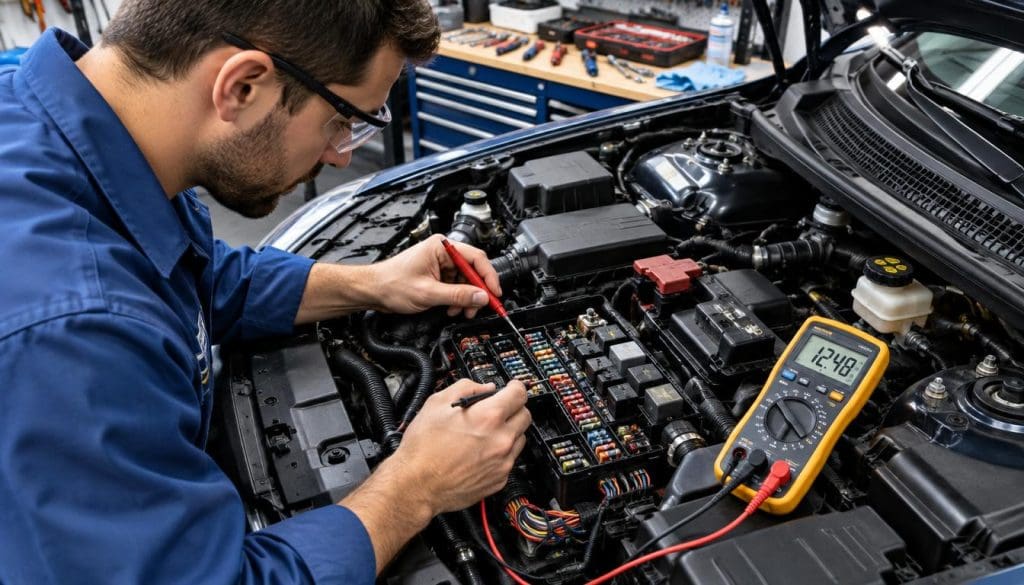
A fuse that fails as soon as you turn the key points the inspection toward the part of the circuit already receiving power. The timing narrows the search, but does not name the faulty part.
A 15-amp fuse must match the vehicle’s specified rating. Its failure alone does not prove that a particular component is bad.
What to check when a 15-amp fuse blows at key-on
If a car fuse keeps blowing when the key is turned, the fault lies somewhere in a section powered at that time. If it fails only when you switch on a device, inspect that device and its supply wiring.
Record the timing and conditions before testing. These details help a technician choose which circuit sections to inspect first.
| Failure timing | Circuit area to investigate | What to record |
|---|---|---|
| Immediately | Section powered at key-on | Key position |
| When a device is switched on | Device and supply wiring | Device name |
| After operating for a while | Powered circuit under use | Time before failure |
| Intermittently with movement, temperature, or moisture | Areas affected by those conditions | Movement, temperature, or moisture |
When the replacement fuse blows again
When a car fuse keeps blowing when replaced, repeated failure calls for an electrical-system inspection. Ford owner’s manual guidance also calls for inspection after repeat fuse failure.
Several consumers may share one fuse, so technicians isolate wiring sections and connected devices. A visual check can miss internal corrosion or wire damage.
A voltage-drop test must run under load, with the circuit powered and carrying current. An unloaded continuity test may pass even when damaged wiring cannot carry operating current.
To test voltage drop across a fuse, place one multimeter probe on each side while the circuit runs under the same load. An inactive circuit gives no meaningful reading.
If a loaded circuit shows excessive voltage drop, test smaller sections, including the fuse input and output. Corrosion, loose connections, and damaged wires can add resistance and heat.
Excessive resistance can heat wires, damage insulation, and raise the risk of electrical fire. Never turn on the ignition or start the vehicle while a multimeter measures current in series. That can blow the meter’s fuse.
How Do You Repair the Cause and Verify the Fix?
Replacing the fuse is not the repair; the repair is correcting the fault that made it blow. Fixing a fuse that keeps blowing means repairing the wiring, connector, or component found during testing.
Then verify the affected circuit under the operating conditions that caused the failure. A repair that works only when the device is off has not solved the original problem.
Blown-fuse car repair cost depends on the diagnosis, the vehicle, and whether the work involves wiring, a connector, or a component. Get a current quote based on the inspection findings.
Before an auto repair inspection, note these details:
- Fuse position and specified rating
- What stopped working and when
- Recently added electrical equipment
- Other functions affected
Avoid using the affected system until it is checked. Do not drive if the failed circuit affects a safety-critical function such as headlights or wipers.
Ask what test identified the failed circuit section and how the completed repair was checked.
Conclusion
A repeatedly blowing fuse is a warning to diagnose the circuit, not a reason to keep installing replacements. The correct fuse rating helps protect the vehicle’s wiring and electrical system.
The underlying fault still needs repair, even after a new fuse stays intact. If electrical problems return, an inspection can help find the source before it causes more damage.
Heaven Automotive is at 6645 Poss Rd. San Antonio, TX 78238. Call (210) 682-3898 to discuss your vehicle’s problem.
Hire Heaven Automotive to fix your vehicle; call (210) 682-3898 or visit 6645 Poss Rd. San Antonio, TX 78238.