

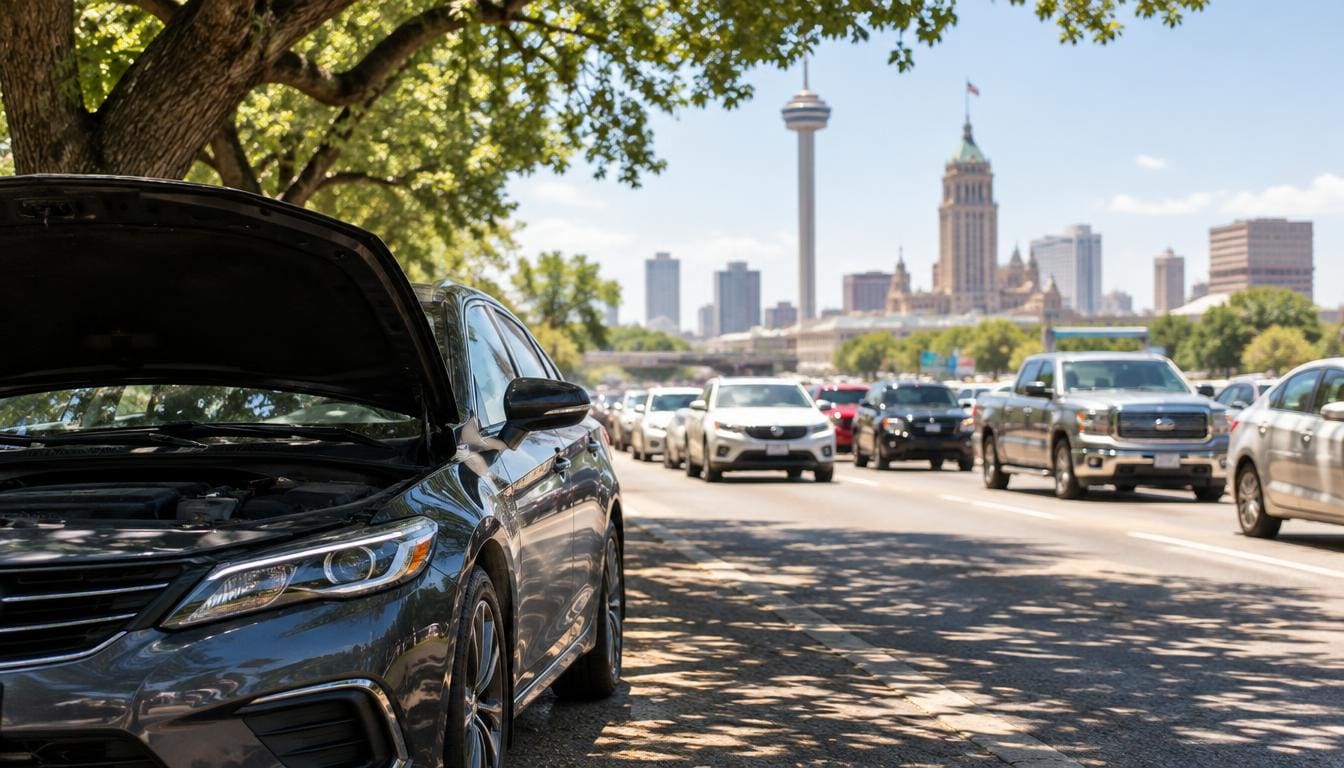
If your temperature gauge enters the red, pull over somewhere safe and shut off the engine rather than trying to reach your destination. That is the safest response to car overheating in summer, especially in San Antonio traffic. The coolant is the fluid mixture that carries heat from the engine to the radiator.
On a hot day, stop-and-go traffic can put extra strain on your vehicle. Your first priority is getting safely off the road, not diagnosing the fault in traffic. This guide explains how to respond, what the signs can mean, and when to arrange repair.
Key Takeaways
- Stop safely when the gauge enters the red.
- Shut off the engine and let it cool.
- Never open a hot radiator cap.
- A normal reading after cooling does not prove the problem is fixed.
- Call for a tow if a warning returns or coolant leaks.
Knowing the warning signs helps you decide when a rising temperature needs immediate action.
Immediate Steps When the Temperature Gauge Climbs
In stop-and-go traffic, take the first safe opportunity to leave the lane and stop away from moving vehicles. Safety comes first when your car overheats while driving. Do not keep driving toward a nearby destination.
If a warning appears, lower the engine’s heat load while you move toward a safe stopping place. A Mazda MX-5 red high engine coolant temperature warning means you should park immediately. Continuing to drive could damage the engine.
- Turn off the A/C as you move toward a safe place.
- Pull fully out of traffic and switch on your hazard lights.
- Shut off the engine once you have stopped.
- Wait for the engine to cool before making a visual check.
- Call for a tow if you see steam, an active leak, or a returning warning.
A sudden cooling failure can cause thermal damage to a cylinder head within 10 seconds. That risk makes a safe stop more important than reaching a driveway or repair shop under your own power.
Keep people clear of traffic while you wait for help. Do not stand near the road to inspect the vehicle, even if the hood looks cool.
Never remove a radiator cap while the engine is hot because pressurized coolant can cause severe burns.
Warning Signs and Normal Engine Temperature
A red temperature gauge or red coolant warning light signals that engine temperature is too high. For a Mazda MX-5, normal driving temperature stabilizes at 100 °C (210 °F) or less.
Is 210 degrees too hot for an engine? Not automatically, because the normal operating temperature depends on the vehicle. Check your owner’s manual for the range that applies to your engine.
Other warning signs can appear before the gauge reaches the red. Watch for these changes:
- Steam from under the hood or visible coolant on the ground.
- A sweet coolant smell, which can signal a leak.
- Repeated need to add coolant, even without a clear puddle.
- Unusual engine noises or an A/C system blowing warmer air while stopped.
- A temperature gauge that rises beyond its usual range.
A red gauge on the Mazda MX-5 marks high coolant temperature and overheating. Other vehicles may use different gauge designs or warning messages, so learn the signs in your manual.
Visible fluid can help you spot a problem, but no puddle does not rule one out. Coolant may leak only while the engine runs, or an internal fault may keep fluid from reaching the ground.
Treat a warning light or a gauge in the red as a reason to stop safely, even if you have not seen steam.
Why Car Overheating in Summer Gets Worse in San Antonio Traffic
A vehicle that stays cool on an open road can reveal a cooling-system weakness during a hot traffic crawl. A 95°F day puts more heat-rejection demand on the cooling system than a 75°F day.
Hot weather leaves less room for a weak system to shed engine heat. Stop-and-go traffic also cuts the natural airflow that passes through the radiator at road speed.
Running the air conditioning adds engine load. Its condenser sits in front of the radiator and shares airflow with it, which can raise the demand on both parts.
| Driving condition | Cooling-system challenge | Why a weakness shows up |
|---|---|---|
| Hot ambient temperature | More heat to release | Less room to cool the engine |
| Stop-and-go traffic | Less natural airflow | Radiator receives less moving air |
| A/C running in traffic | Added engine load | Condenser and radiator share airflow |
The 95°F and 75°F figures illustrate how warmer air changes the cooling challenge. They are not a forecast for a particular San Antonio day.
NOAA’s latest U.S. standard 30-year climate normals cover 1991-2020 and were released in 2021. These normals provide a historical baseline, not a prediction for any single day.
Traffic reduces airflow precisely when the radiator still has to release engine heat.
Common Causes Inside the Cooling System
A full coolant reservoir does not prove that coolant is circulating or that the cooling system is holding pressure. Overheating can result from a problem with coolant level, pressure, flow, or airflow.
A reservoir reading is only one clue. Coolant may be trapped elsewhere, fail to circulate, or escape through an internal leak without leaving a clear puddle.
Coolant Loss and Pressure Problems
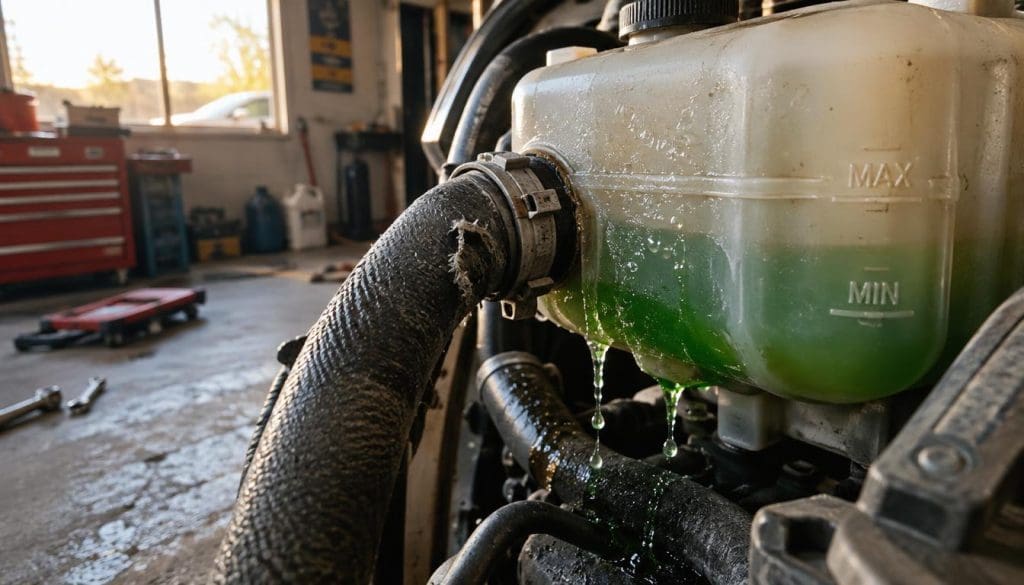
Low coolant is one of the common causes of overheating. Leaks from hoses, the radiator, or the water pump can lower the level as you drive.
A weak pressure cap can also keep the system from holding the pressure it needs. Without enough pressure, coolant may boil sooner, even when the reservoir looks full.
A car overheating with a full coolant reservoir may still have poor pressure, flow, or airflow. An internal leak can also send coolant where you cannot see it.
Restricted Flow and Poor Heat Rejection
The thermostat regulates coolant circulation between the engine and radiator. If it sticks closed, coolant may not reach the radiator as it should.
The water pump moves coolant through the engine and radiator. A failing pump, a damaged belt, or trapped air can interrupt that flow.
A failed cooling fan can reduce airflow when the vehicle is stopped. A clogged or damaged radiator may also struggle to release enough heat.
Ten plausible causes include low coolant, coolant leaks, a weak pressure cap, a failed fan, a blocked radiator, a stuck thermostat, a failing water pump, a damaged belt, trapped air, and a head-gasket or cracked-head problem.
A suspected head-gasket or cracked-head fault needs prompt diagnosis. Continued driving can turn an overheating issue into major engine damage.
Repeatedly topping off coolant without finding why the level falls can leave the underlying fault unresolved.
What the Overheating Pattern Tells You
The speed and timing of an overheat help narrow the first checks more than the temperature reading alone. A car overheating only when parked or crawling in traffic needs both low-speed and high-speed fan stages checked.
The pattern can point a technician toward a first diagnostic focus, but it cannot prove which part has failed. Note when the temperature rises and whether your speed changes the problem.
| When it overheats | What the pattern can suggest | First diagnostic focus |
|---|---|---|
| Idling or slow traffic | Weak low-speed airflow | Check both fan stages |
| Highway speed | Fan or fan-clutch airflow fault | Inspect fan operation and airflow |
| Soon after a cold start | Rapid temperature rise | Arrange prompt diagnosis |
At highway speed, moving air may make up for weak low-speed airflow. A fan or fan-clutch fault can still affect cooling, so road speed does not rule it out.
Rapid overheating soon after a cold start also deserves prompt diagnosis. The timing may help a technician narrow the checks, but it does not identify a failed part by itself.
Keep a brief record of the conditions around each temperature rise. Note traffic speed, whether the vehicle was parked, and how long the engine had been running.
A rising reading that changes with speed gives useful diagnostic clues. Share those details rather than guessing at a replacement part.
Record whether the problem improves or worsens with speed and how soon it begins after a cold start.
Tests That Pinpoint the Failure
After a low system has been topped off and bled, a pressure test is the most important next diagnostic step. Testing before and after a repair shows whether the cooling system holds pressure.
A technician compares the tester reading with the vehicle’s specification. Each vehicle has its own limit, so one pressure cap value does not fit every car.
Pressure-Test the Cooling System
Cooling-system pressure commonly ranges from 5 to 15 psi. Each psi raises coolant’s boiling point by about 3°, though the correct cap pressure depends on the vehicle.
If the system cannot hold pressure, coolant can boil in the cylinder head and next to the cylinder walls. A leak or weak seal may cause the pressure loss.
The system should be topped off and bled before this test. If the tester needs excessive pumping to build pressure, trapped air may be present.
Testing after the repair checks whether the system now holds pressure. This step can help confirm the repair rather than relying on a normal gauge reading alone.
Check for Combustion Leaks When Indicated
When a failed head gasket or cracked head is suspected, a technician should perform a block test after the pressure test. This test checks for combustion gases in the cooling system.
A positive result can point to an internal engine leak. The test helps separate that concern from a coolant leak outside the engine.
Pressure readings and test results guide the repair choice. Replacing parts without checking the system can miss the reason coolant pressure or flow failed.
Confirm that the repaired system holds pressure before treating the overheating fault as resolved.
Prevent Another Overheating Episode and Know When to Drive
A gauge that falls back to normal after cooling does not establish that the vehicle is ready for a regular trip. Do not resume a normal drive if the warning returns, steam continues, or coolant is leaking.
To help prevent your car from overheating in summer, find coolant loss and worn parts before a hot-weather trip. A normal reading or fresh top-off does not prove that the underlying fault is fixed.
Use this short checklist for routine checks:
- Check coolant levels in the reservoir monthly, with the engine cold.
- Use the coolant and replacement interval named by your vehicle maker.
- Inspect hoses for visible damage or leaks.
- Keep debris out of the radiator’s airflow path.
- Check engine oil as directed in the owner’s manual.
Coolant replacement intervals commonly range from 30,000-60,000 miles. Follow your vehicle maker’s schedule, since the right interval depends on the car and coolant type.
These checks can help you spot a change before summer heat raises the demand on the cooling system. They do not replace diagnosis when the temperature has already spiked.
If the temperature rises again after a brief restart, shut the engine off and arrange a tow rather than continuing to drive.
Conclusion
If the temperature warning returns, the safest next step is a professional diagnosis before normal driving resumes. Stopping promptly can limit further engine damage, but a reading that returns to normal is not a diagnosis.
Heaven Automotive can inspect your cooling system and find the fault behind the warning. The shop is at 6645 Poss Rd. San Antonio, TX 78238. Call (210) 682-3898 to arrange service.
Hire Heaven Automotive to fix your vehicle.