


A loud, sudden roar from your car can be the first sign that someone has cut out part of its exhaust, making catalytic converter theft prevention a practical concern. The damage can leave you with a noisy vehicle, a repair bill, and a disruption to your day. No single measure guarantees protection, but layered habits and a physical deterrent can make your vehicle less appealing to thieves.
VIN etching means marking a vehicle’s identification number on a part so it can be identified. The VIN is the vehicle’s unique 17-character identification number. Adding it to the part can help connect it to your vehicle if someone finds it later. Prevention is about making theft harder, not making a promise that it cannot happen.
Start with steps that suit your vehicle and where you park it. A physical barrier can make removal harder, while clear identification may help investigators recognize the part. Your car’s height and the space beneath it also matter when you choose a device. A few targeted precautions can make your vehicle a harder target without promising it is theft-proof.
Key Takeaways
- No device or habit can guarantee that a vehicle will avoid theft.
- A fitted physical barrier can make access and removal harder.
- Parking choices can reduce how easily someone reaches the underside.
- Marking the part can help identify it if it is recovered.
- Check your policy to learn whether theft of vehicle parts is covered.
Why Are Some Vehicles More Attractive to Thieves?
Thieves seek catalytic converters for their precious metals, not for the emissions-control work the part performs. Platinum, palladium, and rhodium can be sold to scrap buyers, which gives the part value beyond its use in your car. Access and resale value make some vehicles more appealing, but no vehicle is guaranteed safe.
Reported insurance claims rose from 16,660 in 2020 to 64,701 in 2022, a fourfold increase. Those figures describe a past national rise, not a current San Antonio theft rate. Your own risk depends in part on the vehicle’s design and the place where it sits.
Why Thieves Want the Precious Metals
Catalytic converters reduce harmful exhaust emissions by treating gases before they leave the vehicle. Their platinum, palladium, and rhodium can attract thieves seeking quick sales to scrap buyers. People steal catalytic converters for the metals, not because the part is easy to use in another car.
Which Vehicles Thieves Target
Trucks and SUVs with higher ground clearance give thieves more room to reach the exhaust. Hybrids can draw interest because their converters may contain more precious metals. The Toyota Prius has two converters, which may make its exhaust system an added target.
Ford F-150s, Ford Expeditions, and Ford Transit vans were identified as targets in 2026. Their ground clearance, wide use, and fleet presence can give thieves access to several similar vehicles in one place. A fleet parked together may offer more than one chance during a single visit.
Which Cars Are Less Likely to Be Targeted?
Cars with lower ground clearance can be harder to reach beneath, which may reduce access. That does not make a low car immune, and no single model is a proven national leader for theft. The least likely car to have a converter stolen is not a dependable category you can choose by model name alone.
Vehicle height can shape exposure, but parking conditions matter too. A high vehicle in a secure place may face less access than one left in an open spot. Treat your vehicle’s height and parking exposure as risk factors, not as a prediction that theft will happen.
Which Catalytic Converter Theft Prevention Methods Should You Choose?
For most owners, a properly fitted physical shield or cable barrier is the most direct way to make removal harder. These barriers obstruct access around the converter, so a thief must spend more time cutting or removing the device. A barrier can slow theft, but it cannot make your vehicle theft-proof.
Shields, cages, steel plates, and cable-style locks suit different exhaust layouts. Test results show meaningful resistance from some products, not a guarantee against every tool or attack. A catalytic converter theft prevention kit’s cost depends on its design and how it fits your vehicle.
Shields and Cages Block Access
A shield or cage covers open space around the converter, placing metal between the part and cutting tools. A steel plate can serve the same purpose when it fits the chassis. These devices work by making a direct cut or quick removal harder, not impossible.
Cable Devices Add Cutting Resistance
Cable systems wrap around or attach near the converter and exhaust. In a Sawzall test, a Catstrap’s three hardened-steel layers showed only a tiny gouge after three minutes of cutting. Two people installed a Catstrap in five minutes.
A CatClamp’s braided steel cables stopped a Sawzall from cutting through one section after several minutes. The Cat-Rap’s cable-and-plate design resisted removal in a Sawzall test. These results show how devices can add time and effort during an attack.
| Device | Protection design | Sawzall test result | Fit consideration |
|---|---|---|---|
| Catstrap | Three hardened-steel layers | Tiny gouge after three minutes | Check clearance and mounting points |
| CatClamp | Braided steel cables | One section resisted cutting for several minutes | Can be difficult to fit in smaller vehicles |
| Cat-Rap | Cable-and-plate design | Resisted removal in a Sawzall test | Fit depends on chassis and exhaust layout |
Match the Device to Your Vehicle
The best catalytic converter theft prevention device is one that fits your vehicle’s chassis and exhaust layout. A CatClamp may be hard to install in a smaller car, while another system may not suit your mounting points. Ask a qualified installer to check fit before buying a kit.
To stop thieves from stealing your catalytic converter, pair a fitted barrier with separate parking and identification measures. A device must not touch moving parts or sit against hot components. Check that it fits your exhaust layout and does not interfere with moving or hot components before installation.
For a closer look at the Sawzall test results, compare the device design with your vehicle’s underside before choosing a style.
Where Should You Park, and How Can You Mark the Part?
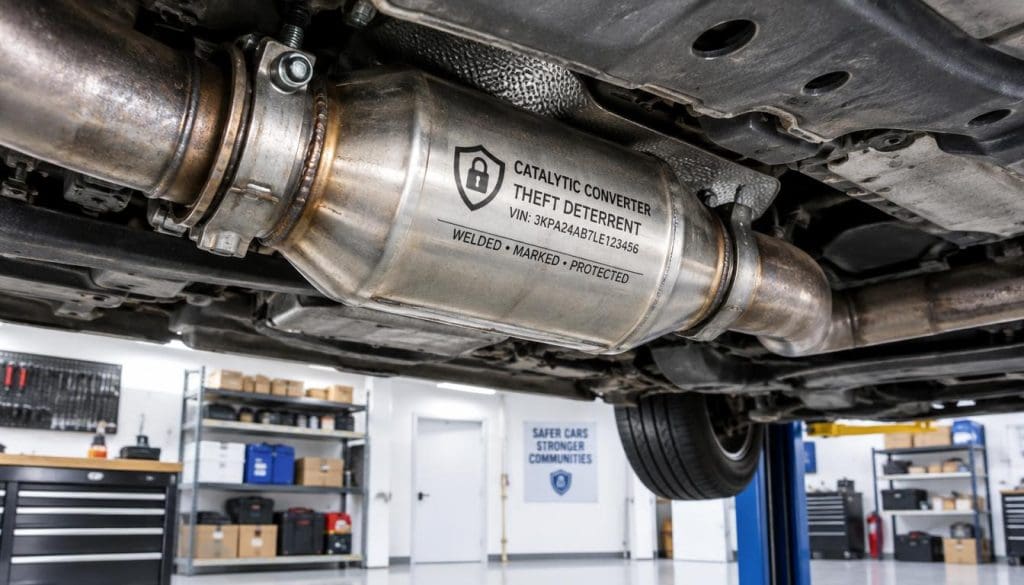
A locked garage is the best parking choice, while a well-lit spot near an entrance is a practical alternative when you park outside. Limit access beneath the vehicle as much as the space allows. A visible, hard-to-reach parking spot can add protection even without a device.
Choose a place where other people can see activity, and avoid leaving wide open access to the exhaust. Marking the converter with your VIN or license plate number can help identify the part later. Engraving or bright paint may alert a buyer or investigator that the part has an owner.
Choose Parking That Limits Access
When you park outside, an area near a building entrance can offer more activity and light. A motion-sensing light or camera may also make activity easier to see. A vibration-sensitive alarm can react to tool activity beneath the vehicle, including sawing.
Add Visible and Audible Deterrents
Use a method that remains clear after routine cleaning and exposure to road grime. Bright, high-temperature paint can make a marked part easier to notice. A license plate number can work if you do not want to write the full VIN on the metal.
- Park in a locked garage or a well-lit, busy area.
- Choose a spot that blocks access beneath the vehicle.
- Use motion-sensing lights or cameras where you park.
- Mark the converter with a VIN or plate number, and consider bright, high-temperature paint.
VIN etching uses the vehicle’s 17-character number as a link between the marked part and your car. Keep a record of the number and where you marked the exhaust. Make sure any paint used on the exhaust is designed to tolerate high temperatures.
How Can You Spot a Stolen Converter and Respond?
If the engine suddenly roars and the exhaust smells unusual, do not crawl under an unsupported vehicle to investigate. A missing catalytic converter can leave an open gap in the exhaust, making your car much louder. Stop and assess from a safe place before deciding whether the vehicle can move.
A loud roar that grows with acceleration is a key warning sign, but it does not prove theft by itself. Sputtering, exhaust fumes, or an unusual smell can also point to damage. An OBD-II check-engine light or a failed inspection may offer another clue.
A catalytic converter stolen from your vehicle can leave more than an exhaust gap. A thief may damage nearby lines or other underbody parts while cutting it out. Have the vehicle checked before driving, especially if parts hang loose or fumes enter the cabin.
A replacement catalytic converter can cost $1,500-$3,000. The final repair may also involve nearby damage, so a professional inspection helps identify what needs attention. Take these steps after a suspected theft:
- Report the theft to police and document the damage.
- Contact your insurer and check your policy.
- Avoid driving if the exhaust is unsafe, and arrange professional inspection and repair.
A sudden change in sound can be the first clue, but an inspection confirms the damage. Photograph visible damage and keep the police report and repair paperwork together for your claim.
What Should You Know About Insurance and Texas Law?
If you only carry liability coverage, theft of your own catalytic converter is generally not covered. Comprehensive coverage, also called other-than-collision coverage, generally covers converter theft. Your deductible and policy terms affect whether a claim pays and how much you receive.
Collision coverage applies to damage from a crash, not theft of your car’s parts. Check the declarations page, which lists your coverage and deductibles, and confirm details with your insurer. Do not assume a policy covers the part just because you have car insurance.
| Policy type | Converter theft generally covered | Coverage distinction |
|---|---|---|
| Comprehensive | Yes | Other-than-collision losses, subject to terms |
| Liability-only | No | Covers liability, not theft of your own parts |
| Collision-only | No | Covers crash damage, not theft |
Texas passed the Deputy Darren Almendarez Act in 2023. The law made theft of property valued below $30,000 a state jail felony, with a possible sentence of up to two years. It also created an offense for unauthorized possession of a catalytic converter.
The Act set record-retention rules for related sales, purchases, and repairs. These rules address how businesses handle converters, while criminal cases depend on the facts and the law. This summary is general information, not legal advice. Review your declarations page and ask your insurer whether comprehensive coverage and your deductible fit your needs.
Read the Texas law’s felony threshold as a general rule, not as a substitute for legal advice about a specific case.
Conclusion
A fitted physical deterrent and careful parking can make your vehicle a less convenient target. Use layers that suit your car, and check whether your insurance includes comprehensive coverage. The right steps can reduce risk without promising that theft will never happen.
If the exhaust is damaged or your vehicle needs a professional check, choose a local repair shop that can inspect the work. Hire Heaven Automotive to fix your vehicle at 6645 Poss Rd. San Antonio, TX 78238, or call (210) 682-3898.