

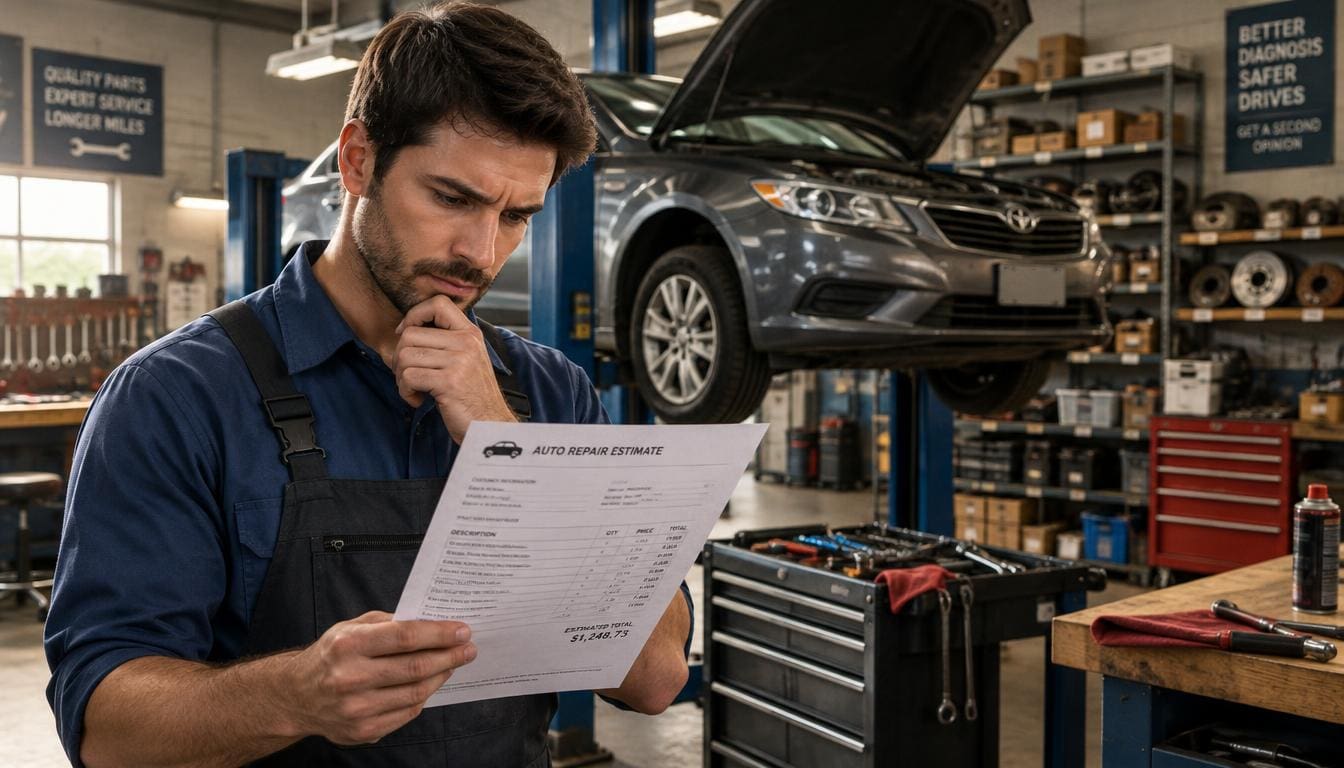
A second assessment is worth considering when the diagnosis is unclear, the estimate surprises you, or you feel rushed to approve work. A diagnostic fee is a shop’s charge for the time spent identifying a vehicle problem before repair work is approved.
Asking another mechanic to inspect your vehicle is a practical step, not an accusation against the first shop. A fresh assessment can help you understand the proposed work and decide whether it fits your concern, your vehicle, and your budget. It can also help you feel more certain before spending money on a major repair.
You do not have to approve work while you still have questions. You can pause before approving a major job and ask for the evidence behind it.
Key Takeaways
- Ask for another assessment when the diagnosis is unclear.
- Take a surprising estimate seriously, but do not assume it is wrong.
- Pause if you feel pressure to approve work without clear proof.
- Keep safety concerns in mind while you seek more information.
- Ask the mechanic to explain the evidence for the recommended repair.
When Is a Second Opinion Car Repair Worth It?
A second quote is particularly worthwhile when the proposed repair exceeds $2,000, especially for transmission work. Use $2,000 as a prompt to pause, not a rule that you must follow.
Getting second opinion advice can help when a repair could cost thousands or when the diagnosis does not fit what you notice. A credible safety concern still needs prompt attention.
Large or Unfamiliar Repairs
A major repair can affect your budget for years, so checking the diagnosis may be sensible. Transmission work is one example, since the repair can involve many parts and labor hours.
Luxury vehicles and electric vehicles can cost 50 to 100 percent more to repair than mainstream vehicles in 2026. That gap makes an unfamiliar repair harder to judge from a number alone.
The threshold is not a reason to delay every costly job. A smaller repair may also need a second opinion if the explanation seems unclear or the recommended work feels too broad.
Unclear Diagnoses and Pressure to Approve
Pause when a shop cannot explain how its diagnosis connects to the problem you reported. A mechanic should be able to describe what failed and why the proposed repair addresses it.
An urgent recommendation without clear proof also merits verification. Ask what could happen if you wait, and whether the vehicle can be driven safely in the meantime.
Getting a second opinion does not mean that the first mechanic acted improperly. It gives you another view of the issue before you commit to repair work.
If the shop says the vehicle is unsafe, ask for the specific evidence and take the safety concern seriously while you verify it.
What Should You Bring to a Second Shop?
Start by asking the first shop for its diagnosis and estimate in writing, rather than relying on a verbal summary. Written details help the next mechanic see what was checked and what work was proposed.
A clear written estimate itemizes labor hours and rates, each part and its price, and separate fees. Photos or videos in a digital vehicle inspection (DVI) can show the issue the first shop observed.
Get the First Shop’s Findings in Writing
Ask for the written diagnosis, the itemized written estimate, and any inspection notes. If the shop used a scan tool, ask for the trouble codes it found.
Some shops provide a digital vehicle inspection with photos or video. Those images can show a leak, worn part, or other visible concern, giving the second mechanic a useful starting point.
| What to bring | What it contains | How it helps |
|---|---|---|
| Itemized written estimate | Labor hours, rates, parts, prices, fees | Shows the proposed work and charges |
| First shop’s written diagnosis | Findings and recommended repair | Explains the first mechanic’s conclusion |
| Photos or inspection video | Images of observed vehicle issues | Shows what the first shop saw |
| Trouble codes and symptom notes | Codes, sounds, feelings, timing | Adds context for diagnosis |
| Vehicle service history | Past repairs and maintenance | Shows what has changed over time |
Record Symptoms and Service History
Write down when the problem began and what you hear, see, or feel. Note if it happens while starting, braking, turning, or driving at a certain speed.
Trouble codes can guide an inspection, but a code alone does not prove which part has failed. Tell the second mechanic about recent repairs and regular maintenance, too.
Technicians can use that history to spot links between an older repair and the current issue. Keep your notes factual, rather than guessing at the cause.
A clear symptom timeline gives the second mechanic useful context without telling them what conclusion to reach.
What Will a Second Opinion Cost, and How Do Repair Estimates Compare?
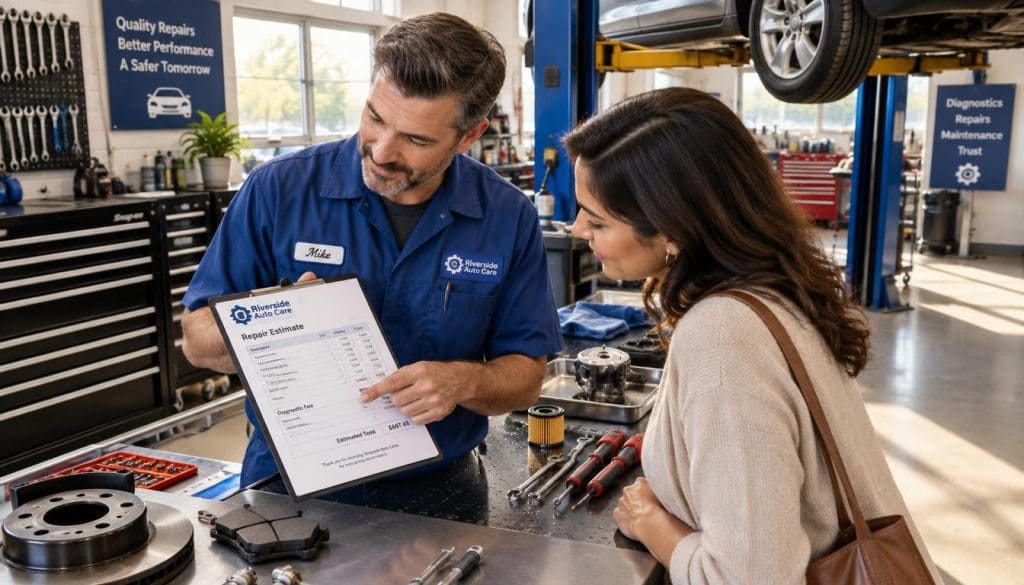
A diagnostic fee is separate from the repair bill, and shops may charge it, credit it toward approved work, or waive it when you approve the repair. In 2026, independent-shop fees are typically $80 to $150; dealer fees are $150 to $200 or more.
Ask about the fee policy before booking. A shop may charge the fee separately, apply it to approved work, or waive it after you approve the repair.
Budget for Diagnosis and Shop Labor
Average U.S. auto-repair labor is $132 per hour in 2026. Independent shops typically charge $110 to $150 per hour, while dealers charge $150 to $200 or more.
A mobile mechanic typically charges $80 to $120 per hour. A mobile mechanic near you may be convenient for an accessible assessment, but confirm they can inspect that system and ask the diagnostic fee before booking.
Mainstream-vehicle transmission replacement or rebuild work at an independent shop typically costs $2,000 to $6,000 in 2026. A transmission unit can cost $1,800 to $3,500 used, $2,300 to $4,500 rebuilt, $2,800 to $5,500 remanufactured, or $3,800 to $8,000 new.
Compare the Work, Parts, and Fees
The repair price depends on the vehicle and the job’s scope. These 2026 ranges cover common work on mainstream vehicles at independent shops.
| Repair | Typical 2026 independent-shop cost | Vehicle and scope |
|---|---|---|
| Front brake pads and rotors | $250 to $600 per axle | Mainstream vehicle, one axle |
| Alternator replacement | $450 to $1,000 | Mainstream vehicle |
| Radiator replacement | $450 to $1,100 | Mainstream vehicle |
| Water-pump replacement | $400 to $1,200 | Mainstream vehicle |
| AC compressor replacement | $800 to $2,000 | Mainstream vehicle |
A starter estimate can also shift with vehicle access. In 2026, a Ford F-150 estimate ranges from $413 to $488, while a Honda Accord estimate ranges from $680 to $965; access work can affect labor.
Small parts priced below about $50 often carry a markup of 100 percent or more. Parts over $300 typically carry a 10 to 20 percent markup, and a markup alone does not prove overcharging.
Compare the labor hours, parts, and separate fees line by line instead of judging a quote by its total alone.
How Can You Choose a Shop for an Independent Assessment?
Choose the second shop for relevant diagnostic ability and clear communication, not simply because its first number is lower. A good fit is a shop that can assess your specific vehicle and explain its findings.
Online estimate advice can help screen a quote, but it cannot replace a hands-on diagnosis. Check the shop’s experience with your repair and the inspection method it plans to use.
Check Credentials and Communication
Use these checks when you review a shop’s service and approach:
- Relevant experience with the repair you need.
- Verifiable ASE certification in the needed repair category.
- Clear written explanations, with visual evidence when available.
- A written warranty policy to review before approving work.
ASE certification involves tests in specific repair categories. Confirm that the mechanic’s certification matches the type of work your vehicle needs.
Reading second opinion car repair reviews means more than checking a star rating. Read critical comments and notice whether the shop responds with clear, respectful details.
Second opinion car repair complaints can point to repeated concerns, but one review may not tell the whole story. Look for specific facts about communication, delays, or work quality.
Match the Inspection to the Problem
An auto repair shop near you should still have the right experience and tools for the issue. A shop that handles routine service may not inspect every complex system.
Ask how the mechanic plans to assess the vehicle and what findings they will explain in writing. Their answer can help you judge whether the inspection fits your concern.
Reviews can help you screen a shop, while online advice can help you frame questions about an estimate. Neither can examine the vehicle in person.
Before booking, confirm that the shop handles your vehicle type and the specific problem you need assessed.
What Should You Do When Two Mechanics Disagree?
Treat disagreement as a reason to gather better evidence, not as proof that either mechanic is dishonest. Agreement on the diagnosis can build confidence, but you still need to compare the work and price.
A lower quote deserves a close look at its parts, labor, and included work. If the diagnoses differ, ask both mechanics for written evidence and consider a third assessment.
Compare the Evidence and Safety Advice
Ask both mechanics these questions before choosing a repair:
- What evidence supports each diagnosis?
- Is the vehicle safe to drive?
- Which work is urgent, and what risk comes with waiting?
- What additional test would distinguish the two explanations?
Look for a clear link between the reported issue, the inspection results, and the repair. If one mechanic suggests a test, ask how its result would change the repair plan.
Decide Whether to Repair, Wait, or Get More Help
To decide if a car is worth repairing, weigh the bill against the vehicle’s value, likely near-term repairs, and how long you plan to keep it. A repair can make sense when it keeps a dependable vehicle on the road longer.
In 2026, an engine replacement on a mainstream vehicle typically costs $3,468. Other major jobs can include infotainment replacement at $2,452, an air-conditioning overhaul at $1,156, and ABS-module replacement at $818.
Other repair costs include intake-manifold work at $790, fuel-tank replacement at $721, and power-steering-rack replacement at $714 for mainstream vehicles in 2026. These figures can help frame a decision, but the written estimate must match the actual work.
If you have no money for car repairs, ask about payment options and check any applicable warranty or insurance coverage. Before taking on financing, discuss which safety-critical work needs attention first.
If the evidence still does not resolve a safety-related diagnosis, get another qualified assessment before driving or authorizing major work.
Conclusion
You can make a more confident repair decision when you understand the diagnosis, evidence, and proposed work. Take time to read the written estimate and choose a repair plan that fits your vehicle and budget.
A second opinion can help you decide what to do when the repair plan is unclear. Ask the mechanic to explain any point you still do not understand before you approve the work.
Contact Heaven Automotive at 6645 Poss Rd. San Antonio, TX 78238 or call (210) 682-3898 to hire Heaven Automotive to fix your vehicle.