

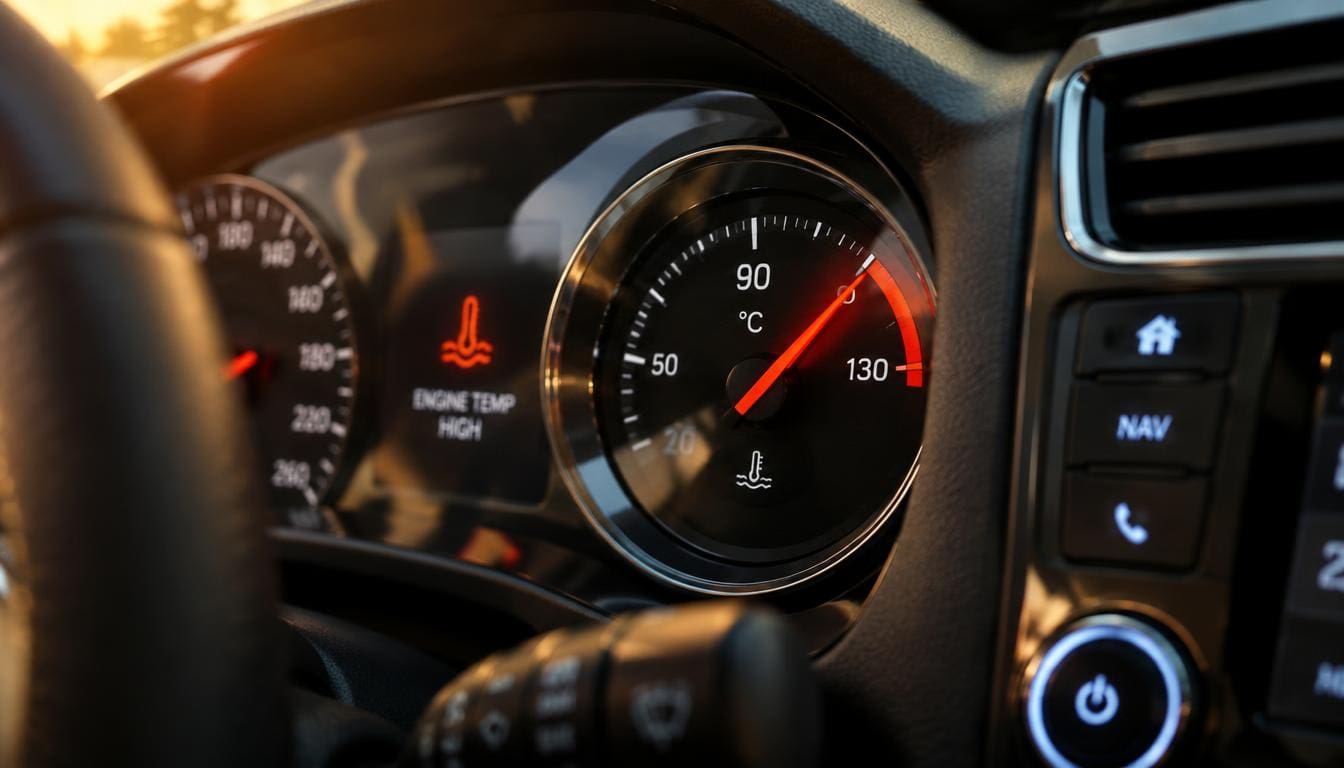
Your car’s temperature, sounds, and coolant level can all change when coolant stops circulating properly. Coolant circulation is the movement of coolant through the engine and cooling system to carry away heat. When the pump falters, the engine may overheat, leak coolant, or make unusual noises.
Other warning signs include steam or a sweet odor, weak cabin heat, and repeated coolant loss. These symptoms can point to a failing pump, but they do not prove the cause without an inspection. A rising temperature or visible coolant loss deserves prompt attention, even if the car still runs.
Key Takeaways
- Watch for a rising temperature or warning light.
- Check for coolant leaks near the front of the car.
- Notice new whining, grinding, or rumbling noises.
- Steam, a sweet smell, and weak cabin heat can signal trouble.
- Repeated coolant loss needs an inspection, even without overheating.
What Does an Overheating Engine Tell You?
A temperature gauge that climbs unusually high can mean the engine is no longer shedding heat effectively. Reduced coolant flow from a failing pump can cause engine overheating and may lead to serious damage.
If the temperature light comes on or the gauge spikes too high, shut the engine down as soon as it is safe. A warning can point to a pump problem, but other cooling system faults can cause the same reading.
Take these three actions when the temperature rises:
- Pull over somewhere safe.
- Shut the engine down once you are safely stopped.
- Wait for the engine to cool before arranging an inspection.
Do not keep driving with a temperature warning. An overheating engine can harm the head gasket or cylinder head, turning a cooling issue into a costly repair.
Never open a hot cooling system. Pressure can force boiling coolant out and cause severe burns.
A normal temperature reading later does not explain why the gauge climbed. Tell the repair shop when the warning appeared and how high the gauge went.
Do not restart an engine that is still showing an overheating warning.
Signs of Water Pump Failure: What Do Leaks Reveal?
A coolant puddle near the front of your car is a useful clue, but it does not identify the leaking part by itself. Location and residue can help narrow down the source.
Coolant puddles may look green, orange, or pink, depending on the coolant. A leak can come from a hose, radiator, gasket, or water pump, so check the area rather than guessing from color alone.
Coolant Puddles Near the Front of the Car
A puddle beneath the front end is one of the visual signs of a bad water pump, especially when it appears below the pump area. Still, the fluid may have run from another part, so a puddle alone cannot confirm the source.
Use a flashlight to look for wet surfaces around visible hoses and the pump. Keep your hands clear of moving parts, and do not inspect near a hot engine.
| What you see | What it can indicate | What to check |
|---|---|---|
| Colored coolant puddle near the front | Coolant leak from a nearby part | Hoses, radiator, and pump area |
| White or orange residue at the weep hole | Coolant escaping past the pump seal | Water-pump weep hole |
| Steady drip from that hole | Water-pump seal failure | Pump replacement |
Residue or Drips at the Water-Pump Weep Hole
A seal leak may leave coolant or white or orange crystallized residue at the water-pump weep hole. The small opening releases coolant if a pump seal leaks, helping keep coolant away from the bearing.
A steady drip from the hole means the pump should be replaced. Do not plug the weep hole, since trapped coolant can reach and damage the pump bearing.
Leave the weep hole open so escaping coolant cannot be trapped against the pump bearing.
What Do Water-Pump Noises Sound Like?
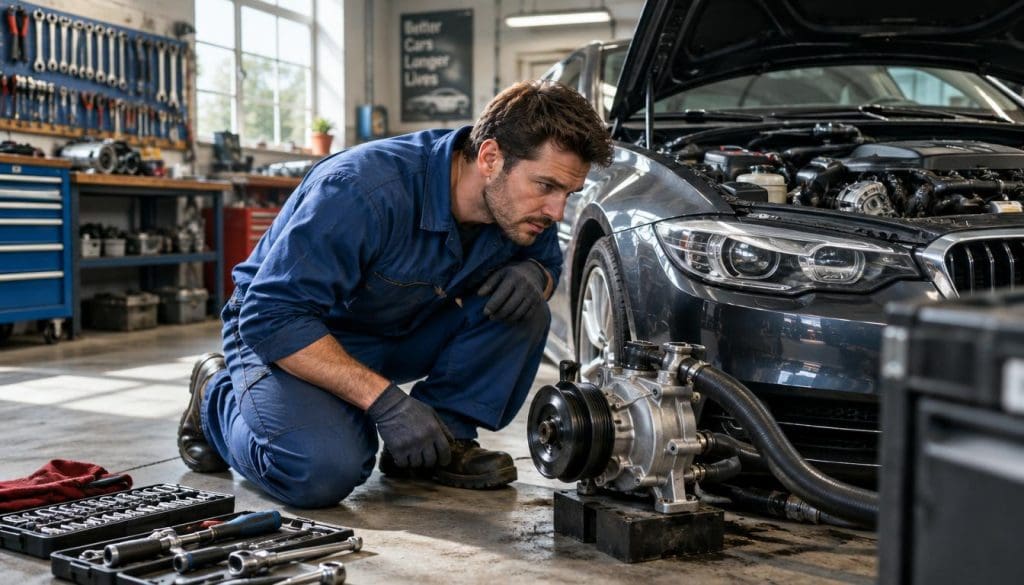
A whine or grind that rises with engine speed is more concerning when it comes from the pump housing. Bearing wear can create a growl, grinding sound, or rumble that changes as the engine speeds up.
A noise that grows louder during acceleration can point to a failing water pump bearing. Belt or pulley faults can make similar engine-bay noises, so an inspection should confirm the source.
Whining or Grinding That Changes With Engine Speed
A worn bearing may whine at idle, then grind or rumble more clearly as engine speed rises. If you hear a bad water pump sound when accelerating, note when it starts and whether it changes with engine speed.
Do not lean into the engine bay to locate a sound while the engine runs. A belt and pulley can move quickly, and sound can travel across the engine compartment.
Noise alone does not prove the pump has failed. A belt that slips or a pulley that wears unevenly can also make a whine or squeal.
Checking Pulley Play With the Engine Off
You can check for bearing wear by gently rocking the water-pump pulley side to side. The engine must be off and cool before you touch the pulley.
Any detectable side-to-side movement is abnormal and can reveal bearing wear. Some vehicles make the pulley hard to reach, so do not remove parts just to perform this check.
If the pulley feels loose, ask a technician to confirm the source before replacing parts. Check pulley movement only with the engine off and fully cool.
Can Steam, a Sweet Coolant Odor, or Weak Cabin Heat Signal Pump Trouble?
Steam under the hood or a sweet coolant smell after a drive can signal that coolant is escaping or overheating. Either clue deserves attention, especially when it appears with another cooling system symptom.
Steam can form when overheated coolant boils and escapes. Poor circulation from pump trouble can contribute to overheating, though a leak elsewhere can also release coolant.
A sweet smell after driving can come from leaking coolant. The odor may linger around the car or enter the cabin, but smell alone does not identify the leak’s location.
If steam appears, stop safely instead of continuing to drive. Steam means hot fluid may be escaping, and the engine may not be cooling as it should.
Weak cabin heat can also occur when coolant is not circulating properly. The heater core uses engine heat to warm cabin air, so poor coolant flow may leave the vents blowing cool or only slightly warm air.
A heater problem can have other causes, including a thermostat issue or low coolant. Look at the whole pattern, not one symptom in isolation.
Weak cabin heat alongside another cooling-system symptom makes a pump inspection more important.
What Does Frequent Coolant Loss Mean Without a Visible Leak?
Repeatedly adding coolant is a warning sign even if your temperature gauge has not climbed. Coolant loss can come first, before a failing pump causes the engine to overheat.
Frequent top-offs with no obvious hose leak warrant a pump check. A radiator, hose, or heater-core leak can cause similar coolant loss, even when the leak is hard to spot.
A small leak may leave little fluid on the ground, especially if coolant reaches a hot surface and dries. Look for changes in the coolant level over time rather than relying on one check.
A bad water pump can cause symptoms without overheating, so a steady temperature gauge does not rule out a fault. Mechanical pump trouble may also occur with no check-engine light; a normal dashboard is not proof that the pump is healthy.
The check-engine light tracks certain engine faults, but not every mechanical part has a sensor. A pump can leak or wear without turning that light on.
Keep a record of the coolant level and each top-off. Track how often you need to top off coolant and arrange an inspection if the level keeps falling.
How Can You Check the Pump and Plan a Replacement?
You can look for leaks and test the cooling system without removing the pump, but the engine must be completely cool before a pressure test. A careful check can help separate a pump leak from another cooling-system fault.
Use only the pressure listed for your vehicle. A pressure tester can help locate leaks, but the test does not confirm every cause of overheating or noise.
How to Test a Water Pump Without Removing It
To test a water pump without removing it, start with an engine-off visual check for leaks or residue. Then perform a pressure test only when the engine is completely cool.
Remove the radiator cap and fit the tester with an adapter made for your vehicle. A typical modern-car test uses 13 to 16 psi, but pressurize only to your vehicle’s specified level.
Inspect the pump and other visible parts for leaks after pressurizing the system. A leak may show at a hose, radiator, or pump, helping you narrow down the source.
How to Tell Whether the Thermostat or Water Pump Is Bad
To tell whether your thermostat or water pump is bad, compare the symptoms and inspect for pump-specific clues. A thermostat stuck closed can also cause overheating.
A pump leak or bearing noise points more directly toward the pump than overheating alone. Symptoms can overlap, so a mechanic may need to inspect the cooling system before choosing a repair.
Five Common Causes of Water-Pump Failure
Five common causes of water pump failure are seal failure, bearing wear, a worn or slipping drive belt, corrosion or contaminated coolant, and cavitation from air bubbles in the coolant.
- Seal failure
- Bearing wear
- A worn or slipping drive belt
- Corrosion or contaminated coolant
- Cavitation from air bubbles in the coolant
A mechanical pump may run from an accessory belt, timing belt, or timing chain. An electric pump runs from an electric motor, so its drive system differs.
Replacement Cost, Timing, and Tools
A water-pump replacement typically costs $300 to $800, with vehicle complexity and location affecting the total. Parts cost depends on pump type.
| Pump type | How it is driven | Typical parts cost |
|---|---|---|
| Mechanical accessory-belt-driven pump | Accessory belt | $50-$250 |
| Mechanical timing-belt- or timing-chain-driven pump | Timing belt or chain | $50-$250 |
| Electric-motor-driven pump | Electric motor | $300-$800 |
External, belt-driven replacement work often takes 2 to 4 hours. Timing-belt-driven pump work typically takes 4 to 8 hours.
Depending on the vehicle, replacing a water pump may call for a pulley puller, torque wrench, or special hose-clamp pliers. Timing-belt-driven pump repairs can involve more access work.
When the pump uses the timing belt, replacing the belt, tensioner, and idler pulleys at the same time can avoid repeating access labor. Flush and refill the system with properly mixed coolant, following the vehicle’s maintenance requirements.
Check your vehicle’s service information for its specified pressure and torque requirements before any repair work.
Conclusion
Do not ignore a temperature warning, recurring coolant loss, or a new pump noise. Early inspection can help stop continued overheating and limit added engine damage.
A confirmed pump fault usually calls for timely repair, since poor cooling can put the head gasket and cylinder head at risk. A technician can inspect the pump and check for other cooling system issues before replacing parts.
For local repair help, contact Heaven Automotive in San Antonio. The team can inspect your vehicle and handle the needed repair.
Contact Heaven Automotive at (210) 682-3898 or visit 6645 Poss Rd. San Antonio, TX 78238 to hire the team to fix your vehicle.