

We at Heaven Automotive help drivers spot early signs that a vital component in modern vehicles is struggling.
Most modern vehicles use tank-mounted electric pumps since the mid-1980s. Their job is simple but critical: deliver steady fuel flow and pressure so the engine starts, accelerates, and runs smoothly.
When the unit can’t meet pressure specs, owners often need a fuel pump replacement to restore reliability. We see real-world complaints like hard starting, hesitation under load, and unexpected stalling. These symptoms usually trace back to not getting enough fuel to the engine.
Diagnosis matters. Filters, wiring faults, or contaminated fuel can mimic a failing unit, so we test before we recommend replacing parts. Our guide walks you from warning signs to confirmation tests and then to a practical overview of when to replace fuel pump components.
Safety and accuracy come first. If you lack tools or experience, we invite you to hire Heaven Automotive to inspect and fix your vehicle with confidence.
Key Takeaways
- Tank-mounted electric systems are common in most modern vehicles.
- Hard starts, hesitation, and stalling often point to insufficient fuel delivery.
- Proper diagnosis rules out filters, wiring, and contamination before parts are changed.
- We prioritize safety and accurate testing over quick fixes.
- Follow the guide: symptoms, confirmation, then a practical repair plan.
- Consider professional service if you lack testing tools or tank access.
Warning signs of a failing fuel pump in today’s vehicles
Early warning signs often show up as poor acceleration, repeated long cranks, or sudden stalling when you ask more from the engine.
Hard starts, hesitation, stumbling, and stalling under load
We see a pattern: idle may be fine, but the vehicle hesitates when you accelerate, climb, or tow. This under-load stumble means the delivery system cannot meet increased demand.
Low pressure symptoms that mimic a clogged filter
Loss of power, surging, and intermittent hesitation feel like a clogged filter. We never assume the unit is bad until we verify actual fuel pressure at the rail.
When the check engine light points to fuel systems issues
If the CEL is on, scanning OBDII codes can show low pressure or lean codes that point to either a filter restriction or a failing fuel pump.
- Long cranks = slow pressure build; repeated events are a red flag.
- Consistently running low fuel and bad fuel can speed wear on in-tank units.
- Next we will test rail pressure, key-on prime behavior, and basic electricals before we advise replacing parts.
| Symptom | Likely cause | Quick check |
|---|---|---|
| Stumble under load | Weak delivery under demand | Road test uphill |
| Hard starting | Slow pressure build | Key position prime listen |
| Surging/hesitation | Low pressure or clogged filter | Measure pressure at rail |
How we confirm the problem before replacing fuel pumps
We start with quick, noninvasive checks that separate simple electrical faults from delivery failures. This saves time and prevents needless teardown.
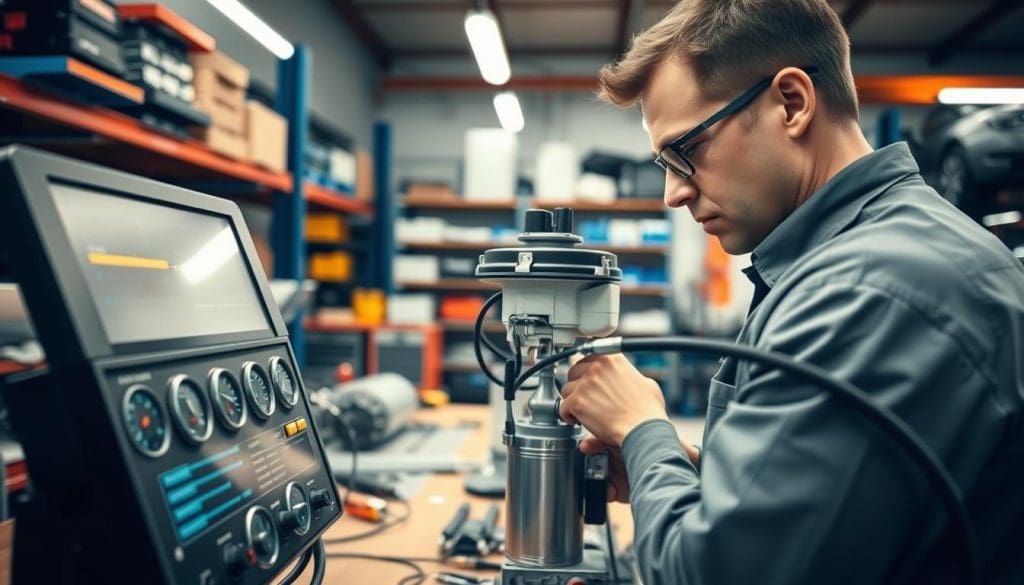
Listen at the filler opening with the key in ON
With the cap open, we listen for the prime hum for about two to three seconds when the key is in the ON key position. Silence here often points to an electrical feed issue rather than a mechanical failure.
Check fuse and relay before deeper testing
We inspect the fuse and relay early. A blown fuse replaced with the same amperage can restore operation without dropping the tank.
Verify rail pressure with an assistant turning the key
Using a rag at the fuel rail test port, we have an assistant turn the key to ON (not crank). The presence of pressured fluid tells us the delivery side is working.
Test power and ground at the pump
We use a digital meter to confirm power and ground at the module connector. If both are present and pressure is still low, the unit itself is likely faulty.
Watch for bad fuel and low fuel issues
Bad fuel and running on low fuel can overheat and wear the pump tank motor. Keeping tanks near full and avoiding contaminated gas helps extend system life.
Decision point: correct power and still low pressure means replacement is the reliable fix.
Fuel pump replacement: a practical how-to overview (access panel or drop the fuel tank)
We first check whether a service access panel exposes the sending unit; if not, we prepare to support and lower the tank safely. This decision determines tools, time, and risk for the job.
Safety first: relieve system pressure, disconnect the negative battery cable, work in a ventilated area, and keep a fire extinguisher and approved containers nearby. Wear safety glasses and gloves and eliminate ignition sources.
Prep and tank drop
Siphon or drain enough gas to reduce weight. Disconnect the filler hose, electrical connectors, and any ground straps before supporting the tank with a jack and a wide block of wood.
Remove straps or mounting bolts, lower the tank slowly, and avoid stretching lines or wiring. Take your time—rushed drops cause costly damage.
Swap, reassemble, and verify
Decide whether to change the full module or just the unit. Transfer the sending arm if needed, fit a new filter sock and O-ring, and confirm the new part matches the old one.
Reconnect lines and wiring, raise and strap the tank, add gas, prime the system, inspect for leaks, and road test to verify pressure and drivability. Finally, we replace the fuel filter to protect the new assembly and extend service life.
Conclusion
We base repair decisions on measured pressure, verified power, and road testing so fixes last and issues do not recur.
Our test steps—listen for the prime, check fuse and relay, verify rail pressure, and confirm power and ground at the connector—separate wiring or filter faults from a failing in-tank unit.
To extend service life, keep the tank above a quarter and avoid questionable gas sources. Properly matching parts, fitting the filter sock and seals, and checking for leaks after work are key.
If the unit has power and ground but still cannot maintain enough delivery or pressure, replacing the module is usually the correct fix.
Want it done right? Hire Heaven Automotive to diagnose, handle tank work safely, and get your vehicle reliable again.