


On a hot San Antonio drive, warm air from your vents can make a refrigerant top-off seem like the obvious fix. Summer traffic, bright sun, and a hot cabin can make a small cooling problem feel urgent. You need to know whether adding refrigerant will help or only delay a lasting fix.
A properly working car AC system is closed, so it should not use up refrigerant during normal driving. When the level drops, the system may have a leak or another fault that needs attention. A quick top-off can cool the cabin for a while, yet it cannot fix an escape point. Treat cooling that fades after a top-off as a reason to have the system checked, not as a reminder to add more.
Key Takeaways
- A working car AC system should not need routine refrigerant refills.
- A recharge restores refrigerant but does not seal a leak.
- Warm air alone cannot identify the cause of an AC problem.
- The vehicle label or manual identifies the correct refrigerant type.
- Repeated cooling loss calls for diagnosis before another top-off.
- A professional test can help separate a recharge need from a repair.
How Does AC Recharge vs AC Repair Change the Fix?
An AC recharge restores refrigerant, but an AC repair fixes the cause of the cooling problem. The difference matters because a lower refrigerant level can weaken cooling without explaining why the level fell.
A closed-loop system circulates refrigerant through the same parts rather than using it up during normal operation. A properly working car system should not need periodic refrigerant refills, and a need for more refrigerant usually points to a leak that needs diagnosis.
The air conditioning system moves heat through a cycle with four main parts. The compressor moves refrigerant, the condenser releases heat, the evaporator absorbs heat from the cabin, and an expansion device controls flow.
When refrigerant is low, the system may not move enough heat out of the cabin. A recharge returns the refrigerant to the amount set for that vehicle, but a low refrigerant level often signals a leak that still needs attention.
AC repair includes diagnosis and work that correct the reason cooling failed or refrigerant escaped. That work may involve fixing a leak, addressing a failed part, or correcting another fault found during testing.
The service choice depends on what the tests show. A system with a known refrigerant loss may need both a repair and a recharge, while a component fault may need repair without adding refrigerant.
A recharge by itself does not mend a leak or restore a failed compressor. If the system loses cooling again after a recharge, the underlying fault still needs attention.
Why Can Topping Off Refrigerant Fail?
A top-off can make the vents feel cooler for a while while a leak continues to drain refrigerant. Temporary relief does not tell you whether the amount is right or whether the source of the loss is fixed.
Adding refrigerant without testing may hide a leak for a short time. The cooling can improve, then fade again as refrigerant escapes through the same opening.
Too little or too much refrigerant can reduce cooling and stress system parts. The correct amount depends on the vehicle specification, not on a guess or a single pressure reading.
A low charge can limit heat transfer and change system pressures. An overfilled system can also work poorly because the refrigerant cannot move through the cycle as intended.
An untested top-off can make later diagnostics harder. A technician may need to sort out whether poor cooling comes from a leak, an incorrect charge, or another problem.
Adding refrigerant also leaves faults in other parts untouched. A compressor, electrical issue, or restricted component can still prevent cold air from reaching the cabin.
Even a clear improvement after a top-off does not prove that the repair is complete. A leak may be small enough to allow better cooling for a time before the refrigerant level falls again.
Repeated top-offs can turn a short-term change into a recurring expense without addressing the cause. Keep track of when cooling changes and whether it fades soon after service.
Do not treat short-lived cooling as confirmation that the system is fixed.
Which Refrigerant Does Your Car Use?
The correct refrigerant depends on your car’s AC system, not on which product is easiest to find. R-134a and R-1234yf need different service equipment and must not be mixed.
Check the vehicle label or manual to confirm the refrigerant before service. A wrong type can lead to poor service and an incompatible charge.
R-134a and R-1234yf Costs and Characteristics
In the March 2026 comparison, R-134a cost $5-$10 per pound at retail and $3-$6 wholesale. R-1234yf cost $40-$80 per pound at retail and $15-$30 wholesale.
| Refrigerant | Retail cost per pound | Wholesale cost per pound | Global warming potential |
|---|---|---|---|
| R-134a | $5-$10 | $3-$6 | 1,430 |
| R-1234yf | $40-$80 | $15-$30 | 4 |
The global warming potential values and listed prices are from the March 2026 comparison. R-1234yf was developed as a lower-global-warming-potential replacement for R-134a.
The refrigerants also differ in flammability. R-134a is classified as non-flammable, while R-1234yf is mildly flammable, with an A2L classification.
Their service-port fittings differ, so the matching service equipment matters. The oils differ too: R-134a systems use PAG 46, 100, or 150 oil, while R-1234yf systems use PAG 46 oil rated for R-1234yf.
How Vehicle Year Helps Identify the Refrigerant
Vehicle year offers a useful clue, but it does not confirm the refrigerant on its own. Most cars made before 2014 use R-134a, while most made after 2021 use R-1234yf.
Cars made from 2014 through 2020 may use either refrigerant, depending on the manufacturer. Automakers in the United States began moving to R-1234yf around 2014.
Use the label in the engine area or check the owner’s manual for the exact type. Do not choose by model year alone, especially for a car made during the transition years.
Confirm the refrigerant on the vehicle label before any service begins.
What Signs Mean Your Car AC Needs Diagnosis?
Warm air from the vents is a common clue, but it does not identify the failed part by itself. Several faults can cause similar changes in cooling or airflow.
Symptoms alone cannot confirm low refrigerant. Look for patterns and other clues, then use testing to find the actual cause.
Cooling and Airflow Symptoms
These signs can help you describe what the car is doing. Note when each change happens and whether it began after service.
- Warm air from the vents.
- Cooling that fades soon after a recharge.
- Oily residue near an AC part or hose.
- A noisy compressor during AC use.
- Weak airflow from the cabin vents.
- Cooling that changes between idle and highway speed.
Weak vent airflow can have causes beyond refrigerant level. A cabin air filter or a problem with the blower can limit the air that reaches you.
Clues That Point Beyond Low Refrigerant
On cars with a compressor clutch, either low or high refrigerant pressure can stop the clutch from engaging. The car may then blow warm air even though the fault is not simply a low charge.
An inoperative clutch can also point to an electrical fault, a switch problem, or trouble with the compressor or clutch itself. Each possibility calls for a different check.
Oily residue may be a clue that refrigerant or oil is escaping, but appearance alone does not locate the leak. A technician can use leak detection tools to check the system.
Cooling that changes with engine speed can also point to an airflow or component issue. A careful account of when the cooling changes can help narrow the diagnosis.
Arrange diagnosis when cooling fades quickly after service or when you spot oily residue.
How Much Does a Car AC Recharge Cost?
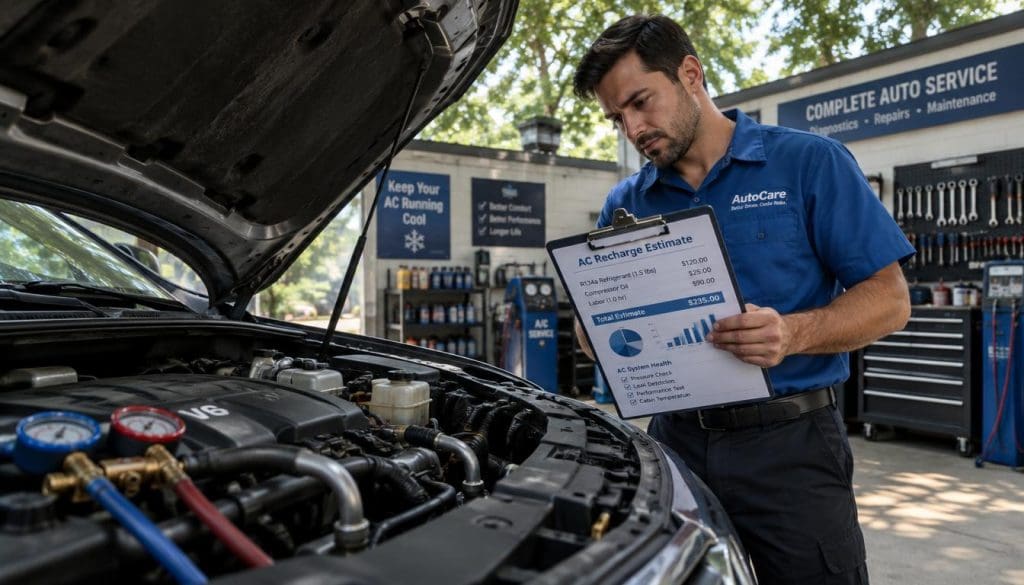
The listed 2026 shop recharge range is $150-$350 overall, with refrigerant-specific ranges that can be higher or lower. Your system type affects the estimate because R-1234yf service costs more in the listed ranges.
In 2026, an R-134a shop recharge is listed at $150-$250, while an R-1234yf shop recharge is $250-$450. The overall listing and the refrigerant-specific ranges describe different scopes.
| Service type | Listed 2026 price | Condition |
|---|---|---|
| Shop recharge | $150-$350 | Overall listing |
| R-134a shop recharge | $150-$250 | R-134a system |
| R-1234yf shop recharge | $250-$450 | R-1234yf system |
| DIY recharge kit | $40-$130 | Retail kit listing |
In the 2026 listings, a DIY recharge kit costs $40-$130. That price does not mean the kit will diagnose why cooling is weak or replace a needed repair.
A typical car using R-134a holds 1 to 1.5 pounds of refrigerant. That is an example, not a universal fill amount for every car or AC system.
The actual charge must match the vehicle specification. A shop may need to do additional diagnostic work or repairs if testing finds a leak or another fault.
Ask whether the estimate covers only a recharge or also includes testing and repair work. Those services solve different parts of the problem.
Use the vehicle’s specified refrigerant and charge amount, not a generic kit estimate, to evaluate the service.
Can DIY Recharge Kits Solve Low Refrigerant?
A kit may offer a quick pressure reading, but that reading is not a complete diagnosis. A gauge reading cannot prove that adding refrigerant is the right choice.
A DIY kit cannot confirm that a leak is repaired or that the system has the correct charge. A pressure reading alone does not reveal the cause of poor cooling.
What a Kit Can and Cannot Tell You
A DIY kit commonly combines a refrigerant can with a pressure gauge. The gauge may show a pressure value, but that value cannot establish the full condition of the system.
The reading cannot show by itself whether refrigerant escaped through a leak or whether a component has failed. It also cannot prove that the charge matches the maker’s specification.
Some cooling problems come from electrical faults, airflow limits, or a failing compressor. Adding refrigerant does not correct those issues.
Safer Choices Before Adding Refrigerant
Check the vehicle label or owner’s manual to learn the refrigerant type and specified charge. Do not assume that a pressure reading means adding refrigerant is appropriate.
When cooling is poor or a recharge has not lasted, arrange professional testing. Refrigerant handling belongs to someone with proper training and equipment.
A professional can check whether the system has a leak or another fault before choosing the service. That avoids using a kit as a substitute for diagnostics.
Do not add refrigerant unless the type and system condition have been confirmed.
What Happens During Professional AC Service?
Professional service starts by testing the system, not by assuming that low refrigerant is the only fault. Testing first helps show whether the car needs a recharge, a repair, or both.
A proper recharge recovers the refrigerant, removes moisture with a vacuum, and refills to the manufacturer’s specified amount. Finding and fixing the cause is separate work from adding refrigerant.
How a Technician Finds the Cause
A technician may use dye or specialized equipment for leak detection. The method depends on the system and the suspected location.
Pressure testing can help show whether the system holds pressure as expected. The technician may also check relevant parts, such as electrical connections, the compressor, and airflow components.
These methods are diagnostic options, not a fixed checklist for every car. The tests chosen should fit the fault and the vehicle’s system.
A confirmed leak calls for work on the leak’s source. If testing points to another issue, a recharge alone may not restore lasting cooling.
What a Proper Recharge Involves
Professional recharging includes recovering refrigerant already in the system. The technician then pulls a vacuum to remove moisture before refilling.
The system receives the amount set by the vehicle maker, rather than a guessed volume. Professional car AC recharging follows three core steps:
- Recover the refrigerant.
- Pull a vacuum to remove moisture.
- Refill to the manufacturer’s specification.
Those steps restore the refrigerant charge, but they do not repair a leak or a failed component. The diagnosis must guide any corrective work.
Ask what testing confirmed the cause and how the completed service will be checked.
Which AC Problems Need a Repair Instead of a Recharge?
A recharge cannot restore cooling when a failed component or electrical fault is the real cause. Corrective work must match the fault found during testing.
A leak needs its source addressed, while a compressor or electrical fault needs component-level work. The exact repair depends on what inspection confirms.
| Fault | Likely repair category | Why a recharge alone will not solve it |
|---|---|---|
| Refrigerant leak | Leak repair | The leak source still lets refrigerant escape |
| Failed compressor | Compressor repair or replacement | The system cannot move refrigerant as intended |
| Electrical fault | Electrical diagnosis and repair | The control or power issue remains |
| Condenser airflow or restricted component | Airflow or component repair | Heat transfer or refrigerant flow stays limited |
A refrigerant leak requires attention to the point where refrigerant escapes. Simply restoring the charge leaves that path open, so cooling may fade again.
A compressor fault can keep refrigerant from moving through the air conditioning system. An electrical issue may also stop the system from operating, even when the refrigerant level is correct.
Airflow problems need airflow-related repair. A broken cooling fan can reduce airflow through the cabin vents, and a failing condenser can leave those vents blowing warm, humid air.
A restricted component can limit refrigerant flow and reduce cooling. Testing helps separate that fault from a leak or a compressor problem.
These examples point to repair categories, not a promise that one part needs replacement. Match the repair to the fault confirmed by testing rather than replacing parts by guesswork.
How Can You Tell Whether the Repair Worked?
A successful repair should address the confirmed fault and restore dependable cooling at the vents. A useful check tests the repaired area and the affected parts, not just the cabin temperature.
Ask the technician to verify vent cooling and check the repaired leak area when relevant. The check should also confirm that the affected compressor or airflow part works.
A change in vent temperature can show whether cooling has returned, but it is not the only check. If the work involved a leak, ask whether the repair area was checked again.
Have the technician confirm operation of the compressor or airflow component tied to the diagnosis. That connects the final check to the fault that prompted the repair.
If warm air returns or refrigerant drops again, arrange another diagnostic check. Do not assume the system needs only a routine refill.
Keep the service findings so a repeat problem can be compared with the original diagnosis.
Conclusion
Choose diagnosis when cooling loss returns, because adding refrigerant again may only postpone finding the cause. An AC recharge restores refrigerant; an AC repair addresses the reason the system stopped cooling or lost refrigerant.
If your cabin keeps warming after service, arrange a check before another top-off. A clear diagnosis can help you choose work that fits the fault and avoid paying for the same temporary change again.
Hire Heaven Automotive to fix your vehicle in San Antonio. Contact Heaven Automotive to fix your vehicle at 6645 Poss Rd. San Antonio, TX 78238, or call (210) 682-3898.