

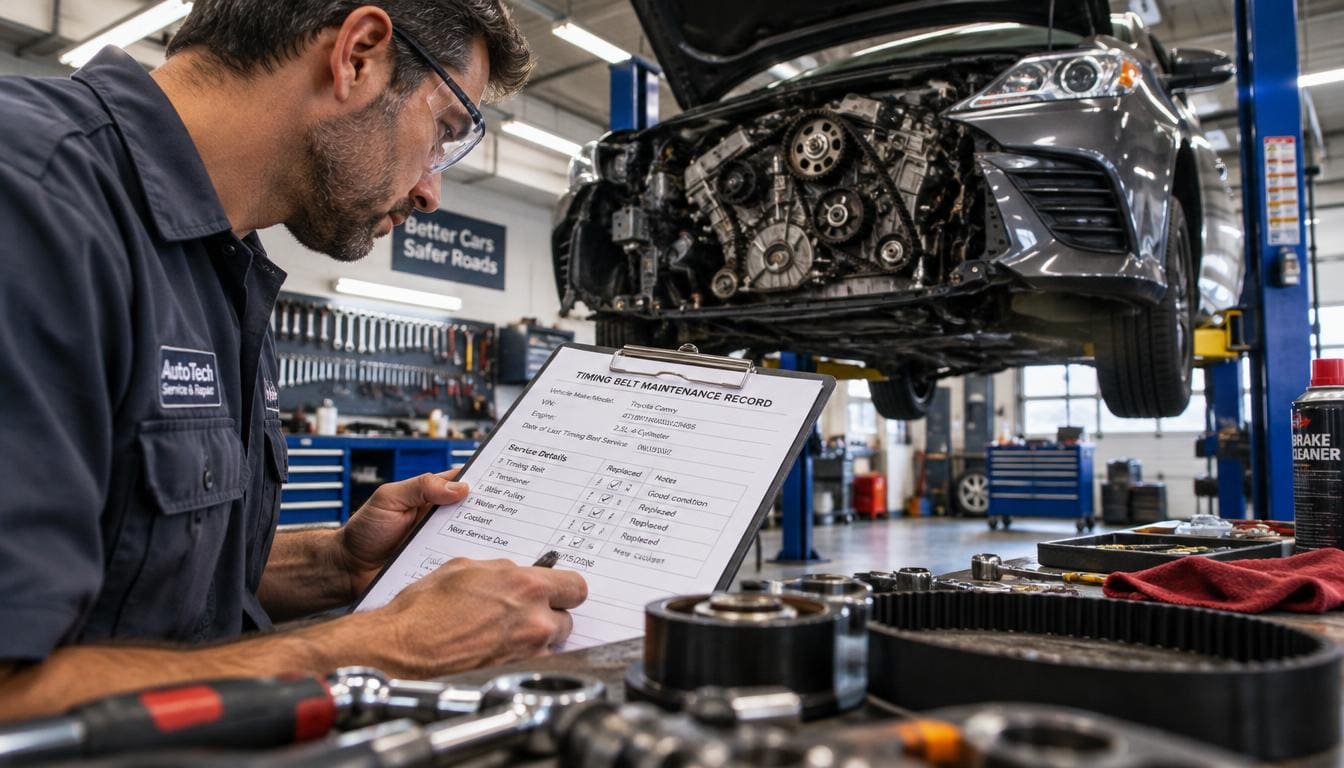
Your next timing service depends first on whether your engine uses a belt or a chain, then on the schedule for that exact engine. The right maintenance plan can help you avoid a breakdown and severe engine damage. A timing belt replacement interval is not the same for every car, and some vehicles do not use a belt at all.
Start by identifying your engine’s timing system and checking its service schedule. You can then decide whether your vehicle needs an inspection or planned service. Possible trouble signs matter, but they cannot replace the schedule or a clear record of past work.
Use the exact schedule for your engine, not a broad rule based only on the vehicle’s make. If a shop has serviced the car, an invoice may show whether the belt was replaced and when. That detail can help you plan maintenance before a missed service becomes an urgent repair.
Key Takeaways
- Find out whether your engine uses a timing belt or a timing chain.
- Follow the schedule for your exact engine, including its time limit.
- Do not rely on symptoms to predict how long a belt will last.
- Check your manual and repair invoices before scheduling service.
- Ask a mechanic to inspect the system if its service history is unclear.
Keep your owner’s manual and service history handy because they help confirm the right maintenance plan for your vehicle.
What Do the Timing Belt and Timing Chain Do?
The timing belt links the crankshaft and camshaft, keeping piston movement and valve operation in sync. That timing lets the engine draw in air and fuel, then release exhaust, in the right order. A broken or slipping belt can disrupt performance and stop the engine.
A toothed, fiber-reinforced rubber belt keeps the crankshaft and camshaft moving together. As the pistons rise and fall, the camshaft opens and closes the valves at set points. The belt’s teeth grip matching gears, so the parts stay aligned while the engine runs.
An interference engine is an engine in which pistons and valves occupy overlapping space at different points in the operating cycle. The parts avoid each other only because the timing system controls their movement. If the belt fails in this design, a piston can hit an open valve and cause severe damage.
A timing chain performs the same job with metal links rather than reinforced rubber. Chains run inside the engine and depend on proper lubrication, so regular oil changes help support their service life. A timing chain normally lasts 100,000-250,000 miles with good oil changes.
A timing belt usually has a scheduled replacement interval, while a chain usually has no set replacement date. A chain can still wear or need repair, so its lack of a routine replacement interval does not make it maintenance-free. Find out whether your particular engine has a belt or chain before applying a belt replacement schedule.
What Is the Timing Belt Replacement Interval for Your Car?
Many timing belts are due every 60,000-105,000 miles or 7-10 years, whichever comes first, but your engine’s manual sets the exact deadline. The time limit counts even when the car has low mileage. A vehicle that sits often can still reach its age limit before its odometer reaches the mileage limit.
Use the mileage or time limit that comes first. For example, reaching the manual’s year limit means service is due even if you drive only a few thousand miles each year. Reaching the mileage limit early also means you should not wait for the calendar deadline.
Check the owner manual for the exact engine, rather than relying on a generic chart for the car’s make. Manufacturers may set different schedules for engines sold in the same model. The manual may also list separate instructions for severe driving conditions.
If your manual gives the timing belt replacement interval in km, follow the kilometer value as printed. Keep the same whichever-comes-first rule for mileage and time. Do not convert the distance and then ignore the years listed alongside it.
The schedule is tied to the engine design and the manufacturer’s maintenance plan. A make-wide chart may leave out important differences between engine versions, so it should not replace the manual. Use the schedule that names your engine or exact vehicle configuration.
Check whether the manual lists a time limit as well as a distance. A mileage-only check can miss an older belt on a low-use vehicle. If the book has several schedules, use the one that matches your driving conditions.
When the manual is missing, a dealer or qualified mechanic can help identify the right schedule from the vehicle details. Keep any service invoice that names the part and date, since a note that says only “engine work” may not confirm belt replacement. If the belt’s age or replacement date is uncertain, treat the schedule as unverified until a qualified mechanic checks the vehicle’s records.
How Do Timing Belt Replacement Intervals Vary by Make and Model?
A timing belt replacement interval is engine-specific, so a Toyota or Chevy badge alone does not establish the due date. The engine code matters because one model name can cover several engine designs, and some versions use a chain instead.
Use the schedule for the exact engine fitted in your vehicle. Toyota timing belt replacement intervals depend on the particular model and engine. Some Toyota vehicles use a timing chain, so a Toyota owner should first confirm which system the vehicle has.
Toyota Timing Belt Schedules Depend on the Exact Engine
There is no single Toyota timing belt schedule that covers every model. A vehicle’s year and model help narrow the search, but the engine version is still important. Check the maintenance schedule for that engine before setting a service date.
A model sold with more than one engine may have different timing systems and maintenance rules. Do not assume a Toyota has a belt because another version of the same model does. The owner’s manual or a technician can help identify the installed engine.
Chevy, Honda, Acura, and Nissan Service Windows
Honda and Acura V6 timing belts are due at 105,000 miles or 7 years, whichever comes first. The same first interval applies to later replacement. Honda and Acura V6 schedules use 105,000 miles or 7 years as the limit.
| Vehicle and engine | First mileage interval | First time limit | Later replacement rule |
|---|---|---|---|
| Honda/Acura V6 | 105,000 miles | 7 years | Same interval |
| Nissan Qashqai 1.5-liter diesel | 90,000 miles | 96 months | 45,000 miles or 48 months |
| Chevrolet belt-equipped engines | 60,000-100,000 miles | Owner’s manual | Owner’s manual |
The Nissan Qashqai 1.5-liter diesel needs its first replacement at 90,000 miles or 96 months, whichever comes first. Later replacements are due every 45,000 miles or 48 months, whichever comes first. Those later time and distance limits apply each time the belt is replaced.
Chevrolet timing-belt service windows typically fall between 60,000 and 100,000 miles, based on engine design and operating conditions. The owner’s manual gives the exact interval and time rule. That range is not a schedule for every Chevy engine.
Match the manual’s schedule to the exact engine fitted in your vehicle, especially when a model was sold with more than one engine.
What Are the Warning Signs of a Failing Timing Belt?
Misfiring, unusual ticking, or rough idling can signal a timing problem, but none reliably tells you how much life the belt has left. Symptoms are clues, not a countdown to failure. A belt may also fail without giving you a clear warning first.
Arrange an inspection when your engine shows a new or repeated timing-related symptom. Slipping timing can disrupt the link between valve and piston movement. The engine may then run poorly or stop starting as it should.
Possible warning signs include these five changes in how your car runs or sounds:
- Misfiring or uneven engine firing.
- Ticking or slapping sounds from the engine area.
- Repeated stalling while the engine is running.
- Rough idling when the car is stopped.
- Difficulty starting the engine.
A technician may find cracks, fraying, looseness, or misalignment during an inspection. Some belts show wear on their surface, but the belt may sit behind timing covers or other engine parts. A driver may not be able to see it safely or fully.
A sound or change in performance can have more than one cause. A mechanic can inspect the belt and related parts instead of treating a noise as proof that the belt has failed. If the engine runs poorly, avoid guessing based on one symptom.
No symptoms do not prove that a belt is safe. A timing belt can fail without a reliable warning, so the service schedule and known replacement date matter more than a quiet engine. Do not wait for a dashboard light to make a decision.
If the engine starts behaving differently, arrange a prompt inspection rather than waiting for a warning light or a more obvious symptom.
What Can Make a Timing Belt Wear Out Faster?
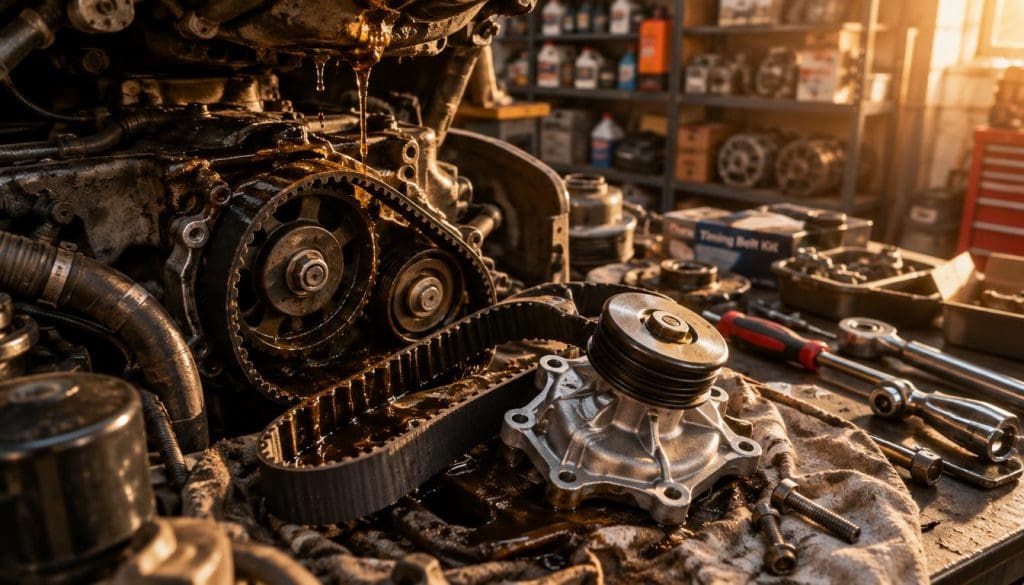
Stop-and-go driving, harsh temperatures, dust, and fluid leaks can make a belt’s operating conditions harder than a normal service schedule assumes. Daily use matters because engine heat, road debris, and driving patterns add stress over time.
Oil or coolant on a timing belt can weaken its rubber. Leaking seals or a failing water pump can put fluid on the belt, even if the belt itself has no visible damage. A leak deserves attention before the belt reaches its scheduled replacement date.
These four checks can help you spot conditions that may increase belt stress:
- Frequent short trips in heavy traffic.
- Regular exposure to very hot or cold weather.
- Frequent driving on dusty or gravel roads.
- Visible oil or coolant leaking near the engine.
Repeated stops and starts can put more stress on engine parts than steady driving. Extreme heat or cold also affects the conditions around the belt. Dust and gravel can add grime around parts that should stay clean.
Oil and coolant contamination can degrade rubber, which is why a fluid leak should not be ignored as a separate minor issue. The water pump, seals, and belt area all deserve attention when a leak appears. A replacement schedule assumes the belt is working under normal conditions, not sitting in fluid.
Driving on dusty roads does not prove the belt needs early replacement. It does give you a reason to mention those conditions during service, especially if the manual has a separate maintenance plan for severe use. A mechanic can assess the belt and the source of any contamination.
Ask a mechanic to trace any oil or coolant leak promptly so it does not continue contaminating the belt.
How Much Does Timing Belt Replacement Cost?
In 2026, a full timing-belt kit job at an independent shop typically costs $850-$1,400, while a simple four-cylinder belt-only job is $400-$750. The installed job costs much more than the belt itself because labor and access make up much of the bill.
Labor accounts for 65-85 percent of a timing-belt replacement bill in 2026. A belt alone sells for $26-$59 at AutoZone and O’Reilly, but that price does not cover installation or the other parts in a full service.
The Difference Between Belt-Only and Full-Kit Service
A belt-only estimate covers a narrower repair than a kit estimate. A full kit often includes the timing belt, water pump, tensioner, and idler pulleys. Comparing those totals without checking the parts list can make two different jobs look alike.
| Service type | Typical 2026 price | What the figure covers | Labor-rate context |
|---|---|---|---|
| Simple four-cylinder belt-only replacement | $400-$750 | Belt and installation | Rates vary by shop |
| Full kit at an independent shop | $850-$1,400 | Belt, water pump, tensioner, idler pulleys | Independent-shop rates |
| 2014-2019 Ford 1.0 EcoBoost Fiesta or Focus wet-belt replacement | $1,200-$2,000 | Wet-belt replacement | Rates vary by shop |
Parts prices and labor rates depend on the shop and the engine layout. The table gives typical 2026 prices, not a quote for every car. Ask whether the estimate includes the water pump and related timing parts.
Labor, Parts, and Why Access Matters
Independent-shop labor rates commonly run $120-$159 per hour in 2026. Dealership rates commonly run $170-$250 per hour. A tight engine bay or a layout that requires removing other components can add labor to the repair.
The timing belt may sit behind covers and parts that take time to remove. Engine design also affects how easily a technician can reach the belt. A simple four-cylinder job may cost less than work on an engine with restricted access.
How a Wet Belt Changes the Estimate
A wet belt runs inside the engine and is exposed to oil. Replacing one can take more work than replacing an ordinary timing belt. A wet-belt replacement on a 2014-2019 Ford 1.0 EcoBoost Fiesta or Focus typically costs $1,200-$2,000 in 2026.
Before approving work, compare the listed parts, labor, and any pump replacement. A quote should make clear whether the shop plans to replace the belt alone or a full kit. Compare estimates by the parts and labor each includes, not just by the quoted total.
What Does a Timing Belt Service Include, and How Long Does It Take?
A standard four-cylinder replacement can take 3-4 book hours, while a wet-belt job typically takes 7-9 labor hours. Engine layout changes the work because it affects how many parts a technician must move to reach the belt.
Technicians remove timing covers and other components to reach the belt. Once the area is open, they can check related parts and replace items that would otherwise be hard to reach later. The labor time is not always the same as the time your vehicle stays at the shop.
Standard Belt Replacement Jobs
A standard service includes access to the timing belt and its fit on the engine gears. The technician removes covers and other parts in the way, then installs and aligns the replacement belt. The exact steps depend on the vehicle’s engine design.
Many shops also replace the water pump, tensioner, and idler pulleys while the timing covers are already off. These parts work near the belt, and replacing them during the same service can avoid repeating some of the access work later.
On many belt-driven engines, the pump, tensioner, and idler parts add $200-$350. They usually add little labor when the timing covers are already off. Ask the shop to explain which of these components its quote includes.
Wet-Belt Service Jobs
A wet-belt service usually takes longer because the belt runs inside the engine and requires extra work to reach. Wet-belt jobs typically take 7-9 labor hours, compared with 3-5 labor hours for other timing-belt jobs. The figures describe labor time, not a promise about how long every repair takes.
| Job type | Typical labor time | Example |
|---|---|---|
| Easy four-cylinder | 3-4 book hours | Standard belt replacement |
| Transverse V6 or Subaru boxer | 5-6 book hours | Access takes more labor |
| Wet-belt job | 7-9 labor hours | Belt runs inside the engine |
Book hours are the shop’s set labor estimate for a repair. They do not always match the clock time from drop-off to pickup, since scheduling and parts availability can affect the visit. Ask when the shop expects your vehicle to be ready.
A full service plan should list the belt and any related parts being replaced. If the water pump is not included, ask whether the shop checked it while the area was accessible. Ask the shop to itemize the belt, pump, tensioner, and idler pulleys so you can see what its service plan covers.
What Happens If a Timing Belt Breaks While You’re Driving?
If the timing belt breaks while you are driving, the engine can stop immediately and steering or braking may take more effort. Stay focused on control and move out of traffic if you can do so safely.
In an interference engine, pistons can strike open valves after belt failure. That collision can cause major engine damage, and repairs for valve or engine damage can cost $2,500-$6,500. The exact outcome depends on the engine and what happens when timing is lost.
Without the engine running, power steering may stop assisting you. Braking can also take more effort, so keep a firm grip and press the brake as needed. If the vehicle still responds, steer toward a safe place away from moving traffic.
Once stopped, switch on your hazard lights so other drivers can see the vehicle. Stay out of traffic and arrange roadside assistance. Do not try to restart the engine, since a restart attempt may add stress after timing has failed.
Do not try to drive the vehicle to a repair shop, even if the engine starts again. A vehicle with a broken belt needs a professional check before anyone tries to run it. Once safely stopped, arrange a tow instead of attempting to drive the vehicle to a repair shop.
How Can You Check Your Belt’s History and Plan Service?
Check the owner’s manual and service history first, because those records can tell you which schedule applies and whether the belt was already replaced. A clear date matters when you are deciding whether service is due.
The owner’s manual gives the service schedule for your engine. The service history should show when a timing belt was last replaced. Together, they help you judge the next service date without relying on the vehicle’s age alone.
Review the Service History and Owner’s Manual
Look for a maintenance section in the manual and find the schedule that matches your engine. Then review repair invoices, service records, or receipts for a timing belt replacement. A record should show the work date clearly enough to compare it with the schedule.
An invoice may list the belt as part of a larger engine repair. Read the details instead of assuming that any engine work included the belt. If the records only say “maintenance” or “engine service,” ask the shop what work it performed.
Use this checklist to organize your next steps:
- Locate the maintenance schedule in the owner’s manual.
- Search repair invoices for the last timing belt replacement.
- Confirm the engine configuration using the VIN.
- Ask a mechanic to verify the schedule if records are incomplete.
An absent record does not confirm that the belt was replaced. It means you do not have proof of the service date. A mechanic can inspect the belt and advise whether replacement is needed when records do not establish its age.
Confirm the Belt and Engine With a Technician
A VIN can help identify the vehicle’s exact engine configuration. That detail matters when a model came with more than one engine, or when one version uses a chain instead of a belt. Share the VIN with a qualified mechanic if you are not sure which engine is installed.
A technician can confirm the timing system and match it to the correct schedule. The belt may be concealed, so a visual check may require removing covers or other parts. Ask what the inspection includes before approving any additional work.
If you have incomplete records, give the shop any dates and invoices you do have. A partial service history may still help narrow down prior work, but it cannot replace a confirmed replacement date. If the service date cannot be verified, ask a qualified mechanic to confirm the engine and recommend the next service step.
Conclusion
Protect your engine by confirming whether it uses a timing belt and checking the service date against the exact engine schedule. Your owner’s manual and verified service history are the best places to start. A qualified mechanic can help when the engine type or service date remains unclear.
Plan service before a belt fails, and keep the repair record with your vehicle documents. For local help, you can hire Heaven Automotive to fix your vehicle in San Antonio.
Hire Heaven Automotive to fix your vehicle at 6645 Poss Rd. San Antonio, TX 78238, or call (210) 682-3898.