


A new whine, shudder, or delay in acceleration can make an ordinary drive feel uncertain. CVT transmission problems can have several causes, and symptoms alone cannot confirm which part has failed.
In San Antonio, you can have a new transmission concern assessed before choosing a repair. A careful check can help separate a transmission fault from another vehicle problem, such as an engine or sensor issue.
A new change in how your vehicle sounds or responds deserves attention. Note when it happens, how long it lasts, and whether a warning light appears. That information can help a technician narrow down what to inspect.
A prompt diagnosis can help you understand whether the issue is limited or more serious.
Key Takeaways
- A new whine, shudder, or loss of acceleration calls for attention.
- One symptom can have more than one cause.
- A diagnostic scan and inspection help identify the fault.
- Use the fluid and service schedule specified for your vehicle.
- Ask what confirmed problem each recommended repair will address.
What Is a CVT Transmission?
A CVT changes its drive ratio without shifting through a set of fixed gears. CVT means continuously variable transmission, though “CVT transmission” is widely used in everyday conversation.
A CVT uses a steel belt or chain between two variable-width pulleys. One pulley connects to the engine, while the other transfers power toward the wheels. Together, these parts change how engine power reaches the road.
The transmission fluid designed for a CVT is called CVT fluid. It lubricates and cools the system, while helping it maintain the hydraulic pressure and friction the belt or chain and pulleys need.
In a conventional automatic transmission, fixed gears create set ratios. The transmission shifts among those ratios as speed or load changes. A CVT can vary its ratio through a continuous range instead.
That design does not mean every CVT operates in exactly the same way. Vehicles may use a belt or chain, and the correct fluid and service needs depend on the model.
The belt or chain and the two pulleys are the parts to keep in mind as you consider wear and repair.
How Does CVT Design Change the Way Your Car Feels?
A CVT can hold the engine at a steady RPM while the vehicle continues to gain speed. That feeling can be normal, even if you are used to an automatic transmission that shifts through gears.
The pulleys change their effective diameters to adjust the drive ratio. As the vehicle speeds up or slows down, the CVT can move through a continuous range rather than select one fixed gear ratio.
This shiftless design can make acceleration feel smooth. It can also keep engine speed in an efficient range for the current driving demand, rather than moving through a set sequence of gears.
During firm acceleration, the engine may hold one RPM as road speed rises. Some drivers find that sound or feel unfamiliar. It does not, by itself, show that the CVT has a fault.
Pay closer attention when the engine revs but the vehicle does not gain speed as expected. A new or pronounced mismatch between engine speed and vehicle speed needs attention, especially if it differs from your usual experience.
Acceleration can also feel different when you move from one vehicle to another. Engine size, vehicle weight, and the CVT’s control settings all affect how the system responds.
Judge a change against how your own vehicle usually accelerates, rather than assuming every unusual RPM pattern means failure.
What Are Common CVT Transmission Problems?
The most common CVT trouble involves fluid or pressure problems, wear in the belt-and-pulley assembly, or a control fault. Those groups can overlap, so one sign does not point to one failed part.
Low, contaminated, or incorrect fluid can contribute to transmission trouble. A fluid issue may affect lubrication or the pressure needed to operate the belt-and-pulley system.
Mechanical wear can affect the belt or chain, pulleys, and related internal parts. A damaged part may limit how well the transmission transfers power, though inspection is needed to confirm the source.
Other CVT problems involve hydraulic pressure, the control valve, or an electronic control module. These parts help manage the CVT’s operation, and a fault may cause the system to respond in an unexpected way.
That is why different transmission problems can feel alike while needing different repairs. A control fault, for example, can affect how the CVT behaves without proving that its belt or pulleys have failed.
A warning code or unusual driving change gives a technician a place to start. It does not settle the repair choice before the system has been checked.
A symptom points toward an area to inspect, but it does not identify the failed part by itself.
What Symptoms Point to a Failing CVT?
A CVT that is starting to fail may shudder, whine, or raise engine RPM without a matching increase in speed. A new change matters more than a driving trait your vehicle has always shown.
Watch for RPM changes, new vibration or noise, and dashboard warnings. Nissan CVT failure symptoms can include the same general signs, but a scan and inspection are needed to identify the fault.
RPM Surges and Changes in Acceleration
Engine RPM may rise without the vehicle gaining speed at the same rate. You may also feel hesitation when pulling away or notice surging during steady driving.
A short delay can have more than one cause. Note whether it happens from a stop, during a hill climb, or after the vehicle has warmed up.
Shuddering, Whining, and Grinding
A shudder during takeoff can feel like a brief shake through the seat or floor. A whine or drone that changes with road speed also deserves a check.
Grinding sounds can point to a serious mechanical concern. Do not assume that a new noise is normal just because the vehicle still moves.
Warning Lights, Fluid Clues, and Power Loss
A transmission-overheat warning calls for prompt attention. Darkened fluid or a burnt smell can also signal a problem, while a scan may show codes such as P0868 or a valve-body-related fault.
Nissan CVT transmission failure symptoms can include warning lights, slipping, or changes in acceleration. A code helps guide diagnosis, but it does not identify the failed part on its own.
| Observed sign | What you may notice | Why to get it checked |
|---|---|---|
| RPM surge | RPM rises without matching acceleration | Power transfer may be affected |
| Shudder or road-speed whine | Vibration or noise changes with speed | Inspection can find the source |
| Overheat warning or burnt-smelling fluid | Warning light, dark fluid, or burnt odor | Heat or fluid trouble needs attention |
Stop treating a new overheat warning or sudden loss of power as a normal driving quirk.
What Causes CVT Transmission Problems?
Heat, contaminated fluid, low fluid, and sudden loads can all add stress to a CVT’s belt-and-pulley system. Small issues can build when they go unchecked.
Old or low fluid can reduce lubrication and affect hydraulic pressure. A leak may lower the fluid level, while worn fluid may no longer protect parts as intended.
Fluid Breakdown and Leaks
CVT fluid works under heat and pressure. Over time, fluid can break down, and a leak can leave the transmission short of the amount it needs.
A leak may come from a seal, gasket, or another connection. A stain under the vehicle is a reason to arrange an inspection, even if the driving feel seems unchanged.
Heat from Load and Driving Conditions
Towing, steep mountain grades, and hot stop-and-go traffic can raise CVT fluid temperatures. These conditions ask the transmission to work harder, and added heat can contribute to wear.
Repeated heavy use can be more demanding than a brief trip under light load. Follow the vehicle maker’s towing limits and guidance for your model.
Incorrect Fluid and Shock Loads
CVTs need fluid made for their design. Incorrect fluid can change the friction or pressure the system needs, which may contribute to damage.
Hard shock loads can also place extra force on the belt-and-pulley system. Sudden jolts, abrupt changes in load, or hard impacts can raise stress on internal parts.
- Fluid degradation
- Heat from heavy use or driving conditions
- Leaks or low fluid
- Hard shock loads
A fluid leak deserves attention even if the vehicle still accelerates normally.
How Can You Diagnose a CVT Issue?
A proper diagnosis starts by recording exactly when the symptom appears, not by replacing a part based on one clue. Clear details help narrow the problem before a repair begins.
A scan, inspection, and road test can help separate CVT trouble from other causes. A diagnostic scan can check for stored OBD-II trouble codes, while a road test may help reproduce the concern.
Use this sequence to prepare for transmission repair:
- Note when the issue starts and what the vehicle is doing.
- Check whether a warning light appears on the dashboard.
- Scan the vehicle for stored OBD-II codes.
- Inspect the fluid and look for visible leaks.
- Road-test the vehicle when it is safe and appropriate.
A check-engine light or poor acceleration can come from a fault outside the transmission. An engine, sensor, or wiring issue may create a similar driving concern.
A trouble code gives a technician a useful lead, but it does not prove which part has failed. The code needs to be weighed with the vehicle’s history and inspection results.
Give the technician the vehicle’s make, model, year, mileage, and a clear description of what changed.
Which Repair Options Can Address a CVT Failure?
A CVT may need a limited repair or a full unit replacement, depending on what the inspection finds. The confirmed fault should guide the repair plan.
Fresh fluid cannot reverse worn pulleys or a damaged belt. Fluid service can address a fluid-related need, but it is not a fix for internal mechanical damage.
Fluid or Limited Component Repairs
Some repairs involve fluid service, gaskets, seals, or a limited part. A leak may call for a seal or gasket repair, followed by the correct fluid service for that vehicle.
Solenoids, which control fluid flow, may also need attention. The repair should match a confirmed fault rather than a guess based on one symptom.
Control Valve and Electronic Repairs
A control valve body directs hydraulic pressure through the transmission. A fault in this area can sometimes be addressed without replacing the complete unit.
An electronic issue may involve the transmission control module or its programming. A technician can use diagnostic results to decide whether a part, wiring repair, or software update fits the problem.
When Internal Damage Calls for a Replacement
Extensive damage to the belt-and-pulley system may call for replacing the CVT. A limited repair is not automatically the better choice when internal damage is widespread.
The condition of the case and internal parts can affect the repair plan. Ask whether the estimate covers the failed component alone or includes work needed to restore the full assembly.
Ask which confirmed fault each recommended part or service is meant to address.
How Much Does CVT Transmission Repair Cost?
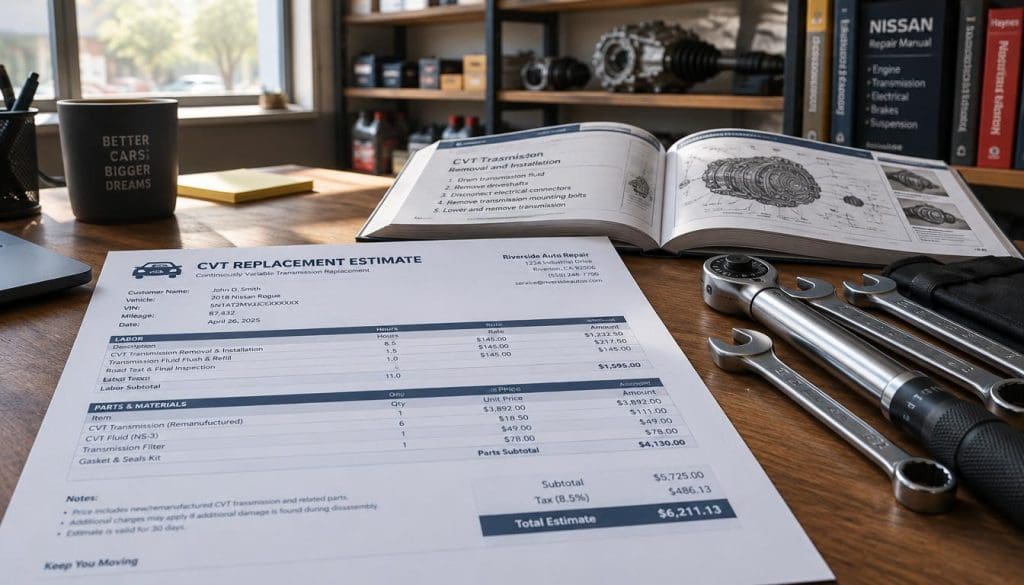
Minor CVT work is estimated at $300-$1,500, while a full replacement is typically $3,000-$5,000 in 2026. The repair type changes the bill, along with the vehicle and labor involved.
A replacement estimate includes a new or remanufactured unit and 8-12 hours of labor. The minor-repair range covers work such as solenoid service or fluid service.
| Repair type | Typical estimate | What it may include |
|---|---|---|
| Fluid service | $300-$1,500 minor-repair range | CVT fluid service |
| Solenoid work | $300-$1,500 minor-repair range | Solenoid service or replacement |
| CVT replacement | $3,000-$5,000 in 2026 | New or remanufactured unit and 8-12 labor hours |
These are typical estimates, not a quote for every vehicle. The make, model, parts choice, labor time, and shop rates can all affect the final amount.
A written estimate should name the repair, parts, and labor. It should also explain whether the price covers extra items needed to complete the work.
Ask whether the replacement unit is new or remanufactured. The estimate should also show the labor included, so you can compare similar repair scopes.
Compare written estimates by the diagnosed fault, parts, and labor included, not only by the total.
How Long Should a CVT Last?
A CVT typically lasts 100,000-150,000 miles, or about 7-12 years of average driving. That is a typical range, not a promise for every vehicle.
Service history and driving conditions affect how long a CVT lasts. Some units with consistent fluid service reach 150,000-200,000 miles or more, while neglected units often fail between 70,000 and 100,000 miles.
| CVT history | Typical mileage range | Context |
|---|---|---|
| Typical service life | 100,000-150,000 miles | About 7-12 years of average driving |
| Consistent fluid service | 150,000-200,000 miles or more | Some units reach this range |
| Neglected maintenance | 70,000-100,000 miles | Many neglected units fail within this range |
| Early-generation 2013-2017 CVTs | 80,000-120,000 miles | Typical range for this era |
Those ranges describe broad patterns, not a set end point. A particular CVT may fall above or below them based on its condition and use.
A vehicle’s mileage alone cannot tell you whether its CVT is healthy. A well-kept transmission with higher mileage may differ from one with a poor service record.
Vehicle condition, maintenance history, and driving conditions affect where a particular CVT falls within these ranges. Use mileage as context for an inspection, not as a substitute for checking the actual transmission.
How Should You Maintain CVT Fluid?
Use the exact fluid specification and service schedule for your vehicle rather than assuming every CVT takes the same fluid. The right fluid matters because CVT designs have specific needs.
A general fluid-service interval is 30,000-60,000 miles, but your model’s schedule takes priority. Check the owner’s manual or the manufacturer’s service guidance for the required interval.
Honda CVTs, for example, specify Honda HCF-2 fluid. That model-specific requirement is not a general recommendation for other brands or vehicles.
Universal automatic-transmission fluid is not a safe substitute for CVT fluid. Using the wrong fluid can cause damage, even if the container says it fits many vehicles.
Use this short maintenance checklist:
- Confirm the exact fluid specification for your vehicle.
- Follow the specified service interval for your model.
- Have leaks or concerns about fluid condition checked.
Fluid service needs can differ by model, year, and driving use. A shop should follow the vehicle’s listed specification, rather than choosing a fluid based only on the transmission type.
Verify the fluid name in the owner’s manual before approving a service.
Which Nissan CVT Models Have Extended Warranty Coverage?
Several Nissan model groups received CVT coverage extensions to 84 months or 84,000 miles, whichever came first. Model-year matches alone do not guarantee eligibility.
The extension for listed models began May 23, 2023, and is not a safety recall or campaign. The terms depend on the vehicle and its individual coverage status.
| Nissan model | Model years | Extended limit | Coverage detail |
|---|---|---|---|
| Altima | 2017-2018 | 84 months or 84,000 miles | CVT assembly and internal parts, gaskets and seals, control valve body, torque converter, cooler kit if applicable, and module reprogramming |
| Sentra, Versa Sedan, Versa Note | 2018-2019 | 84 months or 84,000 miles | CVT assembly and internal parts, gaskets and seals, control valve body, torque converter, cooler kit if applicable, and module reprogramming |
| Rogue, Rogue Select | Rogue: 2014-2018; Rogue Select: 2015 | 84 months or 84,000 miles | CVT coverage extension |
| Pathfinder | 2015-2018 | 84 months or 84,000 miles | CVT coverage extension |
For the Altima, Sentra, and Versa groups, coverage includes the listed CVT assembly parts, gaskets and seals, control valve body, and torque converter. It can include a cooler kit when applicable and transmission control module reprogramming.
Rogue and Pathfinder models also had their CVT coverage extended to 84 months or 84,000 miles. Their specific terms may differ from the other model groups.
Ask a Nissan dealer to check the VIN, purchase date, mileage, and applicable terms. Have a Nissan dealer verify your VIN and current eligibility before authorizing paid work.
Which Vehicle CVT Models Have a Troubled Record?
CVT reliability depends on the specific model, year, design, and maintenance history, not just the badge. Model details matter more than a broad claim about a whole brand.
Early Nissan Jatco CVTs from 2013-2017 have a documented mixed reliability record. That concern does not mean every Nissan CVT, or every vehicle from another maker, will fail.
Nissan CVT Failure Symptoms by Model
Early Jatco units in 2013-2017 Altima, Sentra, Rogue, and Versa models were associated with class-action settlements and warranty extensions. These vehicles are worth checking by model year and history.
Some earlier Rogue models had a separate heat-related issue. Nissan issued a low-power fail-safe bulletin for 2011-2013 Rogue and 2014-2015 Rogue Select models without a tow package, with a cooler-kit fix.
Post-2019 Nissan CVT units are improved, but regular fluid service still matters. A past record should guide your questions, not replace an inspection of a specific vehicle.
Honda CVT Updates and Coverage
For 2015-2016 Accord and CR-V CVTs, a software update addressed a pressure issue that could cause belt slip and RPM surges. The update applied to those model years, not every Honda CVT.
Honda extended coverage for belt deterioration in 2016-2020 HR-V models to 7 years or 150,000 miles. That coverage applies to the listed concern and years.
What to Check on Toyota and Ford Models
Toyota CVT transmission problems and Ford CVT transmission problems should be judged by the exact vehicle and transmission, not the brand name alone. Look up the model year and identify the transmission fitted to that vehicle.
“Which car has the worst transmission problems?” has no single supported answer across all CVTs. A useful comparison needs matching details, such as model year, transmission design, service record, and reported fault.
Check the exact model year and transmission type before applying a brand-level reputation to a vehicle.
What Should You Do If Your CVT Enters Limp Mode?
A sudden reduction in power can mean the CVT has entered a protective fail-safe mode. That response is a warning, not proof that the problem has corrected itself.
If a transmission-overheat warning appears or the vehicle cannot maintain speed, pull over safely. A CVT fail-safe can reduce vehicle speed when fluid temperature becomes too high.
Some earlier Nissan Rogue models had a heat-related low-power fail-safe. The system may limit power to protect the transmission, but the cause still needs attention.
Do not force the vehicle to keep going when its speed is too low for traffic. Continuing to drive under an active warning can leave you in an unsafe spot or add stress to the transmission.
Once stopped in a safe place, arrange professional diagnosis. Avoid trying to clear the warning by repeatedly restarting or pushing the vehicle harder.
If the vehicle cannot keep up safely with traffic, stop driving when you can do so safely and arrange help.
Can a CVT Be Repaired or Must It Be Replaced?
A CVT can sometimes be repaired, but extensive internal damage may make replacement the more practical choice. The failed parts decide which path makes sense.
A limited fault may need only a targeted repair, while widespread belt or pulley damage can call for replacement. The case and other internal parts also affect that choice.
When a Limited Repair May Be Enough
A limited repair may suit a confirmed problem with a seal, solenoid, control valve, or electronic part. This can leave the larger belt-and-pulley assembly in service if inspection finds it sound.
The word “repair” can cover very different work. Ask whether the proposed job fixes the failed component or includes other work needed to address the full cause.
When Internal Damage Favors Replacement
Extensive damage to the belt, pulleys, or transmission case may favor a replacement unit. Many shops replace a failed CVT rather than rebuild it because few shops rebuild the belt-and-pulley assembly.
That does not mean a rebuild is never possible. It means you should confirm what the shop can do and whether the proposed repair covers the damaged internal parts.
Use this short decision list when comparing options:
- Confirm which component has failed.
- Compare the repair scope with the replacement scope.
- Ask which parts and labor each estimate includes.
Base the decision on the diagnosis and written scope of work, not on the word “repair” or “replacement” alone.
What Happens During a CVT Diagnostic Visit?
A clear account of the symptom and the vehicle’s history helps a shop begin with useful context. Your notes can save time by showing when the concern started and how it changes.
Bring the vehicle details, mileage, warning information, and service records you have. A shop can use those details to understand the concern before discussing repair options.
Prepare these details for the visit:
- Make, model, and year
- Current mileage
- When the symptom began and the conditions when it appears
- Warning lights or stored codes, if known
- Available CVT fluid-service records
Include details such as whether the concern began after a long drive or appears only at certain speeds. A clear timeline can help the technician reproduce the issue when conditions allow.
Heaven Automotive is located at 6645 Poss Rd. San Antonio, TX 78238. You can call to discuss a CVT diagnosis or repair for your vehicle.
Call Heaven Automotive at (210) 682-3898 or visit 6645 Poss Rd. San Antonio, TX 78238 to discuss your vehicle.
Conclusion
Take a new CVT warning seriously, but let a diagnosis determine the repair. A change from your vehicle’s usual behavior deserves a closer look.
Use the fluid specification and service schedule for your model to support long-term care. Then base repair choices on the confirmed fault and the work each estimate includes.
For help with a CVT concern in San Antonio, contact Heaven Automotive. Hire Heaven Automotive to fix your vehicle and get help with the next step.