

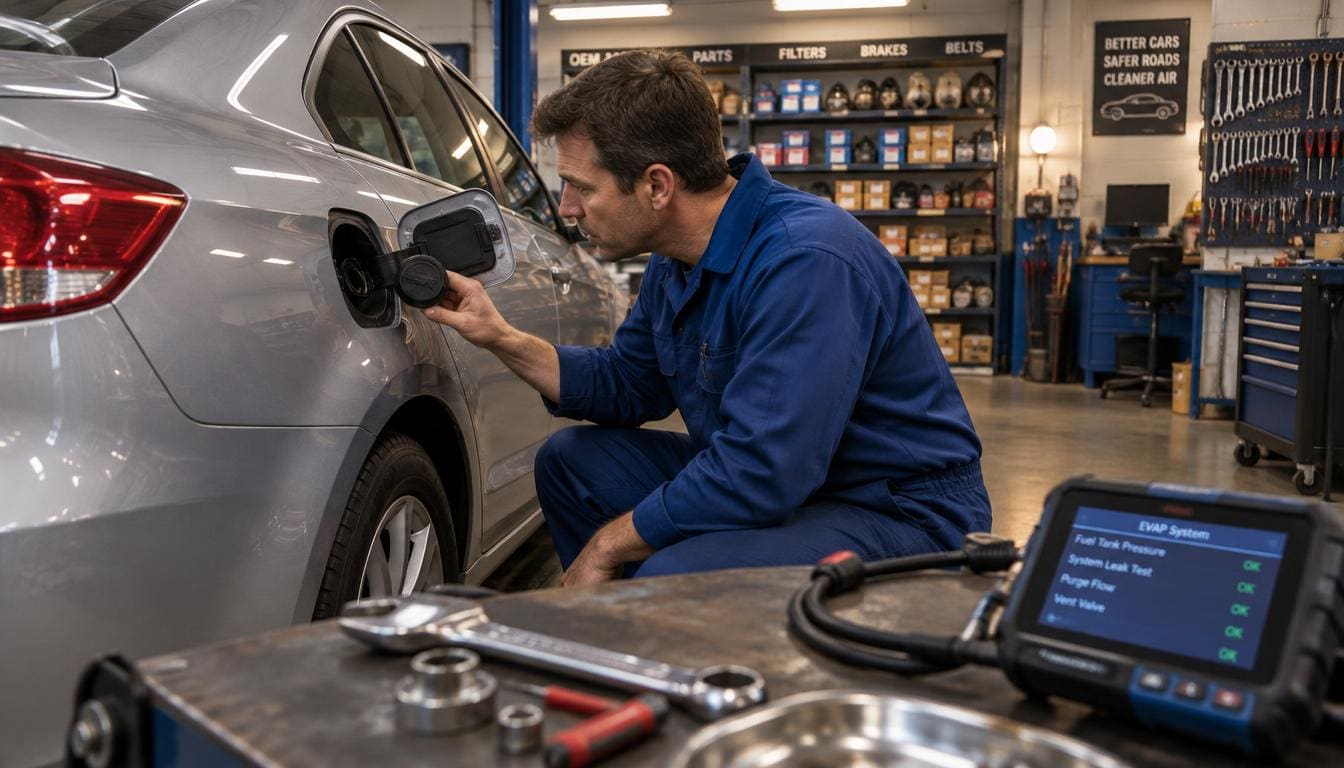
An EVAP fault means fuel vapor may be escaping instead of being contained and routed back to the engine. An evaporative emission control system is closed, trapping fuel vapor in a charcoal canister and routing it to the engine. The engine burns that vapor with fuel. An EVAP system leak can let vapor escape before it reaches the engine. The check-engine light may be your first clue. A loose gas cap is one possible cause, but hoses, valves, the canister, or the fuel tank can also be involved. A code alone cannot tell you which part failed. The right fix starts with finding the leak, not guessing at a replacement part. This guide helps you understand the code and choose a safe next step. A trouble code is a starting point for diagnosis, not proof that the gas cap is the failed part.
Key Takeaways
- An EVAP code points to a fault, not always a failed gas cap.
- Fuel-vapor odors deserve prompt attention.
- Visible hose checks can help, but hidden leaks need proper tests.
- A confirmed diagnosis can prevent needless part replacement.
- After repair, the vehicle must rerun its EVAP monitor.
What Do EVAP Trouble Codes Mean?
The code narrows the type of EVAP fault, but it does not identify the failed part by itself. Read it as a clue, not a repair order. In a P04xx code, P identifies the powertrain computer, 0 marks a generic code, and 4 points to the EVAP system.
The last two digits identify the particular fault, not the component that caused it. P0455 points to a gross or large leak, generally linked to an opening larger than about 0.080 inch. P0456 points to a very small leak, while P0457 is linked to a loose or missing fuel cap.
| Code | Meaning | Practical clue |
|---|---|---|
| P0455 | Gross or large leak | Opening generally larger than about 0.080 in. |
| P0456 | Very small leak | Code identifies leak size, not location |
| P0457 | Leak associated with loose or missing cap | Check the cap, then confirm the diagnosis |
That size limit describes a leak category, not a part name. An EVAP system leak detected as a small leak could come from several places. The code does not say which hose, seal, or component needs repair.
P0440 is a general EVAP-system failure code. It signals a problem in the system without naming a leak size or failed part. P0442 points to a small leak, while P0455 indicates a larger opening.
P0456 sets a very small-leak category, and P0457 connects the fault to a loose or missing cap. These codes help a technician choose tests. They do not prove that a cap, valve, or canister is faulty.
Codes can also appear with other faults stored in the vehicle computer. A scan tool may show those related codes, which can help narrow the cause. Record the full code before clearing it.
A cap-related code deserves a cap check, but the code still needs confirmation. P0455’s gross-leak threshold gives a useful size clue, not a direct measurement of the failed part.
Different makes may use extra code details or test rules. Use the exact code and vehicle information when planning diagnosis. Treat P0455, P0456 and P0457 as diagnostic clues rather than a parts list.
What Causes an EVAP System Leak?
A damaged or poorly sealed gas cap is a common cause, but the leak can also come from elsewhere in the sealed vapor path. The cap is only one link in a system that connects the filler area, hoses, valves, canister, and fuel tank. A code cannot name the failed piece on its own.
A leak can form anywhere vapor should stay contained. A cracked hose, stuck valve, or damaged charcoal canister can cause an evap leak. The tank or a connection near it may also lose its seal.
A Loose, Missing or Worn Gas Cap
A gas cap seals the filler opening after you refuel. If it is loose, missing, or worn, fuel vapor may escape and trigger a code. A damaged rubber seal may fail even when the cap feels tight.
Some caps also crack or lose shape with age and repeated use. The filler neck can be rusty, bent, or dirty where the cap seals. That can keep a sound cap from sealing well.
Cracked Hoses and Faulty Valves
EVAP hoses carry vapor between the fuel tank, charcoal canister, and engine. Heat, age, or movement can crack a hose or loosen a connection. A small split may be hard to spot during a quick visual check.
The purge valve routes stored vapor to the engine. If it sticks open, vapor may move when the system expects the path to stay closed. The vent valve controls fresh-air flow and can also fail or stick.
A GM bulletin identified water intrusion into the vent valve as a possible cause of P0455 and other codes in some 2007-2010 GM trucks. That finding applies to those trucks, not every vehicle with the same code.
Canister, Tank and Model-Specific Faults
The charcoal canister stores fuel vapor until the engine can burn it. Damage, a loose fitting, or a blocked path around the canister can affect the seal. A leak near the fuel tank may take more work to find.
A bulletin for 2015 Jeep Grand Cherokee and Dodge Durango models calls for replacing a split purge-valve hose when P0455 or P0456 appears. This is a model-specific repair, not a standard fix for all vehicles.
Another vehicle may have a different weak point, even with a matching code. Use a vehicle’s year and model when checking for a known component issue, since a bulletin for one model does not establish the cause on another.
What Symptoms Can an EVAP Leak Cause, and Is It Safe to Drive?
Many EVAP leaks turn on the check-engine light without changing how the car drives. Normal driving can continue, but an active warning still needs attention. A leak alone usually does not stop the vehicle from running.
An active check-engine light can hide a separate engine problem. If another fault starts while the light is already on, you may not see a new warning. Do not treat normal engine performance as proof that every system is fine.
- The check-engine light stays on or appears after a drive.
- A gasoline or fuel-vapor odor may come and go.
- Normal drivability may change little or not at all.
- An active EVAP fault may cause an emissions inspection failure.
The smell of fuel can have causes beyond an EVAP leak. A strong gasoline odor needs prompt attention, especially if you notice it around the vehicle after parking. Avoid ignoring it just because the engine starts and runs normally.
EVAP leaks often cause no clear change in power, idle, or starting. Some faults can affect how the vehicle runs, though that is not the usual sign of a simple leak. Pay attention to new symptoms that appear with the warning light.
An emissions inspection may fail while the fault is active, even if the car feels normal. Inspection rules and readiness checks can vary by state. A lit check-engine light is a reason to address the fault before an inspection.
If the light flashes, the vehicle runs poorly, or you notice other serious symptoms, seek help promptly. Those signs may point to a fault beyond the EVAP system. A strong gasoline smell deserves prompt attention even when the engine seems to run normally.
How Can You Diagnose and Fix the Leak?
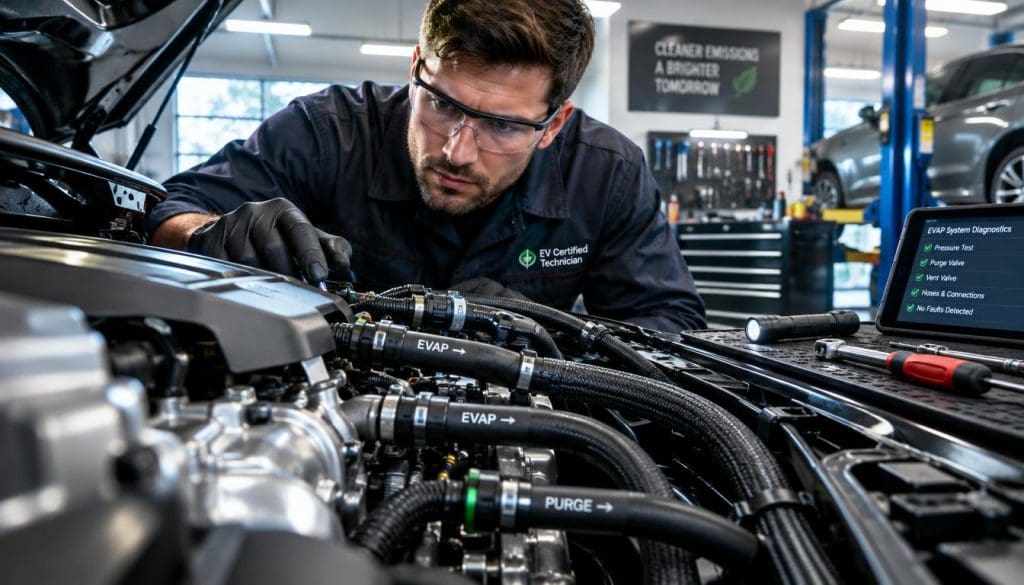
Start with the gas cap and visible connections before replacing EVAP components. Simple checks come first, since a loose cap or visible hose damage may explain the fault. Keep the engine cool before looking under the hood.
How to fix an EVAP system leak depends on the specific fault confirmed by testing. Replacing parts based only on a code can waste money and leave the leak in place. Use a measured order instead of swapping parts at random.
Check the Gas Cap and Filler Neck
Look at the cap seal for cracks, flattening, or missing pieces. Check the filler neck for dirt or visible damage where the cap makes contact. Tighten the cap until it seats as designed.
If you tightened the cap, drive for a few days and see whether the warning returns. A temporary cap issue may stop triggering the fault after the vehicle runs its checks. A persistent code needs further diagnosis.
Inspect Accessible EVAP Hoses
With the engine cool, look at accessible hoses and connections for splits, loose ends, or signs of rubbing. Do not reach near hot parts or moving belts. A visual inspection can find obvious damage, but it cannot rule out a hidden leak.
Check only areas you can see and reach safely. EVAP lines may run near the fuel tank or beneath the vehicle. Leave raised-vehicle work to a shop with proper lifting equipment.
Test the Purge and Vent Valves
An OBD-II scanner can retrieve stored codes, with basic models starting around $25-$50. Write down the exact code before clearing anything. The code helps guide the next test but does not name a failed part.
A technician may test the purge valve and vent valve with a hand vacuum pump. A good purge valve should not hold vacuum with no power applied. A vent valve should hold vacuum when energized.
Those results do not apply to every design or test setup. Vehicle makers use different valve layouts and test steps. Follow the manufacturer’s procedure rather than treating a generic vacuum check as universal.
Repair the Confirmed Fault
Once testing confirms the cause, repair or replace that part. The fix might involve a cap, hose, valve, canister, or another sealed connection. A shop should explain what test linked the repair to the fault.
Some repairs are easy to reach, while others require parts near the fuel tank or under the vehicle. A visual inspection alone may miss a leak that appears only under certain conditions. Proper diagnosis helps prevent repeat work.
Do not clamp or block EVAP lines as a shortcut, since that can create another fault or damage the system.
How Does an EVAP Smoke Test Find a Hidden Leak?
A smoke test makes an otherwise invisible leak visible by showing where smoke escapes from the sealed system. The escape point matters: smoke can reveal a split, loose fitting, or failed seal that a visual inspection missed.
EVAP systems need very low test pressure, about 1 PSI or less. Normal system pressure is roughly one-half PSI, or 12 inches of water. Pressure above about 7 PSI can blow off hoses or damage the EVAP pressure sensor.
Seal and Pressurize the System Safely
A technician seals the system and introduces low-pressure smoke through an EVAP service port when available. The smoke moves through connected lines and components. Where it escapes can point to the leak’s location.
Another method uses the fuel filler neck with a gas-cap adapter. That setup lets smoke enter through the filler opening. Testing through the filler neck does not test the gas cap itself.
The vent valve may need to be commanded closed with a scan tool. If it stays open, smoke can leave through the vent and hide a leak elsewhere. The test may then show an open path rather than the fault being sought.
Use the correct port and adapter for the vehicle. A service-port connection and a filler-neck setup do not test the system in exactly the same way. The technician chooses the method that fits the vehicle and the test goal.
Read the Smoke Without Missing the Leak
Smoke may appear around a hose, fitting, valve, canister, or tank connection. The technician follows the visible plume to its source, then checks whether the suspected part is truly leaking. Air movement can make faint smoke harder to spot.
Some equipment and procedures support UV dye, which can make escaping smoke easier to see. The dye is not used in every test. A careful look around the whole path helps avoid missing a second leak.
A smoke test can locate a leak, but it does not automatically prove which part should be replaced. A technician may need to isolate sections or run another test. The final repair should match the confirmed leak point.
Keep test pressure at about 1 PSI or less, since higher pressure can damage EVAP components.
What Can an EVAP Repair Cost?
A gas-cap replacement can be a relatively small expense, while a leak-detection pump repair can cost substantially more. The failed part changes the bill, as do diagnosis, labor, and access. A code alone cannot tell you which estimate applies.
A gas cap may cost about $15-$40, while a leak-detection pump repair typically costs $400-$900. The pump range includes diagnosis and installation. Other EVAP repairs need an estimate based on the confirmed fault.
| Repair | Price information | What affects the bill |
|---|---|---|
| Gas cap | About $15-$40 for a P0455-related replacement | Cap type and diagnosis |
| EVAP leak-detection pump | Typically $400-$900, including diagnosis and installation | Part, labor, and access |
| Other EVAP parts or lines | Estimate depends on the confirmed fault | Part cost, labor, and access difficulty |
A cap is usually a simpler repair than a pump, but the correct part still matters. A cap that does not fit your vehicle may not seal properly. The estimate should match the vehicle and the diagnosed problem.
A pump can take more time to reach or replace than an easy-to-access cap. Part choice and labor affect the final bill. Ask whether the estimate covers diagnosis, the part, and installation.
Other EVAP parts and lines can vary widely in access and repair time. A hose may be simple to reach, while a component near the fuel tank may take longer. A shop should explain the work included in its estimate.
Ask the shop to name the failed part and the test that confirmed it. The quote should state whether diagnosis and installation are included. Typical leak-detection pump costs include diagnosis and installation, but your written estimate should spell out its own terms.
Compare estimates only after confirming that they cover the same part and labor.
Why Does the Check-Engine Light Return After Repair?
The light can go out when a code is cleared even though the vehicle has not yet rerun its EVAP self-test. Clearing is not proof that the repair worked. The onboard monitors must run again under suitable driving conditions.
Some vehicles need a few weeks of normal driving to rerun their EVAP monitor. The computer checks the system only when conditions allow its test to run. Short trips or changing conditions may delay that check.
Use this post-repair checklist:
- Clear the stored code after the repair.
- Drive normally so the onboard monitors can rerun.
- Rescan to confirm the fault has not returned and check monitor readiness.
An OBD-II scanner can turn off the check-engine light by clearing a stored code. That action does not show that the monitor has completed its test. A light that stays off for a short time is not enough to confirm the repair.
Monitor readiness matters during an emissions inspection. If the test has not run, the vehicle computer may not have confirmed the system is working. A scan can show whether the monitor is ready.
If the same code returns after the monitor runs, the fault may remain or another leak may exist. A repaired part does not rule out a separate problem in the system. If the code returns after the monitor runs, have the diagnosis repeated rather than clearing it again without checking.
When Should a Technician Handle the Diagnosis?
A professional diagnosis is worthwhile when basic checks do not identify the fault or the repair requires specialized equipment. Hidden faults take more than a quick look. Intermittent leaks, valves, pressure sensors, and canister problems may need professional diagnostic tools.
Some U.S. emissions components may be covered for up to 8 years or 80,000 miles. Coverage depends on your vehicle and the failed component. Check before paying for a repair that may qualify.
- Provide the exact trouble code.
- Share your vehicle’s year, make, and model.
- Ask whether emissions warranty coverage or model-specific service information applies.
Service bulletins can point to a known issue on a specific model. A 2021 Acura TLX bulletin identifies a fuel main flap unit stuck open as a possible cause of a code. It recommends replacing the fuel capless unit, but that repair does not apply to every vehicle.
Warranty coverage depends on the part and vehicle, not just the code. Check your vehicle’s warranty documents or ask the service department to confirm coverage before authorizing a covered repair.
Conclusion
A gas cap is a sensible first check, but a returning EVAP code calls for a complete diagnosis. The cap may be loose or worn, but a hose, valve, canister, or tank connection can also cause a leak. A confirmed fault helps you avoid replacing parts that still work.
If the light returns or you smell fuel, arrange a proper inspection. Heaven Automotive can diagnose and fix your vehicle in San Antonio. Contact Heaven Automotive at (210) 682-3898 or visit 6645 Poss Rd. San Antonio, TX 78238 to hire the team to fix your vehicle.