


A sudden drop at the pump can make you wonder whether exhaust feedback is involved. An oxygen sensor replacement may seem like the quick fix, but poor fuel economy can have other causes. The air-fuel mixture is the proportion of air and fuel entering the engine cylinders. When exhaust feedback is wrong, your car may use more fuel, run poorly, or release more emissions.
Checking the cause first can protect your fuel economy and help you avoid replacing a part that still works. A check engine light can add urgency, but it does not name the failed part on its own. You will learn which changes matter and how testing can help you choose a sound repair.
Key Takeaways
- A drop in gas mileage can have several causes.
- A check engine light alone does not prove sensor failure.
- Live readings can help separate a bad sensor from a leak or wiring fault.
- Sensor type and location affect replacement cost.
- Use the warning light and changes in how the vehicle runs as reasons to investigate, not as proof that one particular part has failed.
What Are the Signs of a Bad Oxygen Sensor?
A check-engine light paired with worse fuel economy or rough running is a strong reason to get the fault checked. Several changes can point to a faulty oxygen sensor, though none confirms the cause alone. Look for a pattern across how your engine runs, how much fuel you use, and what comes from the exhaust.
Watch for these six signs as you use your car:
- A check-engine light appears.
- Fuel economy declines over several fill-ups.
- The engine idles roughly.
- Acceleration feels weak, or the engine misfires.
- The engine stalls, either at idle or while driving.
- Black exhaust smoke or a fuel or rotten-egg odor appears.
A faulty oxygen sensor can raise emissions, and the vehicle may fail an emissions test. Some states require emissions testing every couple of years, but the schedule depends on your state.
Black smoke or a strong odor can also point to another fuel or exhaust problem, so note when it starts. A mechanic can use that detail alongside the engine’s behavior and test results. Timing matters when the problem comes and goes rather than staying constant.
Note when rough idling or stalling happens, since an intermittent pattern can help with inspection.
How Oxygen Sensors Affect Fuel Economy
The upstream sensor affects mileage because the engine computer uses its readings to adjust fueling. It measures oxygen in the exhaust, and the computer changes fuel injection in real time. A failing upstream sensor can hurt fuel economy and drivability more directly than a downstream sensor.
A rich air-fuel mixture has too little oxygen, while a lean mixture has too much. The sensor sits on the exhaust pipe, where hot exhaust and outside air expose its parts to harsh conditions. A bad oxygen sensor can reduce fuel economy by 10-20 percent.
Most modern vehicles have two to four oxygen sensors. V6 and V8 engines with dual exhaust banks can have four or more.
| Engine layout | Typical oxygen sensor count | Count exception |
|---|---|---|
| Four-cylinder | 2 | Usually two sensors |
| V6 | 4 | Dual exhaust banks can mean 4 or more |
| V8 | 4 | Dual exhaust banks can mean 4 or more |
Bank 1 is the side of the engine with cylinder number one. Sensor 1 is the upstream sensor, located before the catalytic converter. The downstream sensor sits after it and mainly checks how well the converter works.
Many cars built after 2005 use a wideband, or air-fuel-ratio, sensor upstream. Modern oxygen sensors are typically rated for 60,000-100,000 miles. Older cars made before 2000 with unheated sensors often needed replacement at 30,000-50,000 miles.
Compare your fuel economy across several fill-ups before treating one unusual tank as evidence of a sensor problem.
How Can You Confirm a Faulty Oxygen Sensor?
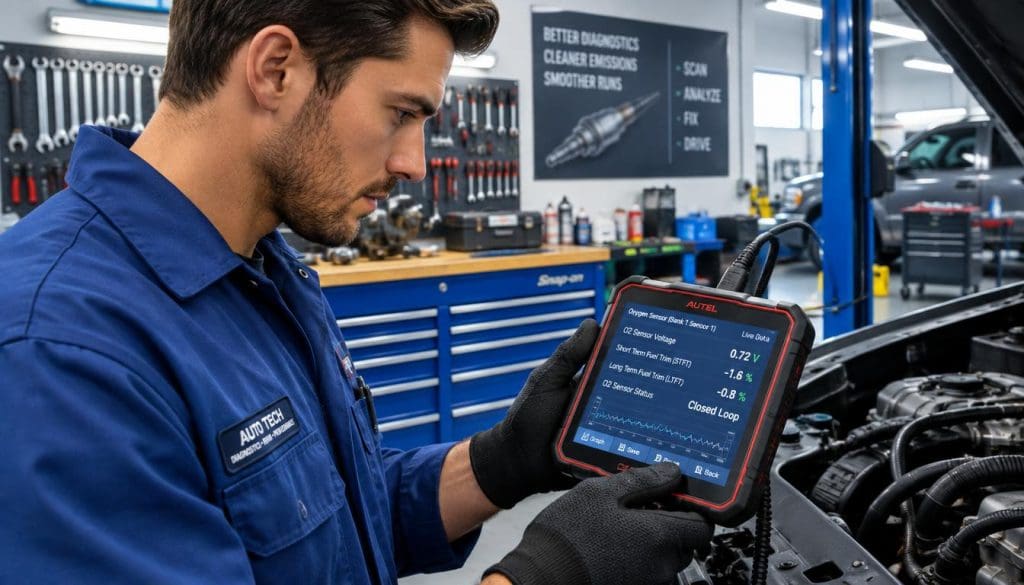
A trouble code narrows the investigation, but it does not by itself confirm that the sensor needs replacing. A scan tool can show code details and live sensor readings. P0130-P0167 codes can point to an oxygen-sensor circuit or reading, not prove the root cause.
Live data can show whether a sensor signal changes as the engine runs. On a narrowband sensor, a reading above 0.45 volts indicates a rich mixture, while a reading below 0.45 volts indicates a lean mixture. A single reading needs context from the engine and other test results.
AutoZone’s Fix Finder reads diagnostic trouble codes for free in 1-2 minutes. It provides basic codes, not a definitive diagnosis of a faulty oxygen sensor.
Read the Trouble Code and Live Data
A code reader can identify a fault area and help guide further checks. It cannot tell you on its own whether the sensor, its wiring, or another part caused the code. Ask for the code number and any live-data readings recorded during testing.
A mechanic can compare the signal with engine conditions and check whether it responds as expected. The reading may point to a rich or lean condition without showing why that condition exists. That distinction helps prevent a needless part swap.
Check for Leaks, Contamination and Wiring Faults
Inspect the wiring and electrical connections for damage or poor contact. Overheating, age-related wear, and electrical problems can all cause sensor failure. Oil coolant contamination can also harm the sensor, especially when a leak reaches the exhaust area.
A leaking vacuum hose or exhaust system can create a similar oxygen-sensor code. Repair the leak before fitting a replacement, or the same fault may return. Oil or coolant leaks also need repair to protect a new sensor.
Decide Whether the Sensor Has Actually Failed
Sensor replacement makes sense when testing confirms a bad signal or failed circuit and rules out likely causes elsewhere. A shop can test the sensor and inspect its wiring, connectors, and nearby hoses. The results should point to the part that needs repair.
Keep the code details with your repair record so the confirmed fault can be compared with later results.
How Much Does Oxygen Sensor Replacement Cost?
In 2026, shop replacement for an oxygen sensor is $180-$350 fitted, with sensor type affecting the estimate. The part’s location and design can change both parts and labor costs. A wideband sensor often costs more than a standard upstream or downstream sensor.
The table shows typical part and fitted prices in 2026. The upstream sensor sits before the catalytic converter, while the downstream sensor sits after it.
| Sensor type | Location | Part cost | Fitted cost |
|---|---|---|---|
| Upstream oxygen sensor | Before the catalytic converter | $50-$120 | $200-$350 |
| Downstream oxygen sensor | After the catalytic converter | $40-$100 | $180-$320 |
| Wideband or air-fuel-ratio sensor | Often upstream in many post-2005 cars | $80-$200 | $250-$450 |
A Toyota Corolla replacement averages $193, including $53 for parts and $140 for labor. The price changes by location. Replacing all four sensors on a V6 or V8 is estimated at $600-$1,100 fitted, but that is rarely needed when only one has failed.
What the Shop Estimate Includes
A written estimate should name the sensor location, the part, labor, and any needed diagnostic work. Check that it identifies the upstream sensor or downstream sensor, not just “oxygen sensor.” That detail helps you compare estimates that may cover different parts.
Labor can rise if the sensor is hard to reach or stuck in the exhaust pipe. The vehicle make and model also affect which part fits. A good estimate should explain any added work before the repair begins.
DIY Replacement and Safety Steps
You can replace a sensor yourself if you have the right part and tools. The exhaust must be completely cool before you work near it. An oxygen sensor socket costs about $12 and helps remove the sensor without damaging its wiring.
- Let the exhaust cool completely.
- Unplug the sensor connector.
- Remove the sensor with an oxygen sensor socket.
- Install the correct part by hand and tighten to the vehicle’s specification.
- Reconnect the wiring and verify or clear codes with a scan tool.
Choose the Correct Replacement Part
New vehicles need vehicle-specific oxygen sensors, unlike the universal sensors common before 1996. Match the part to your vehicle make, model, engine, and sensor location. A connector that looks close may still be wrong for your car.
After installation, recheck for stored codes and confirm the warning light does not return.
Can You Keep Driving With a Bad Oxygen Sensor?
If the vehicle runs normally, limit driving to what is needed to get the fault checked. A short, necessary trip to a repair facility may be manageable, but continued driving can let excess unburned fuel overheat the catalytic converter. Delay can turn a sensor fault into damage to a more costly exhaust part.
The catalytic converter reduces unwanted gases in the exhaust before they leave the tailpipe. Too much unburned fuel can make it run too hot and damage its internal parts. Replacing a catalytic converter costs $1,000-$3,000 on most vehicles.
Luxury cars can cost $3,000-$5,000 for converter replacement. The final bill depends on the vehicle and the repair needed. A prompt check can help identify whether the engine is sending excess fuel into the exhaust system.
A flashing warning light, severe misfire, stalling, or unsafe running changes the decision. Do not keep driving when the engine cannot run safely. Find a safe place to stop and arrange help instead.
If the engine misfires severely, stalls or the warning light flashes, pull over safely and arrange assistance.
Conclusion
A confirmed oxygen-sensor fault is easier to address before it affects drivability or the emissions system. Testing the cause before replacing a part helps you avoid treating a code as a diagnosis. It also gives your mechanic a clear place to start.
Keep records of the code and repair, especially if the warning light returns. That history can help guide future maintenance and keep your vehicle’s fuel use and emissions in check.
Contact Heaven Automotive at (210) 682-3898 or visit 6645 Poss Rd. San Antonio, TX 78238 to hire the team to fix your vehicle.