

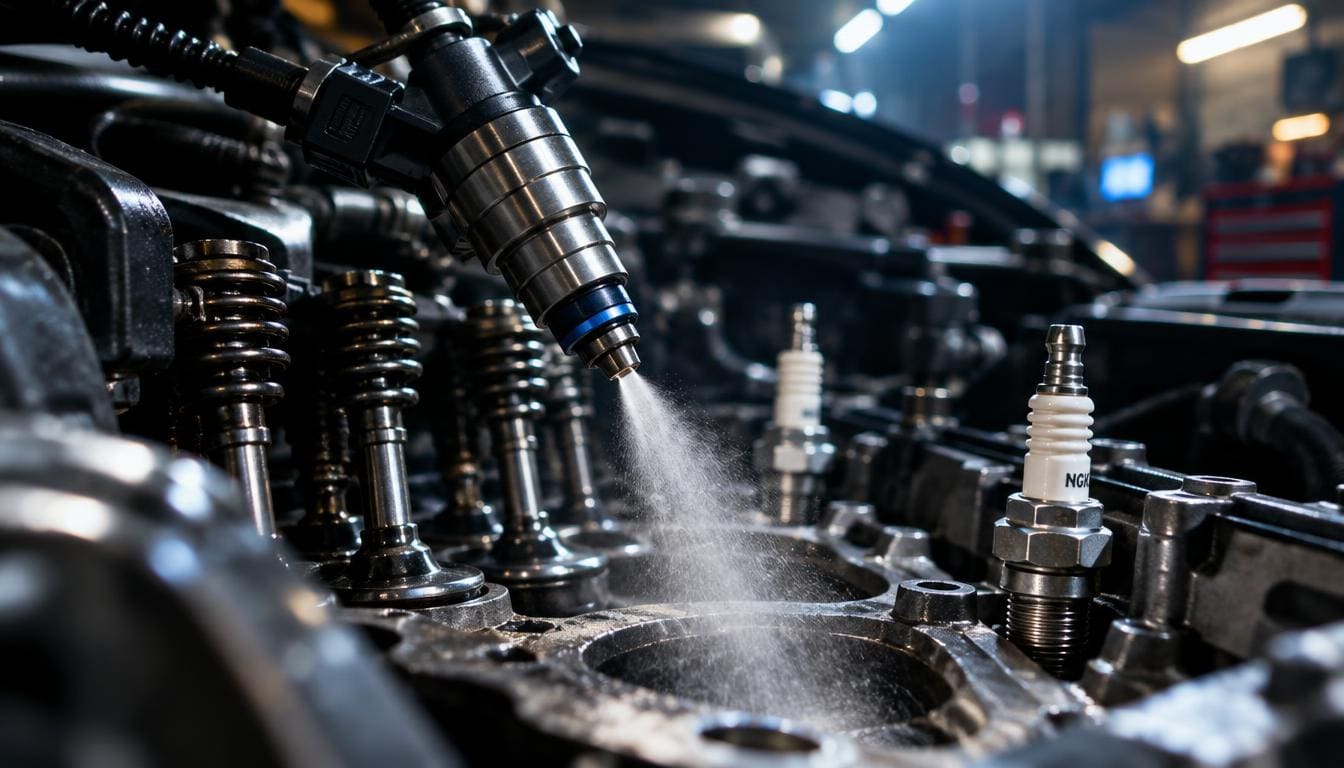
A stumble during acceleration or an uneven idle can be unsettling, but neither symptom proves that a fuel injector is dirty. A fuel injector is a metered component that delivers a fine spray of fuel into the engine. Fuel mixes with air, and deposits can affect engine performance, power, fuel efficiency, and emissions.
Fuel injector cleaning can help when deposits affect fuel flow, but it is not a cure-all. Similar problems can come from other engine faults, so a diagnosis should guide your next step. This guide helps you tell when service may be needed and what to ask before approving it. A symptom alone cannot confirm that cleaning will fix your vehicle.
Key Takeaways
- Rough running can have several causes.
- Ask for professional diagnosis before approving cleaning.
- Choose a cleaning method that fits the confirmed problem.
- Do not drive with a fuel smell or visible leak.
- Hire a repair shop when testing or repair is needed.
Treat a new fuel smell or a visible fuel leak as a reason to stop driving and arrange a prompt inspection.
What Symptoms Point to a Fuel Injector Problem?
A misfire that appears as you accelerate or climb a hill is one reason to have the fuel system checked. Too much or too little fuel can cause a misfire, especially under load. Symptoms point to a possible problem, but test results should guide service.
How injector trouble can feel while driving
A fuel injector problem may affect the engine at idle, under load, or during acceleration. Watch for changes in how your vehicle runs, fuel economy, and emissions.
- Rough idle or stalling
- Misfire or hesitation under acceleration or load
- Poor fuel economy
- Check-engine light
- Surging
- Failed emissions test
A fuel smell or visible leak also needs prompt attention. These signs can point to leaking fuel, not just deposits, so do not treat them as a reason to add cleaner.
What a technician checks before recommending cleaning
A repair shop can use a scan tool to check fault codes and live engine data. A fuel-pressure test checks whether pressure meets the vehicle’s needs. A technician may also use a stethoscope to hear injector clicking and compare fuel delivery across cylinders with a balance test.
Those checks matter because spark plugs, ignition coils, vacuum leaks, low compression, and sensor faults can cause similar symptoms. A scan code can narrow the search, but it does not always prove that an injector has failed. The right test depends on the engine and the fault found.
Ask for diagnosis before authorizing cleaning if the cause of the rough running has not been identified.
Which Fuel Injector Cleaning Method Fits Your Problem?
For a deposit-related problem, an in-tank cleaner is the simplest option, while removed-injector testing gives a more detailed assessment. The best fuel injector cleaning method depends on whether deposits or a mechanical fault caused the issue. Fuel injection cleaning is worth considering for confirmed deposit-related trouble, not as a substitute for diagnosing a misfire.
The fuel filter, fuel pump, and fuel injectors work together as parts of the fuel system. Some shop services pair a tank additive with intake-manifold and throttle-body cleaning. These added services do not replace tests that check whether an injector works as it should.
Tank additives and on-vehicle cleaning
An in-tank additive travels with the fuel through the system and can help with deposits. On-vehicle fuel-rail cleaning uses a connected system to push cleaner through the rail and injectors. A fuel injector cleaning machine is used for professional bench cleaning and testing after injectors come out.
In gasoline direct-injection engines, fuel does not wash the backs of the intake valves. An in-tank cleaner may help the injectors, but it often cannot fully remove deposits on those valves. Intake-valve deposits may need a different service than injector cleaning.
| Method | Where the cleaner acts | Best fit | Limit |
|---|---|---|---|
| In-tank additive | Fuel tank and injectors | Deposit-related concerns | Will not repair mechanical failure |
| On-vehicle fuel-rail cleaning | Pressurized cleaner through rail and injectors | Service with a connected cleaning system | Does not prove an injector is mechanically sound |
| Off-car ultrasonic cleaning | Removed injectors in an ultrasonic bath | Cleaning with flow, leak, and spray checks | Requires removal and reinstallation |
Off-car ultrasonic cleaning and testing
Off-car service can combine ultrasonic cleaning with timed and measured flow tests. The shop can also run a pressurized leak-down test, inspect each spray pattern, and replace failed parts. A service report can record the test results and work performed.
This process helps show whether an injector flows evenly or leaks under pressure. It takes more work because the injectors must come out and then be reinstalled. A cleaner is most likely to help with deposits, not a mechanical failure or a misfire caused by another engine fault.
Do not expect any cleaning method to repair a mechanically damaged injector.
Can You Clean Fuel Injectors at Home?
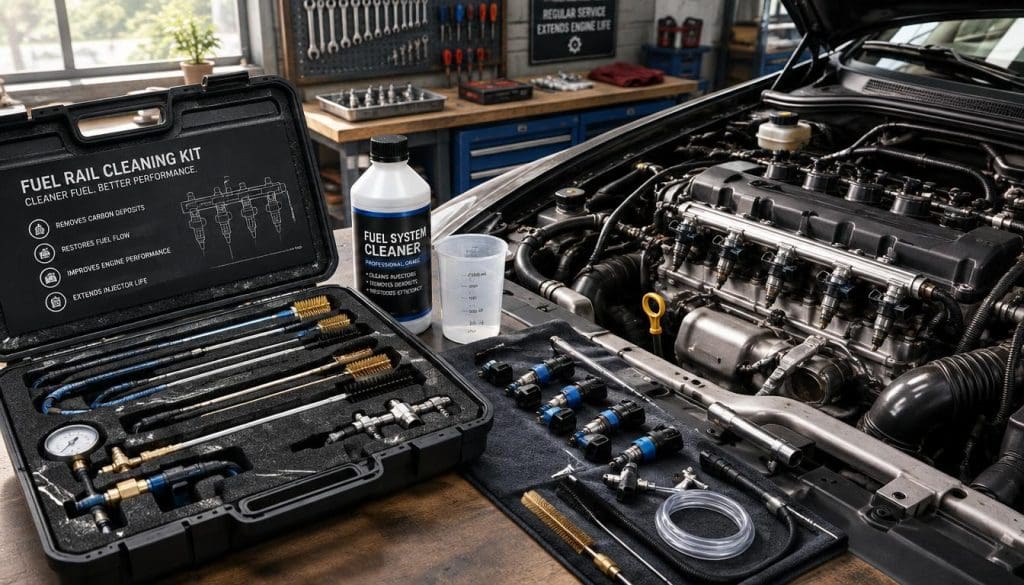
A fuel injector cleaning kit can run cleaner through the fuel rail without removing each injector, but the connection must suit the vehicle. Kit designs and steps differ, so use the product’s own instructions. Do not follow a procedure written for a different vehicle or kit.
Some kits connect to the fuel rail and feed cleaning solution through the injectors while the engine runs. Depending on the kit, its directions may call for about 15-30 minutes of cleaner flow. A tank additive, a rail-connected kit, and fuel injector cleaning spray are not interchangeable.
What a fuel injector cleaning kit does
Fuel injector cleaning spray should go only where its label directs. It is not automatically safe to pour into a tank or connect to a fuel rail. Before use, check these points:
- Confirm the product is compatible with your engine.
- Read the kit’s connection and timing instructions.
- Follow the vehicle manual’s fuel-system precautions.
- Check for leaks after reassembly before driving.
Why removing injectors is not a casual DIY job
Removing injectors involves disconnecting the fuel pump and relieving fuel-system pressure. The work also means handling electrical connectors and fuel-rail hardware. After reassembly, a leak check is vital because fuel can ignite if it reaches a hot surface.
These steps can vary by vehicle, and incorrect handling can damage parts or create a fire risk. A cleaning kit does not make injector removal a simple home task. If you cannot confirm the correct procedure for your vehicle, leave fuel-system disassembly to a qualified technician.
When Should You Use a Fuel Injector Cleaner?
A tank additive is most useful when deposits are the likely issue, not when a component has failed. Deposit-related hesitation or reduced fuel economy can be signs that you need fuel injector cleaner, but other faults can cause the same changes. An additive cannot fix a failing injector or an ignition, vacuum, or compression problem.
Use an additive when its purpose fits the problem and its label lists your engine type. Clean fuel and routine maintenance help limit deposits, but they cannot reverse mechanical damage. If your vehicle still runs poorly after treatment, more cleaner may not help.
When an additive may help
Polyether amine, or PEA, is a detergent found in some deposit-control additives. PEA-based options include Chevron Techron Concentrate Plus, Red Line SI-1 Complete Fuel System Cleaner, and Royal Purple Max Atomizer. These products target deposits, not failed parts.
Sea Foam IC5 is made for gasoline fuel-injection engines. Its directions call for one full bottle in the tank, and one bottle treats up to 25 gallons. Sea Foam recommends adding IC5 at every fill-up to help maintain clean engine performance.
Choosing a product and following its directions
Sea Foam’s every-fill-up recommendation applies to IC5, not automatically to every injector cleaner. Other cleaners may have a different dose or use schedule. Adding more than the label directs does not make a cleaner work better.
Choose a product labeled for your fuel type and vehicle. If the label gives a maximum fuel amount, do not exceed it. Match the dose to the product label and the amount of fuel in the tank.
What Does Professional Fuel Injector Service Cost, and Where Can You Get It?
The amount due for injector service depends on whether your vehicle needs cleaning alone or diagnosis and additional repair. Access and test results shape the work, and added removal or replacement can expand the scope. A fuel injector cleaning price should reflect your vehicle and the work it needs.
A fuel injector cleaning service should begin with professional diagnosis when symptoms could have another cause. Ask the repair shop what it tested, what it found, and why the proposed service fits. A fuel injector cleaning price should not be based on the service name alone.
| Factor | Cleaning-only scope | Expanded scope |
|---|---|---|
| Access | Service without extensive removal | Additional disassembly needed |
| Service method | On-vehicle cleaning procedure | Off-car removal and bench testing |
| Findings | Diagnosis supports cleaning | Testing points to repair or replacement |
Searching for fuel injector cleaning near me should lead you to a shop that can explain its diagnostic steps and proposed service. The right estimate may change if testing finds a faulty injector that needs repair or replacement. Cleaning and repair are different jobs, even when the same part is involved.
Heaven Automotive is at 6645 Poss Rd. San Antonio, TX 78238. Call (210) 682-3898 to discuss your vehicle and the work it may need.
Call Heaven Automotive at (210) 682-3898 or visit 6645 Poss Rd. San Antonio, TX 78238 to discuss your vehicle’s symptoms.
Conclusion
The practical takeaway is to identify the cause before choosing a cleaning method. Deposits may respond to suitable cleaning, while a mechanical fault or another engine problem needs testing. Choose service based on evidence, not a rough idle alone.
Good maintenance can support engine performance, but cleaner cannot repair a damaged part. If your vehicle hesitates, stalls, or loses power, ask a repair shop to check the cause before approving work. Hire Heaven Automotive to fix your vehicle.