

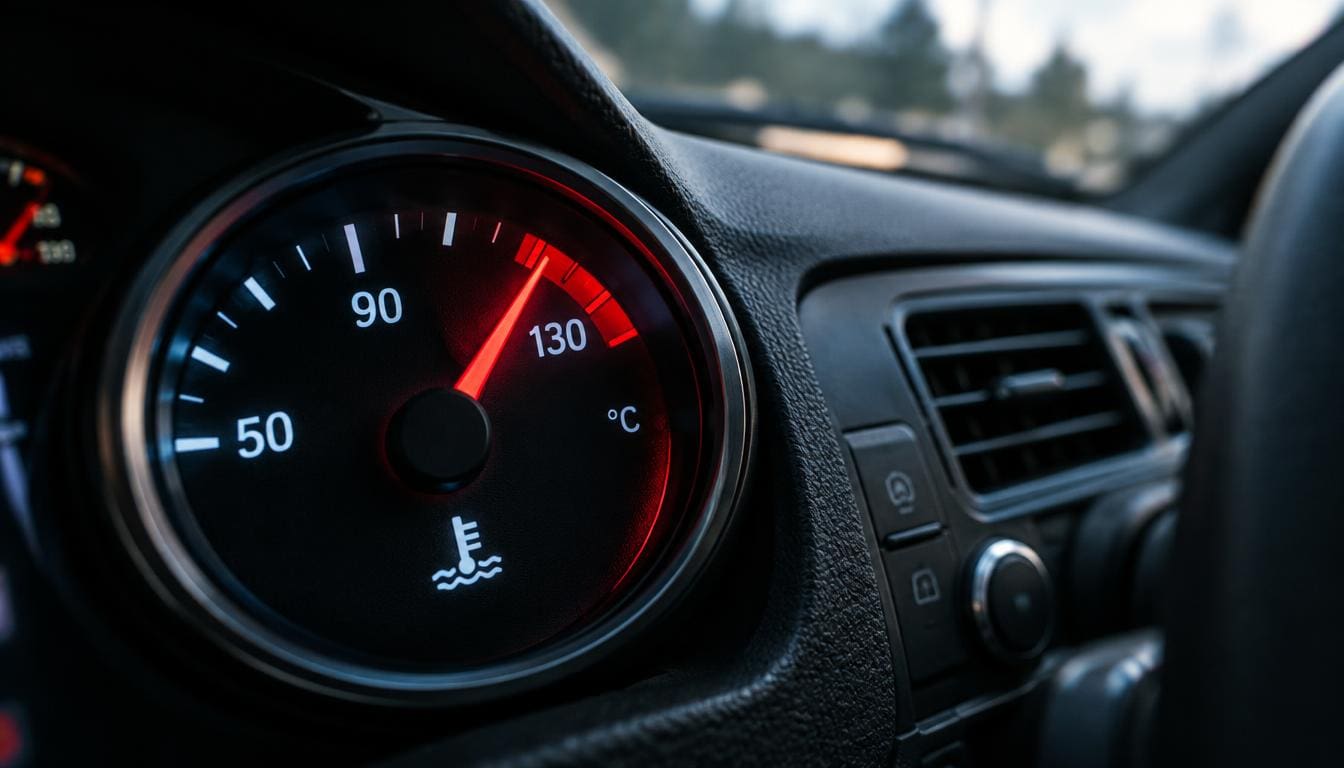
A vehicle can seem fine at first with a failed cooling fan, but heat can build when airflow through the radiator is limited. Your engine may stay cool while the vehicle moves, then warm up in traffic. A rising temperature reading needs your immediate attention.
Watch the temperature gauge, especially when you stop or move slowly. A cooling problem can lead to engine damage if heat keeps rising. This guide helps you spot warning signs, understand common fan faults, and choose a safe next step. Do not keep driving as the gauge climbs.
Key Takeaways
- A fan fault can cause overheating in slow traffic.
- Some vehicles may seem normal before heat builds.
- Use the correct fuse details in your owner’s manual.
- Stop safely if the temperature gauge rises.
- Confirm the failed part before approving a repair.
If the temperature gauge starts climbing, prioritize getting safely stopped over continuing the trip.
What Are the Signs of a Failing Cooling Fan?
A temperature gauge that rises while you are stopped, then settles as you move again, is a useful early clue. The pattern can point to reduced airflow through the radiator at low speed. A fan problem can develop before you see overheating.
Temperature changes at idle and in traffic
Watch for a temperature change while idling or moving through stop-and-go traffic. A fan that does not engage when expected, or runs only now and then, may have a fault. Some vehicles use different fan speeds as coolant temperature changes.
A radiator fan not working while the engine is not overheating can still signal a developing fault. Natural airflow may be keeping the engine cool for now. That does not prove the fan is working as it should.
- The temperature rises at idle or in slow traffic.
- The fan does not engage when expected.
- The fan starts and stops at irregular times.
- You hear grinding, rattling, or clicking near the fan.
Noises and warning signs
Grinding, rattling, or clicking from the engine bay can occur with fan problems. A loose part or a damaged fan may make noise as the fan turns. A new sound deserves attention, even if the gauge stays steady.
A check-engine light can appear, but it does not identify a fan fault on its own. The warning can point to many engine or cooling system issues. A code check and inspection can help narrow down radiator fan problems.
Treat a new grinding or rattling noise near the fan as a reason to arrange an inspection rather than waiting for the gauge to rise.
Why Is Your Radiator Fan Not Working?
An electric radiator fan needs a working motor, an intact power circuit, and a temperature signal before it can run when needed. A fault in any part can stop the fan or make it act unpredictably. Find the failed part before replacing anything.
A cooling-fan thermoswitch is a temperature-activated switch that closes the fan circuit at a vehicle-specific coolant temperature. Some designs place this switch in the radiator, while other vehicles use a different control setup.
Power supply faults: fuses, relays, and wiring
A blown fuse can break the fan’s power supply. A failed fan relay can also keep the fan from engaging at operating temperature. Corroded wiring, loose connections, or damaged connectors can cause similar trouble.
If a replacement fuse blows again, the fan motor may be the underlying problem. Repeatedly fitting new fuses will not fix the cause. A technician can check the circuit and find why it keeps failing.
| Fault | What it affects | Typical clue | Next check |
|---|---|---|---|
| Motor | Fan rotation | Intermittent operation | Motor test |
| Fuse | Circuit power | Open fuse | Correct fuse rating |
| Relay | Fan activation | No engagement at temperature | Relay and circuit |
| Wiring or connector | Power flow | Loose or corroded contact | Inspect wires and plug |
| Temperature sensor or thermoswitch | Fan control signal | Fan stays off or runs on | Vehicle-specific test |
A failed motor or obstructed fan
A faulty fan motor can stop the blades from turning, even when the circuit supplies power. Blocked blades or poor electrical connections can also point to a motor or connection problem. Do not reach near the blades to check for an obstruction.
Older vehicles may use a belt-driven mechanical fan and fan clutch instead of an electric fan. Electric-fan fuse and relay checks do not apply to every vehicle. The repair steps depend on the fan design fitted to your vehicle.
Temperature sensors and fan switches
A failed temperature sensor can stop the fan from activating or make it run continuously. Some vehicles use a separate coolant temperature sender for the gauge and a thermoswitch for fan activation. Thermoswitch locations and ratings depend on the vehicle design.
Switch activation temperatures vary by vehicle. One possible two-speed thermoswitch turns on its first speed at 95 °C and its second speed at 102 °C. Those figures describe one calibration, not a rule for every car.
Check the vehicle-specific parts information before treating a sensor or switch as interchangeable with another design.
How Can You Test the Fan Safely?
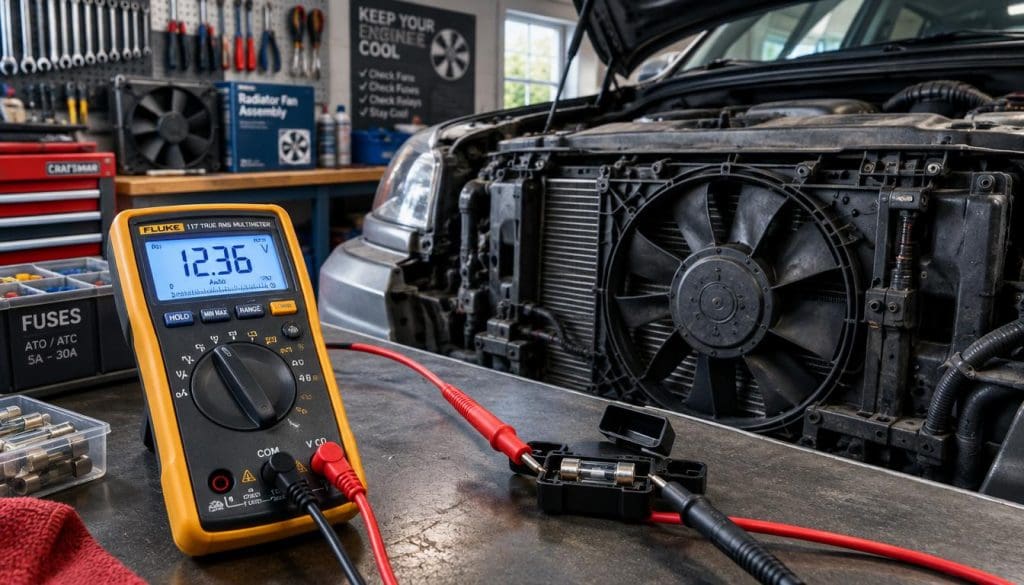
Start with the correct fuse location in your owner’s manual, then check the circuit before assuming the motor has failed. Basic checks can reveal a blown fuse or a lack of power. Do not test unknown terminals by bridging them.
Check the fuse and power supply
Keep the engine off when checking the fuse and connector. Electric radiator fans can start unexpectedly, even when the engine is off. Use a multimeter only if you know how to handle it safely.
With the engine off and accessories powered on, a reading of about 12 volts across a fuse means it is working. A reading of 12 volts at one fuse contact and 0 volts at the other points to a blown fuse.
- Find the correct fan fuse in the owner’s manual.
- Look for visible damage on the fuse and connector.
- Compare both fuse contacts with a multimeter.
- Check whether power reaches the fan connector.
- Arrange a motor test or circuit diagnosis if needed.
Confirm whether the motor responds
If voltage reaches the fan but the fan does not turn, the motor is likely faulty and needs replacement. A direct motor test can help confirm that result, but it requires the right tools and safe test steps.
Do not replace a fuse over and over if it blows again. A repeated failure needs diagnosis because the circuit may have an underlying fault. Avoid guessing at connector pin positions or using a test method for another vehicle.
Keep your hands, clothing, and tools away from the blades because the fan can start even when the engine is off.
Is It Safe to Drive With a Failed Fan?
A failed fan may seem less urgent at highway speed, but the risk can change quickly when you slow down or stop. Moving air can cool the radiator at speed, while little natural airflow reaches it at idle. There is no safe set distance if the temperature starts rising.
| Driving situation | Airflow | Overheating concern | What to do |
|---|---|---|---|
| Highway speed | Natural airflow is higher | May hide the fault | Do not treat airflow as a repair |
| Idling or slow traffic | Limited airflow | Risk rises | Watch the temperature gauge |
| Rising temperature gauge | Not enough to control heat | Immediate concern | Pull over and shut off engine |
Highway airflow can mask the issue, but it does not resolve the fan fault. The vehicle can overheat after slowing down or entering traffic. A long drive may become risky as soon as road speed drops.
If driving is necessary to reach safety or a repair facility, make the trip only as long as needed. Do not keep going just because the gauge settled at highway speed. The cooling system may not hold its temperature in the next traffic jam.
If the temperature rises, pull over somewhere safe and shut off the engine immediately.
Why Does the Fan Behave Differently With the A/C?
A/C use can make the cooling fan run more often because the condenser adds heat ahead of the radiator. The condenser sits in front of the radiator, so its heat affects airflow through the cooling system. Fan behavior depends on vehicle controls and coolant temperature.
Turning the A/C on does not activate the fan on every vehicle. Some control systems run the fan when the A/C needs extra airflow, while others use different rules. Check the expected behavior for your model before judging the fan.
The fan does not run when the A/C is off
A radiator fan not working when the A/C is off may be normal if the coolant temperature remains below the fan’s activation point. The control strategy differs by vehicle. The fan may wait for a temperature signal before it starts.
If the engine warms up and the fan still does not run when expected, the system may need diagnosis. A fan that stays off with the A/C off does not prove the motor has failed. The temperature sensor and fan control setup matter.
The fan keeps running after shutdown
Some newer vehicles may keep the cooling fan running briefly after you turn off the engine. That short run can help reduce engine temperatures. It does not always mean the fan or control system has a fault.
A fan that continues running for an unusually long time, or drains the battery, deserves inspection. The problem may involve a control signal that does not stop the fan. Note how long it runs and whether the vehicle starts normally afterward.
A/C cooling changes while stopped
An A/C system may still operate with a faulty radiator fan. Cooling can get worse at low speed or while stopped because airflow across the condenser is limited. You may notice warmer air from the vents in traffic.
The fan may run more often with the A/C on because the condenser adds heat to air moving toward the radiator. That added heat can affect both systems while the vehicle is still. A fan fault can reduce A/C cooling before the engine overheats.
Check the owner’s manual for the vehicle’s expected fan behavior before treating every brief run after shutdown as a fault.
What Does Radiator Fan Repair Cost?
A 2026 national estimate for replacing a passenger-vehicle radiator fan motor is $809-$922, including parts and labor. The estimate includes parts and labor costs of $611-$632 and $198-$291, respectively. This range covers motor replacement, not every fan repair.
Your estimate may change with the vehicle and the repair needed. Ask whether the quoted work includes diagnosis, a motor, a fan assembly, or a temperature switch. These parts and services are not the same repair.
When a temperature switch is replaced, the shop needs the part specified for your vehicle. The switch should not be overtightened, and air must be bled from the cooling system after the work. These steps help keep the system in proper working order.
Ask for an itemized estimate that identifies the failed component and the work included.
Conclusion
A cooling-fan fault deserves prompt attention, even if the vehicle has not overheated yet. Too much heat can damage the engine, and a clear diagnosis helps target the needed repair. Have the failed part confirmed before replacing components.
If your fan is not working as expected, Heaven Automotive can inspect the cooling system and fix your vehicle. Call the shop or visit its San Antonio location to discuss the problem and arrange service.
Hire Heaven Automotive to fix your vehicle at 6645 Poss Rd. San Antonio, TX 78238, or call (210) 682-3898.