

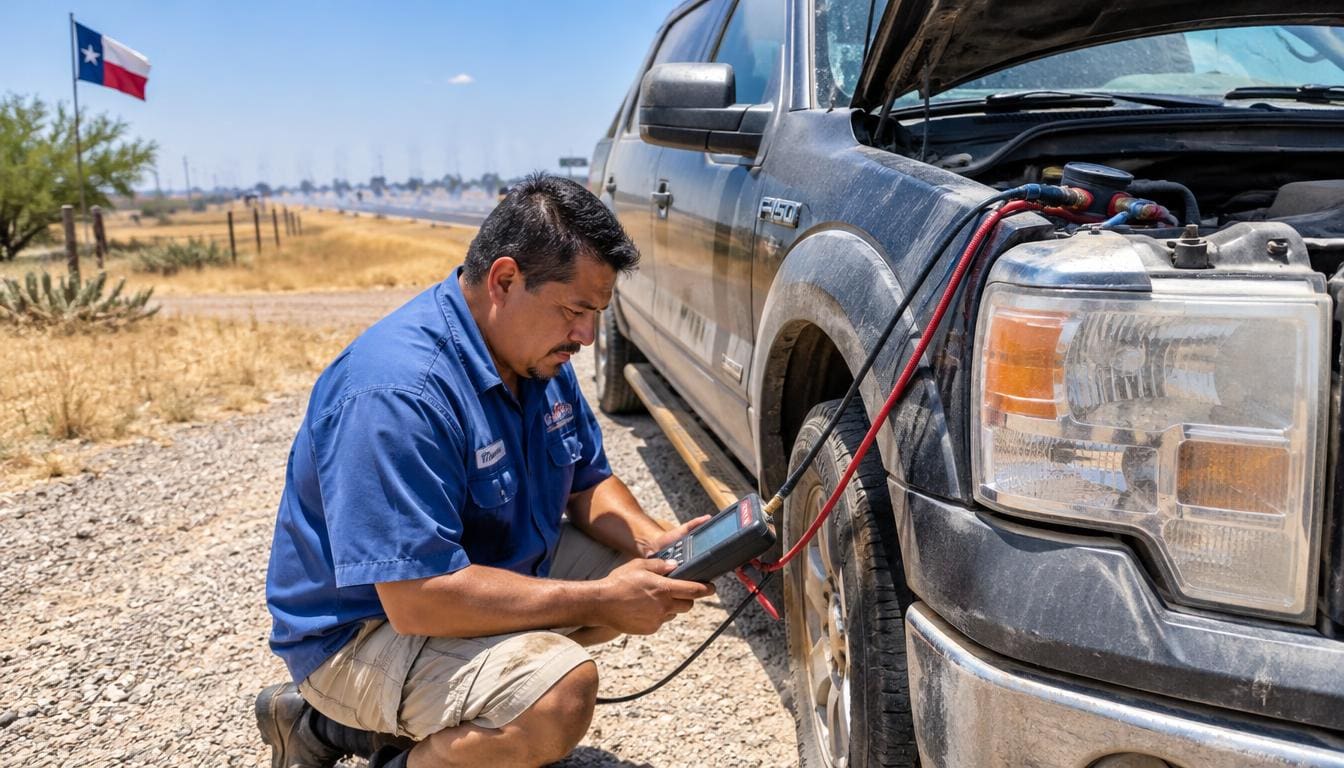
A car A/C that stops blowing cold air usually has an airflow restriction, a refrigerant leak, a compressor or clutch fault, or a control problem. Refrigerant is the fluid that absorbs heat from the cabin and releases it outside the vehicle. On a hot Texas day, warm air can make every drive uncomfortable, but it does not identify a failed part. The repair estimate depends on the diagnosed fault, your vehicle, the parts, and labor.
A shop needs to find the cause before it can describe the work your vehicle needs. A filter check differs greatly from a compressor repair, and the right answer comes from testing. An estimate made before inspection may not reflect the actual repair.
Key Takeaways
- Weak airflow and warm air can point to different faults.
- A dirty cabin air filter can reduce airflow, but does not prove refrigerant is low.
- Warm air at idle can point to a fan or condenser airflow issue.
- A running compressor does not guarantee the cabin will cool.
- A vehicle-specific diagnosis guides a useful repair estimate.
A diagnosis identifies which repair, if any, your vehicle actually needs.
Checks You Can Make Before Booking A/C Service
If the airflow itself is weak, check the cabin air filter before assuming the A/C needs refrigerant. Weak airflow differs from strong airflow that feels warm, and that difference helps narrow the problem.
A dirty cabin air filter can restrict airflow without confirming a refrigerant problem. Most manufacturers recommend replacing this filter every 15,000 to 25,000 miles, but your owner’s manual gives the interval and steps for your vehicle.
- Compare airflow across the vents, including the dash and floor vents.
- Inspect the cabin air filter for dirt, leaves, or other blockage.
- Confirm the temperature and fan controls match your intended settings.
- Note whether the car AC suddenly stopped blowing cold air or cooled less over time.
Look for a clear difference between vents rather than judging one vent alone. A change in airflow from one setting to another can also help you describe what happens.
The cabin air filter cleans air entering the cabin, so dirt can reduce the amount reaching the vents. A blocked filter may also cause excessive climate-control noise or a lasting musty or foul odor. Those signs point to restricted cabin air, not a confirmed fault elsewhere in the A/C system.
When your car AC suddenly stopped blowing cold air, note when the change began and whether airflow also weakened. A sudden change with normal airflow differs from a gradual drop in cooling, so give the shop that timing.
Use the owner’s manual for the filter’s replacement interval and instructions. Some vehicles place the filter behind the glove box, while others use a different access point. Replace a visibly clogged filter according to the procedure and interval in your owner’s manual.
Why Is Your Car AC Not Blowing Cold Air?
A/C symptoms narrow the possibilities, but no single one confirms which part has failed. How the cooling changes can help a technician choose what to test first.
A symptom is a clue, not a diagnosis. The compressor pressurizes and circulates refrigerant, while the condenser releases heat from it. The expansion valve regulates refrigerant flow, and the evaporator absorbs heat from cabin air.
Cooling changes when you stop or idle
If your car AC is not blowing cold air when parked, a condenser airflow or cooling-fan problem may be involved. Cooling that returns at road speed is a useful clue, not proof of a specific fault.
At speed, air moves across the condenser outside the cabin. When the vehicle stops, the cooling fan helps move air through it. A fan or airflow fault may become more noticeable at idle, especially during a hot day.
The compressor runs but the cabin stays warm
A car AC not blowing cold air with the compressor running still needs diagnosis. Compressor operation alone does not rule out low refrigerant, a condenser fault, or another internal-system issue.
The compressor may circulate refrigerant, yet the system may not move heat as it should. A technician checks the system as a whole rather than treating a running compressor as proof of proper cooling.
Different temperatures on the left and right
If your car AC is not blowing cold air on one side, a blend door actuator or vehicle-specific climate-control issue may be the cause. The blend door actuator directs air through the heating or cooling path.
Some vehicles use separate temperature controls for each side. If one side stays warm while the other cools, note which side changes and whether the controls respond.
| Symptom pattern | Possible cause | Useful clue |
|---|---|---|
| Weak airflow | Blocked cabin air filter | Low air volume at vents |
| Warm air at idle | Condenser airflow or fan issue | Cooling improves at speed |
| Warm air with compressor running | Refrigerant, condenser, or internal fault | Compressor operation is not enough |
| Different left/right temperatures | Blend door actuator or climate control | One side stays warmer |
Record whether cooling changes with vehicle speed, since that distinction helps pinpoint an airflow-related problem.
How Technicians Trace Refrigerant Leaks
A confirmed refrigerant leak is found by inspecting and testing the sealed system, not by adding refrigerant and hoping the cooling returns. Finding the leak helps identify the repair, rather than masking the loss.
Do not vent refrigerant or open a pressurized A/C system at home. A technician uses suitable tools to check for leaks and confirm the location before recommending repair.
Leak-check methods and what each can reveal
Automotive A/C leak checks can include a visual inspection, refrigerant detector, UV dye, or soap-bubble test. Each method can reveal different clues, and none should be treated as a guess based on warm air alone.
| Method | What it checks | Where it is useful | Practical limitation |
|---|---|---|---|
| Visual inspection | Oil, damage, or residue | Condenser and compressor area | Small leaks may leave no clear mark |
| Refrigerant detector | Refrigerant near a leak | Condenser, A/C lines, compressor | Needs access near the suspected area |
| UV dye | Dye escaping with refrigerant | Hoses, fittings, valves, condenser | May require dye to circulate first |
| Soap-bubble test | Bubbles forming at a leak | Accessible joints and fittings | Only checks spots the solution reaches |
Discolored PAG oil, a lubricant used in many A/C systems, may appear near a refrigerant leak, especially around the condenser or compressor. Oil discoloration is a clue, not proof on its own.
Common leak locations to inspect
A technician may focus on the compressor hose manifolds, fittings, pressure-switch seal and O-ring, hose crimps, Schrader valve, and condenser. A refrigerant detector can also be checked near the condenser, A/C lines, and compressor.
| Location | Inspection focus | Possible clue |
|---|---|---|
| Compressor hose manifolds and fittings | Joints and seals | Oil residue or detector response |
| Pressure-switch seal and O-ring | Seal around switch | Dye or refrigerant reading |
| Hose crimps | Crimped hose ends | Residue near the joint |
| Schrader valve | Valve seal | Detector response at valve |
| Condenser | Surface and connections | Oil, dye, or detector response |
A hissing noise can accompany escaping refrigerant, but sound alone does not confirm a leak. Ask for the leak location and the proposed repair before authorizing a recharge alone.
What Shapes a Car AC Repair Estimate in Texas
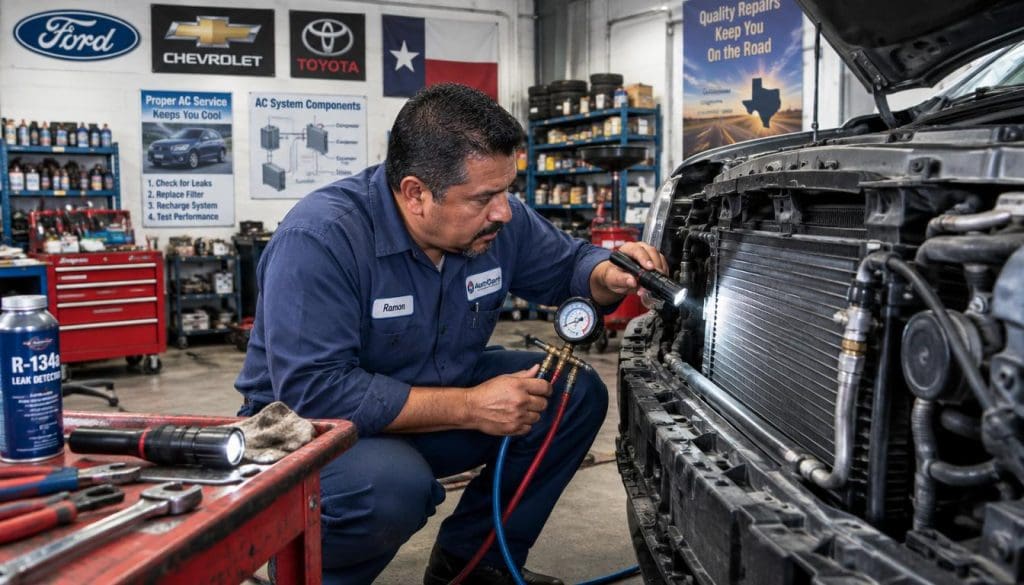
A car A/C repair estimate is based on the confirmed fault and the work your specific vehicle needs. The diagnosed cause sets the scope, not the fact that the vents feel warm.
A reliable amount requires diagnosis and a vehicle-specific quote. The estimate depends on the fault, vehicle, refrigerant type, required parts, and labor.
The fault, parts, and labor behind the estimate
Replacing a cabin filter is a different job from locating a leak or repairing a compressor. An inspection should show which work applies before you approve a repair.
Ask for an estimate that separates diagnostic work, parts, labor, refrigerant service, and any leak repair. That breakdown helps you see what the shop plans to do and what each part of the job covers.
Diagnostic work may involve checks beyond a basic visual inspection. The parts list should match the confirmed fault, and the labor should describe the work needed for your vehicle.
Why the vehicle and refrigerant type matter
Vehicle design affects the parts and labor needed for air conditioning service. The refrigerant specification matters too: R-134a and R-1234yf are distinct refrigerants used in vehicle A/C systems.
Your vehicle’s specified refrigerant type must guide service. A shop needs the correct type for the system, so the vehicle’s details matter when preparing a quote.
If the car AC not blowing cold air needs a repair beyond the filter, the work could involve leak repair, a compressor, or another component. Those jobs do not share one fixed price because the fault and vehicle change the work required.
When asking how much it costs to fix a car AC that is not blowing cold air, request a written, itemized estimate after diagnosis. A general amount cannot account for the correct parts and labor on your particular vehicle.
Get the diagnosis and itemized estimate before approving parts replacement.
DIY Checks and When to Call a Technician
You can check the filter and note the symptoms yourself, but refrigerant and electrical diagnosis call for the right tools. Simple checks can help you explain the problem without opening the A/C system.
Leave refrigerant handling, pressure testing, electrical diagnosis, and compressor work to trained technicians with proper equipment. Those tasks involve pressurized parts or electrical components that need the right tools and skill.
Simple checks you can handle
You can inspect or replace the cabin air filter by following your owner’s manual. You can also check that the climate controls are set as intended and note which vents feel warm.
A visual check can help you spot a loose part or visible debris near an air intake. Do not remove A/C lines or try to read system pressure without suitable equipment.
A fuse may affect an electrical component, but a blown fuse does not explain every cooling fault. If you inspect a fuse, use the manual to find the right one and follow its safety steps.
What to tell the repair shop
Before arranging service, prepare a few details. Clear notes help the shop understand when the issue occurs and what has changed.
- Your vehicle’s year, make, and model.
- When the issue occurs, such as at idle or while driving.
- Whether airflow is weak or simply warm.
- Any unusual noise, odor, or recent A/C service.
Heaven Automotive is at 6645 Poss Rd. San Antonio, TX 78238, and you can call (210) 682-3898 to discuss service. Share the details above when you arrange a visit, especially if the problem changes with vehicle speed.
Call Heaven Automotive at (210) 682-3898 or visit 6645 Poss Rd. San Antonio, TX 78238 to discuss your vehicle.
Conclusion
Weak airflow and warm air can point to different problems, so a filter check alone may not explain poor cooling. A confirmed diagnosis helps you avoid replacing parts by guesswork and gives you a clear basis for the repair.
Give the shop your vehicle details and a clear account of when cooling changes. That simple record can help the technician focus the inspection and explain the work your vehicle needs. Hire Heaven Automotive to fix your vehicle.