

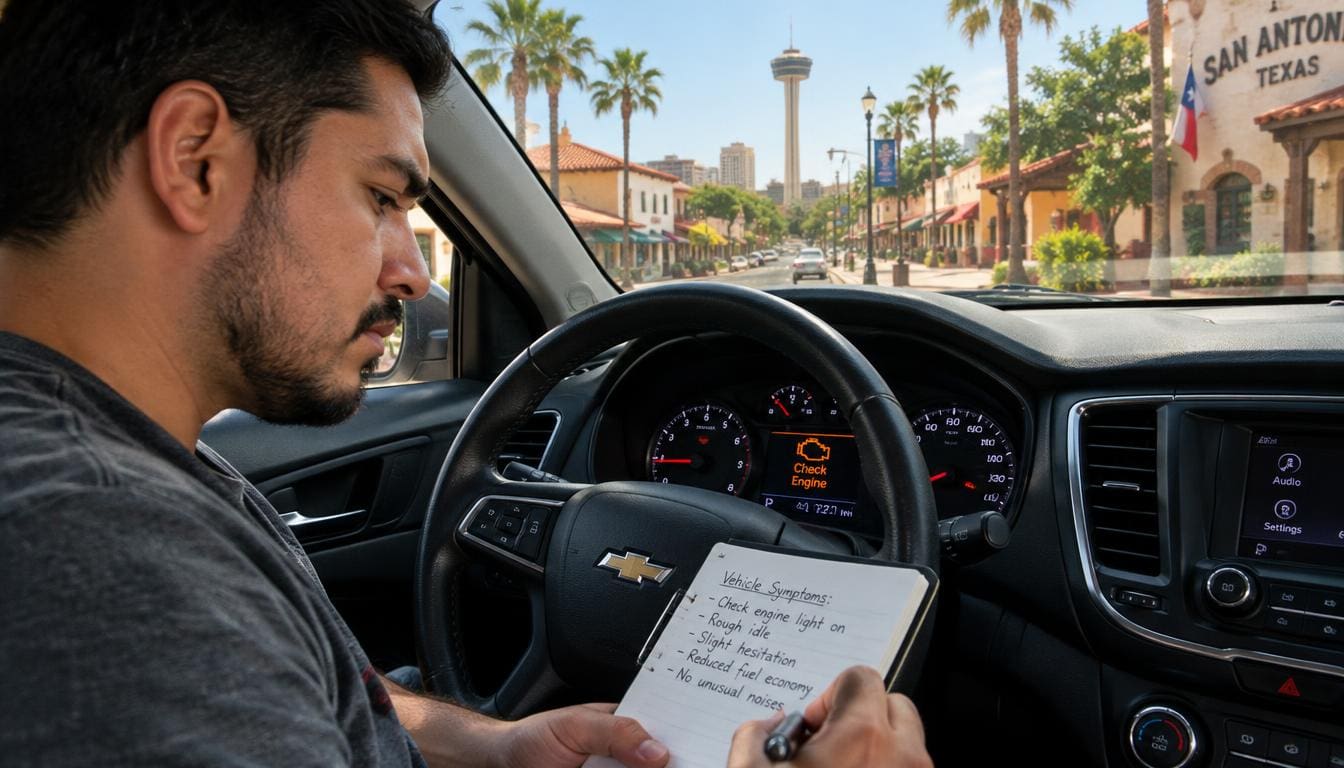
If your check engine light is on in San Antonio, arrange a diagnostic scan soon because the warning can signal anything from an emissions issue to a fault that needs immediate attention. An illuminated dashboard warning can leave you unsure whether your vehicle is safe to use or what repair it needs. The useful next step is finding the cause, not guessing at a repair.
Prompt diagnostics can show whether the issue needs urgent attention or a planned repair. A scan can also help you avoid replacing a part based on a guess. Drivers across San Antonio and Bexar County can note how the vehicle acts before arranging service.
Key Takeaways
- Arrange a diagnostic scan soon after the warning appears.
- Write down when it came on and any change in how your vehicle runs.
- A code points to a condition, not always a failed part.
- A flashing warning or rough running may need urgent attention.
- Keep scan results available until the fault is diagnosed.
Check Engine Light San Antonio: What the Warning Means
The warning means the vehicle’s computer has detected a fault in a monitored powertrain or emissions system, not necessarily that the engine is failing. A diagnostic trouble code is an alphanumeric record stored by the engine control unit (ECU) when a monitored system detects a fault. It points to a condition to investigate, not necessarily the failed part.
An OBD-II scan retrieves stored codes, but a code alone does not confirm which part failed. OBD-II is the standardized diagnostic interface used to read information from the ECU. The ECU stores fault information from powertrain and emissions systems.
A check engine light diagnostic must look beyond the code to find the root cause. For example, P0420 can relate to a catalytic converter, oxygen sensor, upstream exhaust leak, or oil burning.
Those possible causes can call for very different repairs. Replacing a part based only on P0420 can waste money and leave the issue unresolved.
Codes give technicians a useful starting point, but the vehicle’s condition and test results matter too. Treat a code as a lead for testing, not as a parts-replacement instruction.
Driving With a Steady or Flashing Warning Light
A flashing warning calls for you to pull over as soon as it is safe, while a steady light usually allows only a cautious short trip to diagnosis. Flashing often signals an active misfire, which can damage the catalytic converter.
A four-hour drive cannot be confirmed safe without knowing the cause. Even if the vehicle feels normal, a long trip should not be treated as safe simply because no symptoms have appeared.
| Dashboard behavior | Likely urgency | Immediate action | Risk |
|---|---|---|---|
| Steady light, no obvious symptoms | Prompt diagnosis | Limit driving to a cautious short trip | Cause may worsen |
| Flashing light | Urgent | Pull over safely and arrange help | Misfire can damage catalytic converter |
| Steady light with rough running or stalling | Urgent | Stop safely and arrange help | Vehicle may stall or suffer damage |
A steady light still deserves attention, even when the vehicle seems to run normally. Rough running or stalling changes the situation because the vehicle may not remain reliable on the road.
A flashing check engine light is different from a steady warning. If the light flashes, stop safely and arrange help rather than continuing the drive.
Common Causes Behind the Warning
A loose or missing gas cap is a common cause, but the same warning can also come from sensor, ignition, airflow, or emissions faults. An EVAP leak, often involving a loose or missing gas cap, is a common trigger, but it is not the only explanation.
The code narrows the system to check, while symptoms help guide the next test. Rough idle, hesitation, or stalling can help narrow testing without proving which component failed.
Fuel, Air, and Emissions Faults
Fuel vapor leaks can trigger P0455 or P0442, which relate to EVAP leaks. Lean fuel-trim codes P0171 and P0174 can involve vacuum leaks or mass airflow (MAF) sensor faults.
- EVAP leak or loose gas cap, often a common cause of the warning.
- Oxygen-sensor fault, including codes P0135 or P0141.
- MAF sensor performance fault, including P0101, or a vacuum leak.
- Worn spark plugs, wires, or an ignition coil causing a misfire.
- Catalytic-converter efficiency issue, including P0420 or P0430.
- Weak battery or an exhaust gas recirculation (EGR) valve problem.
Code P0128 relates to thermostat operation, another way engine light warnings can arise. A trouble code points to the system or condition, not a guaranteed failed component.
Ignition and Exhaust-Related Faults
Codes P0300 through P0308 indicate random or cylinder-specific misfires. A misfire may involve ignition parts, but testing must show what has failed.
A catalytic-converter code can also relate to an oxygen sensor, an exhaust leak, or oil burning. Use the code and symptoms to guide testing rather than assuming the most familiar cause is the correct one.
How Does a Proper Diagnostic Find the Fault?
A reliable diagnosis pairs the stored code with live data and tests of the system the code identifies. Live data shows how sensors and other systems behave while the engine runs.
A code reading is a starting point, not a full diagnosis. Freeze-frame data records vehicle conditions when a fault is triggered, which can help explain when the issue occurred.
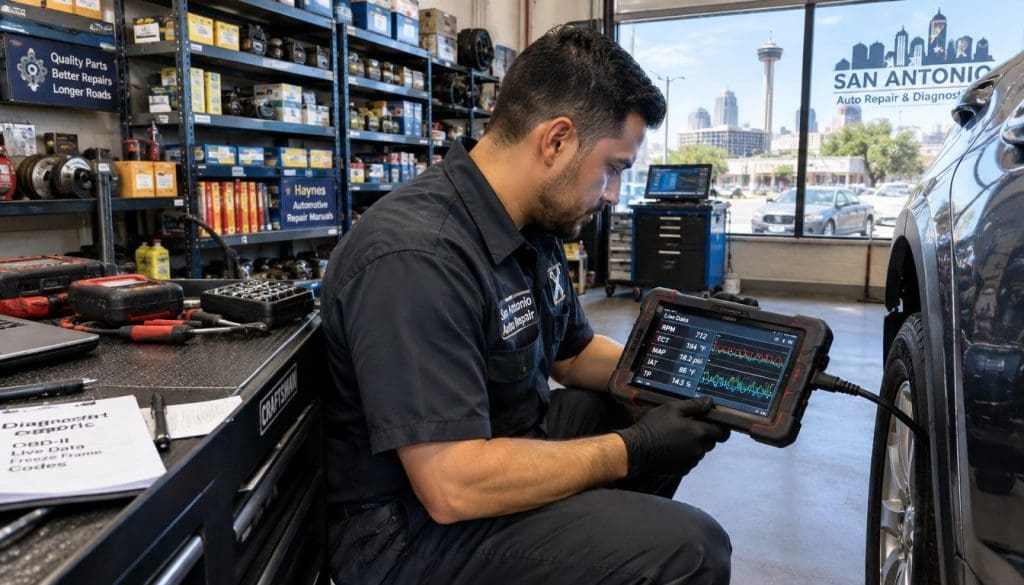
Code Reading and Live Data
An OBD-II scanner retrieves trouble codes and freeze-frame information. Live data can show oxygen-sensor activity, fuel trims, and MAF airflow.
Those readings can help distinguish a failing sensor from another fault that produces a similar code. A technician can compare readings with the conditions recorded when the fault appeared.
Tests That Confirm the Root Cause
A visual check can find damage, but it may miss an intermittent problem. Physical, component, and electrical tests help confirm whether the suspected part or circuit has failed.
Technicians can use a practical four-step process to move from the code toward a confirmed fault:
- Retrieve stored codes and freeze-frame information.
- Examine relevant live sensor data.
- Inspect related hoses, wiring, and connectors.
- Test the suspect component or circuit and verify the result.
Each result helps narrow the cause before a repair begins. Ask for the confirmed fault and the evidence behind the recommended repair before authorizing parts replacement.
Bexar County Emissions Rules and Registration
Texas no longer requires a pre-registration safety inspection for non-commercial vehicles, but eligible vehicles registered in Bexar County face an annual emissions inspection starting November 1, 2026. The emissions program applies on its own schedule, separate from the end of safety inspections.
An active check engine light fails the Bexar County emissions test. Clearing a code without fixing its cause can reset readiness monitors and leave the vehicle unable to complete the test.
Which Vehicles Need an Emissions Inspection
Texas annually inspects gasoline vehicles that are 2 through 24 years old, beginning with the vehicle’s second anniversary. Electric vehicles, diesel vehicles, motorcycles, and mopeds are exempt from the Texas emissions inspection.
Registration Renewal, Safety Inspections, and Fees
Beginning January 1, 2025, non-commercial vehicles no longer need a safety inspection before registration. Texas charges a $7.50 inspection program replacement fee when a non-commercial vehicle is registered.
| Vehicle group | Emissions inspection status | Applicable timing or condition |
|---|---|---|
| Gasoline vehicles 2 through 24 years old | Annual inspection required in Bexar County | Begins with vehicle’s second anniversary |
| Electric, diesel, motorcycle, and moped vehicles | Exempt from Texas emissions inspection | No Texas emissions inspection required |
| Qualifying never-registered new vehicles | Initial inspection program replacement fee | $16.75 covers two years |
| Other non-commercial vehicles | No pre-registration safety inspection | $7.50 replacement fee at registration |
The $16.75 fee applies to a qualifying new Texas-purchased vehicle that is the current or preceding model year. It must never have been registered in Texas or another state.
Check your vehicle’s eligibility and resolve an illuminated warning before relying on a successful emissions test for renewal.
Repair Estimate Factors
The estimate depends on the confirmed fault and the work needed to correct it, not on the code number alone. Testing results help show whether a part, circuit, or another system needs repair.
A code identifies a condition, while a diagnosis confirms the repair. For example, P0420 may relate to a catalytic converter, oxygen sensor, or exhaust leak.
P0300 identifies a misfire condition, but it does not confirm a failed spark plug or ignition coil by itself. That distinction matters because different causes call for different parts and labor.
The confirmed component, vehicle configuration, part choice, labor, and added testing all affect the estimate. Some repairs may need more testing before the right work becomes clear.
A repair estimate should explain the planned work and the parts it includes. Ask for an itemized estimate before approving work, so you can see each charge and the reason for it.
Do not treat one code as having one standard repair price. Approve repairs only after you understand which fault was confirmed and what the estimate includes.
Owner Steps Before and After a Code Scan
A basic OBD-II reader can show a stored code, but it cannot reliably identify the repair by itself. The code is useful information, not proof that a specific part has failed.
Clearing a code does not fix the underlying issue and may erase useful diagnostic information. It can remove freeze-frame data and reset readiness monitors.
What an OBD-II Reader Can Tell You
An OBD-II reader retrieves stored diagnostic trouble codes. Some codes return right away, while others return only after a drive cycle.
A scan gives you a record to share with a technician. It cannot confirm which part failed or whether the condition needs a particular repair.
What to Record and Avoid Before Repairs
Keep useful details with the code before the vehicle goes in for service:
- Write down the exact code shown by the reader.
- Note when the warning first appeared.
- Record recent changes in vehicle behavior.
- Keep diagnostic or repair results available instead of erasing stored information before evaluation.
Simple checks may help, but they do not replace a diagnosis when the warning remains or symptoms develop. Preserved information can help a technician understand what happened before the scan.
Keep the code and the conditions around it until the underlying fault has been diagnosed.
Conclusion
An illuminated warning is a reason to find the cause, not just switch the light off. A prompt check engine diagnostic can identify the fault and help you choose a repair based on evidence.
Keep the scan results and note any change in how your vehicle runs. If you need engine light service in San Antonio, contact Heaven Automotive at (210) 682-3898 or visit 6645 Poss Rd. San Antonio, TX 78238.
Heaven Automotive can help you identify the needed repair and get your vehicle back on the road. Hire Heaven Automotive to fix your vehicle.